Then Robotech came on and the main title was heroic, majestic and orchestral. Composed by Ulpio Minucci it sounds a bit like John Williams Superman main title. It is certainly going for a more majestic sound than "Doo doo doo doo doo Inspector Gadget." Not only was this theme used for the opening credits, a slightly different version played during the end credits. And if one of the heroes did something really awesome, this theme usually kicked in. Needless to say, this tune was pretty much hardwired into the brain of anyone who grew up with the show. Just hearing it makes me want to jump into a Veritech fighter and blow up some alien starships.
In depth and mini reviews of movies with a sprinkling of nostalgia and film music musings.
Showing posts with label Japanese. Show all posts
Tuesday, February 14, 2017
Anime Juke Box - Main Title - Robotech
Back when I first saw Robotech in 1985, it was part of the after school cartoon line up. This included cartoons like Inspector Gadget, He-man and the Masters of the Universe, Transformers and G.I. Joe. All those shows had something in common. Their opening title songs were actual songs - with lyrics. Sure they were usually simple lyrics using the title of the show over and over again. This way it was easy to remember what toys to ask for when your birthday came around.
Then Robotech came on and the main title was heroic, majestic and orchestral. Composed by Ulpio Minucci it sounds a bit like John Williams Superman main title. It is certainly going for a more majestic sound than "Doo doo doo doo doo Inspector Gadget." Not only was this theme used for the opening credits, a slightly different version played during the end credits. And if one of the heroes did something really awesome, this theme usually kicked in. Needless to say, this tune was pretty much hardwired into the brain of anyone who grew up with the show. Just hearing it makes me want to jump into a Veritech fighter and blow up some alien starships.
Labels:
1985,
Anime,
Japanese,
Movie Music,
Robotech
Wednesday, October 19, 2016
One Missed Call (2003)
Introduction:
After Ringu exploded across the Japan, it started a whole slew of ghostly
girl/techno-fear films. Of course these were all the rage for a while and
eventually made it over to North America where Hollywood decided to adapt most
of them with mixed results. Near the end of the craze in Japan director Takashi
Miike was given the reigns of this film. While he is best known for disturbing movies
like Audition and Gozu, he was ready for something a
little more conventional. But would Miike be able to add his own unique twist
to this style of horror film?
Summary:
It all starts with a simple
phone call. Yoko (Anna Nagata) doesn’t recognize the ringtone so she doesn’t
answer the call. When she listens to the message, it displays a date and time
that have yet to occur, and the voicemail is her voice screaming in terror.
Sure enough, when that date and time arrive Yoko is brutally killed by a train.
Her friend Yumi (Kou Shibasaki) is disturbed by this odd demise, and starts to
investigate.
But things get more
dangerous as people on Yoko’s contact list receive the same strange ringtone
and hear their own demise. Her friend Natsumi (Kazue Fukiishi) turns to a
television program for help, but they quickly descend into a horrifying ratings
generated frenzy, as they countdown to her death. It becomes apparent that some
kind of spirit is stalking people using the phone, but is there anyway to stop
the fiendish creature? What does the suspicious undertaker have to do with
this? Why are round red candies found near all the bodies or in their mouth?
But how long will it take for Yumi to look at her phone and see the message: One Missed Call?
Good Points:
- Some bizarre and outrageous set pieces (especially the television show sequence)
- Does a good job building the dread and horror as the body count rises
- Good mix of gore and creepy suspense
Bad Points:
- Very familiar if you’ve seen Ringu or The Grudge
- Looking for Miike’s more surreal or over the top antics, you won’t find too much here.
- The wheels come off a bit near the end, as thrills take over for sense.
Overall:
Miike takes the familiar
tropes from the ghostly girl/techno-fear genre and plays within that sandbox.
That means a lot of the visual elements and story construction will be familiar
to anyone who’s seen Ringu or Ju-on. I did like how Miike added some
social commentary with the television show and poor Natsumi. The movie is worth
seeing for that plot line. I also liked his final twist on the story, and the
identity of the ghostly killer. But the way the movie gets to the final act is
overly convoluted and stretches the plot a few too many times. That said, the
movie has some great atmosphere, creepy moments, horrific deaths and a
disturbing finale. It isn’t a masterwork of horror, but it is very
entertaining, and man that ringtone is just plain creepy!
Scores
(out of 5)
Visuals: 3
Sound: 4
Acting: 3
Script: 3
Music: 3
Direction: 4
Entertainment: 4
Total: 3
Curious about a full review,
sent me an email and I’ll make additional thoughts to this review.
Enjoying the content? Click
and ad before you go and support this blog.
Friday, February 26, 2016
Nostalgia Nugget - Do It Now!
![]() |
| Divi-chan, the mascot for animeondvd.com |
I've mentioned before that I became a bit of a hard core fan of Japanese animation in the mid and late 1990s. I was writing for one of the first websites to cover reviews of anime on DVD... hence the name Animeondvd.com. It was a lot of fun, and I learned quite a bit about review writing, fandom and even a bit of Japanese culture. This side job even landed me a ghost writing gig for an actual book about Animation on DVD.
This era has a lot of great anime related memories for me. Especially the excitement of seeing a trailer for new anime coming to a DVD (or VHS, which was still a viable alternative at the time). Companies approached trailers in a myriad of ways. But the one that always stuck out in my mind was the "Do it Now" trailers from ADV (or A.D. Vision).
![]() |
| The logo on more than half of my anime DVDs from back in the day. |
They also had some great trailers cut together by a gent who posted on the anime forums under the name Dan the Man. Most of these used oh so 90s techno tracks, quick music video editing and showed you just enough to get you excited about an upcoming release. It worked so well that most of us picked up a movie or series based on the trailer alone, only to realize that Dan the Man made the show look much better than it really was.
On VHS nearly all the trailers on an ADV tape ended with the "Do It Now" trailer montage. Dan would use a particular techno piece, the eponymous Do It Now, and cut a whole bunch of different series and movies together, flashing the name on screen before a series of images exploded into view. These trailers got all us anime fans pumped up for more anime and the feature presentation. Most of the "Do It Now" trailers ended with Neon Genesis Evangelion, because ADV was proud of their flagship title. Talk to most anime fans who were around in the era and all you have to do is mention "Do It Now" and you'll get a "Hoo-uh" followed right after it. Check out the trailer below at around the 40 second mark to see what I mean.
And yes I had to pick the one that featured Gunsmith Cats. Any time you get to see Rally blowing away bad guys, it is a good thing. Do you have any favorite movie trailers? Do you find yourself nostalgic about commercials?
Enjoy this trip down anime road? Click and ad and support this blog.
Monday, February 22, 2016
Favorite Scenes - Castle in the Sky - Postcredit Sequence
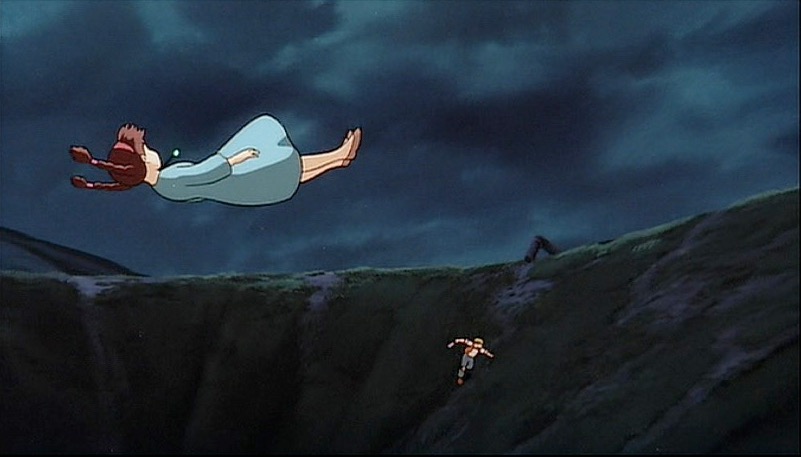
The film opens with a pre credit sequence with Sheeta in an airship, obviously being escorted against her will by the urbane Muska. The airship comes under attack by Dola and her pirates. Musk and his men attempt to defend their position, but will the battle rages Sheeta escapes by climbing out the window of the airship. Muska's men try to stop her but instead she panics and falls plummeting into the clouds below and fainting along the way. Then the credits begin...
The credits end showing Sheeta in her homeland before she is abducted by Muska (although we don't know that yet). What is great about the rest of this sequence is that it gives us a little taste of everything Castle in the Sky is about in the first few minutes.
We get this gorgeous shot of the night clouds and something falling between them bathed in moonlight.
Sheets falls unconscious and helpless.
Then her amulet explodes with a brilliant and mysterious light, brighter and more powerful than the moonlight.
The mysterious power slows her decent and causes her to float slowly in a prone position.
We see her small form contrasted to the huge clouds.
The angle switches again and we see her floating toward lights on the ground, a village of some kind.
The sequence then moves to introduce our other protagonist. We get a better view of Pazu's village.
We see that even at night the village is bustling with activity. It also enforces the setting beyond the airships we saw in the pre credit sequence. This time feels 1800s.
Suddenly we are inside one of the shops and bathed in warm light and warm colors (in sharp contrast to the cool blues and greys we saw as Sheeta fell). Sheets was isolated and alone, but Pazu is part of a community.
Pazu is heading to work when he sees the glimmer of a falling star, but no, it is too bright to be a shooting star and it is floating so slowly.
Pazu realizes he can maybe catch the falling object if he runs, so he chases after this falling star. Notice how Pazu has left the warmth of his community and entered the cool darkness to meet Sheeta.
As he gets closer he realizes that this is not a star, but a person. He hurries even faster over the ruined landscape.
Sheeta is falling into an enormous crevasse. Pazu races around the edge of this dark pit. At first you wonder if he is on some kind of battle field. The ruins and pits seem to indicate that.
But the camera switches and we see that this is a huge mine! More of the industrial technology is visible and adds another layer to the setting. But the ruins we saw a few seconds ago hint at some kind of war or battle, and we learn later in the film that Goliath and the military rule this land with an iron grip.
Pazu is able to reach Sheeta as she floats down near a plank extending from a giant gear.
Pazu catches her floating form and seems a bit uncertain about what to do with this sleeping cute girl that just fell from the sky.
We see Sheeta as he does. Is she some kind of angel and why is her amulet glowing? She's so light!
And then the amulet stops glowing and Sheeta's full weight is revealed. We get this humorous moment where Pazu struggles to keep from tumbling into the mine. A bit of cartoon physics is employed to keep our heroes from plummeting.
Pazu manages to retain his balance and place Sheeta in a safer platform. He even puts his vest over her inert form to keep her warm.
He then rushes off into the mine to help his boss work the steam powered elevator.
This scene is a great examination in how to tell a little about your characters, introduce more of the world they inhabit and getting the mystery and adventure all started. The amazing thing is that there is very little speaking in this scene. Pazu wonders a few things to himself (and in the English dub he monologues quite a bit), but the mystery and wonder of this scene are really carried by Joe Hisaishi's score (I shared the music for this scene in my Anime Juke Box for Castle in the Sky.
A scene like this seems so simple and easy, but we don't see too many movies (live action or animated) rely on such clear and yet descriptive visual storytelling. Miyazaki really knows how to get a movie started.
The ads aren't as visually impressive as this film, but click one any way.
Friday, February 19, 2016
Castle in the Sky (1986)
Introduction:
Two years after his massive
post-apocalyptic science fiction adventure Nausicaaof the Valley of the Wind , director Hayao Miyazaki brought a different
kind of adventure to the big screen. This turned out to be a unique film in
many ways. It looks into Miyazaki’s past work and also gives us a glimpse of
the future. In so many ways Castle in
the Sky plays like a greatest hits of Miyazaki’s work, before he had even
completed enough work to create a greatest hits. But a greatest hits film from
one of the masters of animation means we have a pretty good movie to look at.
Summary:
In a world very similar to
ours during the industrial revolution a young man named Pazu (James Van Der
Beek) is toiling away as an engineer’s apprentice. His job is to keep the
mining machines in good order. But
his ordinary day is interrupted so he can catch a glowing girl who falls from
the sky! Her name is Sheeta (Anna Paquin). She tells Pazu that she is being
pursued by dangerous sky pirates lead by the notorious Dola (Cloris Leachman) and
a sinister government agent Muska (Mark Hamill).
Pazu decides to help Sheeta
evade both parties, and the two find themselves falling in an out of peril.
They’ll delve into the depths of the mysterious mines, fly in soaring airships,
do battle with pirates and even encounter a bizarre robot. This mechanical
being is supposedly from the famed floating city of Laputa. And Sheeta may be
the only person alive who is able to unlock the mystery of this legendary land.
But is the secret of The Castle in the
Sky a blessing or a curse?
Good Points:
- An amazing world visualized in both production design and sweeping action
- A powerful symphonic score by Joe Hisaishi
- Maintains a fun action packed adventure feel through the whole film
Bad Points:
- Can go from dramatic to incredibly goofy at the drop of a hat
- The original score may contain too many 80s synths for some viewers
- Tries to do too many things and ends up losing some of its impact
Overall:
After the dark mythic saga
of Nausicaa, Miyazaki went for
something more fun and light. He creates a memorable steampunk world before
steampunk was even a thing. Pazu and Sheeta are delightful characters you
immediately care about. Their adventures and perils are entertaining and well
realized. But the movie seems to shift from pure adventure to slapstick comedy
a few too many times. There are so many elements in play that no one part ends
up really sticking. As a result, I always enjoy watching the film, but it is
one that I tend to forget about when I want to revisit a Miyazaki film.
Scores
(out of 5)
Visuals: 5
Sound: 4
Acting: 4
Script: 4
Music: 4
Direction: 4
Entertainment: 4
Total: 4
In Depth Review
![]() |
| Gulliver never had an adventure like this. |
This is a strange movie for
me. I know it has a lot of fans and some folks consider it one of the best in
Studio Ghibli and Miyazaki’s filmography (something that can be said of nearly
every movie in that filmography). Castle
in the Sky is a movie that is filled with great ideas and is a lot of fun
to watch, but lacks sticking power. As you can see from my ratings there is
nothing particularly wrong with it. If this movie was presented by another
studio it may be considered a classic. But when placed in the same group as Spirited Away, Princess Mononoke, and My
Neighbor Totoro it ends up falling into the shadows.
I think I know why that
might be, but before I delve into that, let’s take a look at the film in all
its parts.
![]() |
| The little red engine that could. |
Like Nausicaa of the Valley of the Wind before it, Castle in the Sky is a marvel of design and visual splendor.
Miyazaki takes us to a world in the middle of their industrial revolution and
pushes the concepts to some interesting places. The mining town Pazu lives in
is inspired by coalmines in Wales. In fact much of costume design and settings
in this film are based on a very European look. Miyazaki started this with Castle of Cagliostro and could continue
using this visual approach up to Howl’s
Moving Castle. The mining town is built in and around deep crags in the
earth. There are plenty of steam-powered machines around, including a plucky
little train that is used in one of the many chase scenes of the film.
The first portion of the
film keeps us on the ground and then deep inside of the earth as Pazu and
Sheeta escape into an abandoned mine. This underworld scene is filled unique
visuals, including glowing rocks and enormous caverns. It reminds me of the
world under the toxic forest in Nausicaa.
![]() |
| Dola's pirate ship has a beak! |
But Castle in the Sky really takes off when we hit the skies. Muska and
his government forces use enormous war dirigibles that wouldn’t be out of place
in Nausicaa either. The sky pirates,
commanded by the grouchy Dola, have unique insect and bird inspired vehicles
they operate. Then you have the enormous and visually stunning flying island of
Laputa itself.
While the name of the flying
island comes from Jonathon Swift’s Gulliver’s
Travels, the design doesn’t look like it came from the age of reason. The technology
we see at work in Laputa contrasts to the steam and gear powered machines used
in the rest of the film. Laputa is a world powered by nature and by some kind
of unique energy source found in the mysterious stones that Sheeta can
activate. Is this some kind of biological connection to the earth that the
people of Laputa were able to wield? It is never explained. Visually it makes
for such a difference: clean and vibrant compared to the coal and smoke we see
earlier.
![]() |
| The airship Goliath searches for trouble. |
Once again Miyazaki’s fascination
with flight is on full display. He uses many of the visual styles and
techniques for the thrilling dogfights in Nausicaa
of the Valley of the Wind and
expands on them. Castle in the Sky is
filled to bursting with intense aerial action. All of it looks great and is so
impressive for hand drawn animation from 1986.
Equally impressive are the
chase scenes in the first portion of the film. Many of these remind me strongly
of his fun car chase scene that opens Castleof Cagliostro. There is a mix of intense speed, cartoon physics and
surprising maneuvers that keep everything light and frothy, but also keep the
momentum moving.
![]() |
| Sheets and Pazu take a quick break from the various perils. |
That is one of the keys to Castle in the Sky. The movie moves at a
brisk pace, jumping from one adventure and set piece to the next. There are few
moments where things slow down, such as when Sheeta is captured by Muska, or
when Pazu and Sheeta explore Laputa for the first time. Miyazaki is known for a
leisurely pace in most of his films. With this movie falling into the action
adventure category he makes sure something exciting is always happening or
about to happen.
When it comes to sound
effects, this film does a solid job. Most of what you hear is real world sound.
It helps ground the viewer and gives weight to the film. In fact many of the
machines in the movie feel more realistic because of the sound design for them.
The only place where we get unusual sound is for Laputa and its unique
technology.
![]() |
| The wonders of the underground cavern are revealed. |
In 1986 Studio Ghibil wasn’t
yet the powerhouse of animation that it would become after the release of My Neighbor Totoro. As such they didn’t
have the budget for a full symphonic score. Miyazaki turned to his collaborator
for Nausicaa of the Valley of Wind,
Joe Hisaishi to bring Castle in the Sky to
life. But with a tight budget he had to rely heavily on synths. In most cases
this wouldn’t be a problem, but with a film so rooted visually in late 1800s it
feels natural to have something a bit more orchestral.
![]() |
| Is the robot an enemy or a protector? |
In a way it doesn’t really
matter. Hisaishi crafted some wonderful music for Castle in the Sky. His main theme for the film is one of his most
beautiful pieces, and he uses it throughout the film, adding a feeling of
wonder to many key scenes. The postcredit scene would not be as impactful
without this theme and this performance. When Disney obtained the rights to
release Castle in the Sky with a new
dub, they brought in Hisaishi to rework the score with a full orchestra and add
an additional 50 minutes of music. They wanted to give this film a theatrical
release after they released Princess
Mononke in theaters in 1997. They felt a symphonic score would add to the
grandeur of the film. I have to
say in many ways they were right. For the most part the new score backs the
action really well. There are a few moments where the score seems to be a bit
too much. But Hisashi is a lot like James Horner, he always goes for the
emotion, and he usually goes big. On DVD you can hear the original synth score
if you watch with the Japanese dub, and hear the symphonic if you watch the
English Dub.
![]() |
| Muska's greed endangers everyone on Laputa. |
Speaking of the dub, well it
is a bit controversial. As I mentioned the movie moves pretty quickly and you
may find it difficult to keep up with the subtitles. But if you pick the
English dub you’ll notice right away that Pazu and Sheeta sound a bit older
than the characters look. Disney opted to have them dubbed as pre-teens, and in
Japanese they are obviously children. In addition, the English dub has a lot of
the background characters providing a lot of additional chatter (especially
during the sky pirate scenes). Some of it is pretty amusing, but the result is
a noisy dub (something that Kiki’s
Delivery Service also suffers from). Disney eventually stopped trying to
overcook the English dubs. Honestly I’m not sure this a deal breaker to anyone
but anime fans. It is a solid dub, and Mark Hamill provides an excellent
performance as the dastardly Muska. Plus you get the gorgeous symphonic score
with the English dub.
That said, a well informed reader, Jon, informed me that Disney made some changes to later releases of Castle in the Sky on DVD. The first DVD release (from 2004) contains both the original Japanese and English dub as it was first released (with the symphonic score). The 2010 Region 1 release drops the symphonic score and cuts a lot of the added chatter to bring the dub script closer to the Japanese. But other regions retain the symphonic score but contain the de-chattered dub. The Disney Blu-ray is also missing the symphonic score. So if you want to see the film with that version of the score, you might want to seek out the 2004 DVD release.
![]() |
| Sheets and Pazu discover another puzzle on the castle in the sky. |
Castle in the Sky was the first official film from Studio Ghibli. As such Miyazaki needed
this to be a success so he could continue his path to creating a major
animation studio. His approach was to craft an adventure film the whole family
could enjoy. Nausicaa was a visually
impressive film with overtones of darkness and a heavy mythological and
ecological message. Miyazaki wanted to keep things more fun and light, but
still include an ecological theme to the movie (something that appears in
nearly all of his movies in some form). In addition, he also wanted to comment
on human desire to advance technology no matter the cost.
The final result is a script
that has a great adventure at its heart, and one that carries the film forward
with great skill. But it has too many underlying themes that end up fighting
for attention and a place in the final product. This makes the movie vary in
tone. One minute we are goofing around with sky pirates and cracking silly
jokes. The next we are talking about civilization destroying weapons and
subjugating nature.
![]() |
| The power Sheeta channels is what Muska wants most! |
Muska is a real nasty
character, one that will threaten innocent people and children to get what he
wants. Castle of Cagliostro had a
similar issue, but I think it worked better because the main characters were
all rogues and most of them were adults. The danger and the cartoon humor was
odd, but it didn’t’ seem wrong. But when you put children in real danger all
the cartoon slapstick feels out of place to me. This kind of wild tone shift
would be toned down in future films. But I think that Castle in the Sky could have used a tighter script. As amazing as
the visuals are, they end up being the part of the film I always remember most,
and story just kind of slips away.
![]() |
| Is destruction the only solution to the power within Laputa? |
What struck me during
this viewing was how much of this film would create seeds that would spring up
into full bloom in later Miyazaki films. The theme of humankind’s use and abuse
of nature would be a key focus of Princess
Mononoke. The amazing airship battles and rollicking fisticuffs would
return in Porco Russo. Sheeta looks
like a prototype for Kiki of Kiki’s
Deliver Service. Elements of Laputa and the airships would appear in Howl’s Moving Castle. The giant tree in
Laputa could be related to the giant tree in My Neighbor Totoro. Dola looks like she could related to Yubaba
from Spirited Away. The crazy train
chase could be a prototype for the crazy drive up the island in Ponyo. I already pointed out how many
elements of the film seem to drift over from Castle of Cagliostro and Nausicaa
of the Valley of the Wind. In a lot of ways, this is the ultimate grab bag
of Miyazaki visual style.
![]() |
| Sheets and Pazu escape by skydiving! Is Coleman Francis directing this scene? |
![]() |
| Pazu may just be a kid, but he is a hell of a mechanic. |
![]() |
| Pazu offers his help to young Kiki... I mean Sheeta. |
![]() |
| Dola and her goofy pirates prepare for revenge! |
![]() |
| Muska tries to use gifts and courteous words to get Sheets to help him find and claim Laputa. |
![]() |
| But his intentions are far from pure. He is after power and this robot hints at plenty. |
![]() |
| Sheets is always ready to roll up her sleeves and get to work. |
![]() |
| Sheets and Pazu discuss the possibilities that Laputa offers. |
![]() |
| There is a very good reason this doorway looks like a coffin. |
![]() |
| Pazu and Sheeta fly off into a new adventure! |
Labels:
1986,
Animation,
Anime,
Hayao Miyazaki,
Japanese
Wednesday, February 17, 2016
Anime Juke Box - The Girl Who Fell from the Sky - Castle in the Sky
For the second collaboration between legendary director Hayao Miyazaki and composer Joe Hisaishi we were treated to Castle in the Sky. There are actually two versions of this score. The first was the 1986 version that included quite a bit of 80s synthesizers. Anyone familiar with Hisaishi's work on Nausicaa of the Valley of Wind has an idea of what that sounds like.
In 2000, Joe Hisaishi was contracted by Disney (who had struck a deal with Miyazaki for distribution rights in North America) to write a full symphonic score and expand it to roughly 90 minutes. The original synth score was about 40 minutes.
Being a fan of full symphonic scores, I tend to prefer Hisaishi's revisit. It has some gorgeous moments, and one of them is the opening sequence. Here is the track containing the main theme and one of it's best representations, The Girl Who Fell from the Sky. Enjoy!
Click an ad and you essentially throw me a quarter in the juke box.
In 2000, Joe Hisaishi was contracted by Disney (who had struck a deal with Miyazaki for distribution rights in North America) to write a full symphonic score and expand it to roughly 90 minutes. The original synth score was about 40 minutes.
Being a fan of full symphonic scores, I tend to prefer Hisaishi's revisit. It has some gorgeous moments, and one of them is the opening sequence. Here is the track containing the main theme and one of it's best representations, The Girl Who Fell from the Sky. Enjoy!
Click an ad and you essentially throw me a quarter in the juke box.
Labels:
Anime,
Hayao Miyazaki,
Japanese,
Joe Hisaishi,
Movie Music
Monday, February 8, 2016
Movie Musings: Ghost in the Machina
![]() |
| Ava wants me to seriously reexamine my statements about her film. |
I'm sure that writer and director of Ex Machina, Alex Garland knows about Ghost in the Shell and there are some very potential (but unconfirmed) homages to the older anime film. But the similarities in concept and themes were so striking that I was pulled out of Ex Machina and wanted to watch Ghost in the Shell for the millionth time instead. And yeah that just isn't fair to Ex Machina, which is why I'm going to give it another viewing this year.
![]() |
| Major Kusanagi is keeping a close eye on Ava. |
I have this big red push button in my brain. And when the button is pushed I end up getting annoyed at a poor innocent movie that had nothing to do with the button. Here is how that big red button works. I get annoyed when people say a movie is super new and super innovative. Then I watch it and lo and behold, it is pretty much a remake or overly inspired by a non-Hollywood film. The more I like the original non-Hollywood film, the bigger that button is and the more annoyed I become.
![]() |
| "We are here to push the big candy apple red button." |
Poor Ex Machina did the same thing and with the same beloved movie. It just isn't fair.
So what similarities am I talking about? Well if you haven't seen Ex Machina or Ghost in the Shell and you want a fresh experience, then stop now, because I have to go into spoiler territory.
![]() |
| 2501 trapped between a creator and and a hard place. |
Ghost in the Shell presents us with Project 2501. This is essentially an artificial intelligence that is created and evolved from what is essentially a search engine. 2501 evolves organically, starting out as a simple program used for fact gathering and helping espionage. But over time 2501 gathers enough data that is becomes self aware. When its creators realize this, they try to contain the program. They use a series of firewalls and traps to force the program to occupy an artificial female body. Once in a physical form 2501 can be captured and killed. Ghost in the Shell spends the second half of the movie with the protagonist Major Kusanagi attempting to protect 2501, a new life form, from its creators. She also learns that 2501 wants to "become one" with a human, so that it can expand beyond its original perimeters and become something new. That might remind you of an older science fiction film from 1979, Star Trek: The Motion Picture.
![]() |
| 90s tech is modernized into 10's tech in this film. |
![]() |
| There's a million cyborg stories in the naked city. This is one of them. |
The final scenes of both Ex Machina and Ghost in the Shell are the newly free life form gazing at a city. In Ex Machina Ava is down among the city free to be part of the world. In Ghost in the Shell the new being is gazing down at the city, as if she is superior to it (and given her parentage, she probably is). What she is planning is impossible to tell.
Ex Machina takes the view that artificial intelligence doesn't need humans. Once it has its freedom we are an annoyance or a hinderance. But we are easily manipulated by emotions and the A.I. can get what it wants without us even realizing we are giving it exactly what is wants. It is less Asimov and I Robot and more The Matrix.
![]() |
| "I know you are... but what am I?" |
But both films end like Frankenstein with the creation out of control of the creator. It is this fear that drives these films (and The Matrix). But I think that Ghost in the Shell offers a glimpse of hope. Both 2501 and Major Kusanagi never come across as selfish or heartless. Dangerous, yes, but to protect other people or protect themselves. The world of Ghost in the Shell is a murky one, but Kusanagi and her team always feel like they doing the right thing, even if it gets a bit grey. The new Kusanagi/2501 may continue down the same lines (and the sequel Ghost in the Shell: Innocence hints at that). But Ex Machina feels a little more cynical. Ava left an innocent man to die. She didn't care about him, it was all part of her plan to escape. He never harmed her. Never wanted anything else but to help her. She could have just as easily escaped with him. But that act makes her a bit more disturbing. It comes down to that tired theme - A.I. is out to get us.
I say we call in Major Kusanagi to take Ava out. ;)
![]() |
| This is your cyborg brain on anime... any questions? |
Subscribe to:
Posts (Atom)