Showing posts with label Hayao Miyazaki. Show all posts

Thursday, June 30, 2016

My Neighbor Totoro (1988)

Introduction:

No one sets out to make an iconic character, or at least those that do usually don’t accomplish this. These characters are just connect with an audience and grow into a phenomenon. If you are an anime fan, you know who Totoro is, you can’t escape his fuzzy presence. If you don’t know who Totoro is, then go watch My Neighbor Totoro as soon as you can, because he is an iconic character, not just in Japan, but around the world.

Summary:

Satsuki (Noriko Hidaka) and Mei (Chika Sakamoto) are moving to the country with their father (Shigesato Itoi). We soon discover that the girl’s mother (Sumi Shimamoto) is sick and hopefully the country air will help her get well. But mother has to stay in a local hospital until she is well enough to join the three at the new place. After they arrive the girls think mysterious Dust Bunnies may haunt the new home. Satsuiki and Mei explore the house and discover clues to supernatural inhabitants.

In the meantime the girls help their dad around the house and make new friends like Kanata (Toshiyuki Amagas) a young boy who thinks Satsuki is cute, but doesn’t know what to do about it. They also befriend kindly old Granny (Tanie Kitbayashi) who tells them about the forest spirits that live nearby. That is when Mei encounters the Totoro, a huge furry creature living in a huge camphor tree near the house. Totoro and his tiny friends befriend the girls and take them on all kinds of adventures including flying through the air, taking a ride on a Cat Bus and entering an enchanted tree. But when mother takes a turn for the worse is there anything Totoro can do to help the girls in there hour of need?

Good Points:

  • Miyazaki creates a wonderful sense of place and wonder in the animation
  • Totoro and all the supernatural creations are a joy to behold
  • You grow to like all the characters in the film

Bad Points:

  • There isn’t really an overall story, more like a series of vignettes
  • Looking for an antagonist to boo? Not going to find one here.
  • Some may find the movie too simple or too childish (I don’t agree, but I’ve heard that argument before)

Overall:

This is a wonderful example of family entertainment. Young children will connect with the protagonists and fall in love with Totoro and his pals. Adults will find a nostalgic quality to the film that is so appealing. The movie puts you into the world of a child and does it so effectively. All the pieces come together to make a film that is entertaining and soothing all at once. It isn’t hard to see why this became a big hit and remains a classic in Miyazaki’s filmography ever since.

Scores (out of 5)
Visuals: 5
Sound: 4
Acting: 4
Script: 4
Music: 4
Direction: 5
Entertainment: 5
Total:  4

In Depth Review
The big Totoro lets out a giant Yawp!
I think that one of the toughest genres to create in movies is the family film. Most end up too dumbed down for adults to enjoy. Others end up a little too snarky and meta to be anything more than a mild amusement that is soon forgotten. It is rare that you actually see a family film that is whimsical, positive and entertaining all at once. My Neighbor Totoro should be required viewing for anyone attempting to create family entertainment and do it the right way.

I often hear Hayao Miyazaki called the Japanese Walt Disney, and I think his work on My Neighbor Totoro and Kiki’s Delivery Service is where that idea comes from. I appreciate the comparison, but it doesn’t quite fit. Both men are more then just comparison points to each other. As I mentioned above, you could compare Totoro to Mickey Mouse when it comes to a popular icon created from family entertainment. Totoro is inescapable in Japan. And if you have any stores near you that sell merchandise or pop culture from Japan (especially anime or manga) odd are you’ve seen Totoro there too.

Why the lasting appeal? Why the accolades? Why the huge amount of success that allowed Miyazaki to continue with his dream of making animated films into 2013? Let’s take a look at all the different elements and see how they work together.

The pastoral and old fashioned setting.
For the first time in a Miyazaki directed feature film we have a setting in Japan. Because we aren’t in the post apocalyptic world of Nausicaa of the Valley of the Wind or the steam punk fantasy of Castle in the Sky, the design has a more down to earth feel. The film is a period piece, set in 1958. This gives the clothing, automobiles and town surrounding our protagonists an old fashioned but homey feel to it.

The country setting allows Miyazaki to show off nature in the form of the giant camphor tree, the rolling hills surrounding the village and waving open fields of grass. My Neighbor Totoro feels much more open and airy compared to Castle in the Sky. The setting adds to the nostalgic atmosphere that wraps the whole film in a comfy familiar blanket, even for non-Japanese audiences.

What mysteries await in the new house?
The character design follows Miyazaki’s normal style. They are variants on what we’ve seen in the past. The Totoros look related to the Panda family from Panda Go Panda and Satsuki could be Nausicaa’s little sister. Old Granny could be a stand in for Yubaba in Spirited Away. But this movie actually establishes more designs that Miyazaki will use in future films.

Like the previous films, some of the visual highlights include moments when characters take flight. Totoro uses a magic top to take to the air with Mei and Satsuki. Later in the movie, the flying Cat Bus hurtles across the countryside and leaps high into the air, providing a thrilling ride for those inside. It just wouldn’t be a Miyazaki film without those moments.

Who ya gonna call? Dust Bunny Busters!
But I also like some of the creepy scenes early in the film, when the girls explore their new house.  The home has plenty of darkened passages and closed doors that could open to anything: even a group of Dust Bunnies! Miyazaki does a good job creating an eerie atmosphere of mystery. It’s not too scary (like elements we’d see in Spirited Away or Princess Mononoke). But it creates a few moments of the uncanny as the two girls come in contact with the spirits that inhabit the house and surrounding forest.

Sound work follows suit for the film. Most of what we hear is typical sound effects for the pastoral setting and vintage cars. When some magic is needed for the Totoros and the Cat Bus then some interesting sound design is used. It is all creative and immersive.

Mei befriends the giant Totoro.
When it came to the music for My Neighbor Totoro Miyazaki once again turned to his composer of choice, Joe HIsaishi. Hisaishi creates three main melodies for the film, and they are all used to flesh out songs used in the film and on the soundtrack album. The opening title theme Hey Lets Go! gets things off to a cheery start. It is also used when the family goes to visit their sick mother in the local hospital. The end title track, is the theme for the Totoros, and actually features a chorus singing their name several times. It’s a jaunty tune and is used several times in the film. The other theme is one used when Mei gets lost. We only hear it a couple times at the end of the film, but Hisaishi uses the melody for a song called The Lost Child on the album. Hisashi creates a set of other memorable motifs for the Dust Bunnies, Cat Bus and the girl’s mother. The music is all light, melodic and fits the film so well. Much of the emotion and nostalgia comes from Hisaishi’s score. While it is primarily orchestral, there is some use of 80s synthesizers in nearly every track to supplement the music. It may be one of Hisaisihi’s most cheerful and uplifting scores for a Miyazaki film – and that is saying something.

Even the Cat Bus is pleased that Mei and Satsuki find
each other.
When it comes to the vocal cast, it is important that the two main girls are able to convey the mixture of innocence and wonder that makes the film work. In Japanese you have Noriko Hidaka as Satsuki and Chika Sakamoto as Mei. Both girls do a fine job. Sakamoto makes Mei just cute enough that you don’t want to strangle her when she gets bratty. Hidaka also does a great job combining the affection and annoyance of having a younger sibling to take care of. Their interaction with each other and the other characters goes a long way to making the whole thing work. There have been two English dubs for this film one done in 1993 for Fox and one in 2005 for Disney. Both English dubs work well, with Dakota and Elle Fanning appearing in the Disney version with Lea Salonga (of Aladdin fame) as their mother.  I usually like to watch this one in Japanese, because of the very Japanese setting, but both English dubs work just fine and allow English speaking viewers a chance to enjoy the animation.

Mei in hot pursuit of the white rabbit... I mean
little and medium Totoros!
If there is one criticism you can level at My Neighbor Totoro it is that the film doesn’t have a traditional narrative. The movie plays out more like a series of vignettes about the girls moving into the new home with their father and how they adapt to the changes and the fact that their mother is still very ill. There is a story arc of sorts, as both girls grow up a bit over the course of the movie. But there is no antagonist to challenge the girls, or grand goal or objective at the heart of the film, at least not one that is obvious. As a writer I really admire how Miyazaki and his crew are able to make this approach work. We connect immediately with the girls, most of us have moved to a new home and had to deal with all the strange things we encounter. I love how Satsuki and Mei have this mixture of excitement, fear and daring in the first portion of the film as they explore the “haunted house” and meet the dust bunnies. Even the scenes where the girls meet Totoro are an interesting mixture of suspense and wonder. All these moments keep us interested in the girls and what they are going to encounter next.

Satsuki is isolated in this frame, as she searches
for the lost Mei.
In many ways this film reminds me strongly of Alice in Wonderland as envisioned by Disney or the Jim Henson film Labyrinth. You get a series of encounters and adventures, but not a clear plot path. The story seems to meander at times as you take the journey with the characters. But by the time it is over, you realize that each moment played into the character’s growth in some way and by the end of the film they have learned something about themselves.

It takes a deft touch to make something like My Neighbor Totoro work. For me this is the first film where everything comes together just about perfectly for Miyazaki. His abilty to capture that childlike wonder, that thrill of discovery, the fear of the unknown and the dispair of losing someone so important to you – all these elements come into play in this simple story. But it is that simplicity that makes the film so endearing, entertaining and have that staying power. Pretty much anyone who sees My Neighbor Totoro will not forget it. Children connect with the girls and the cute and helpful Totoro. Adults will pick up on the nostalgia for a simpler time and the delightful visuals that capture the imagination. Miyazaki even manages to include a little ecological message about the Totoros being spirits of the forest and being attracted growing plants.


The leaf hat just isn't cutting it.
Of course some folks find the whole thing just too cute, or too slight. While I can understand that to a point, I think they don’t understand the core of the film. My Neighbor Totoro Isn’t going for the narrative scope of something like Princess Mononoke or even Castle of Cagliostro. It is about a family dealing with some serious issues, a sick mother, a big move to a very different place and meeting new neighbors. But it does it from the point of view of children, who see some of these things as games, fantasy or sometimes as confusing and scary events. That is the magic of the film. Miyazaki reaches younger viewers who feel like the film is speaking to them. It reaches older viewers because it reminds us of our childhood and some of the great and amazing things we experienced. My Neighbor Totoro is a must see for anyone who enjoys good entertainment. I can understand why it is many people’s favorite Miyazaki film, and while I rate a few other films a bit higher, it is the start of his winning streak.

The girls rush to find adventure in the "haunted house".
Time for a snack after the move.
The girls visit their sick mother.
She seeks him here, she seeks him there. She seeks
that rascal everywhere.

And then this happened... a cat bus appeared.

"Are you seeing this $%@&?" "Yeah, I totally see
a Cat Bus."

The girls and the Totoro's combine forces to make the
little acorns grow.

Mei is a child of the corn.

Hey Link, I think the Totoro has the Ocarina of Time.

This has to be one of my favorite scenes in the movie.

Friday, May 20, 2016

Move Musings: Where Have I Seen This Before? Star Wars: The Force Awakens

While watching Star Wars: The Force Awakens I had a little bit of deja vu. And yes, more than the fact that the story was essentially A New Hope. Some of the actual visuals from the film were very familiar. And yes beyond the fact that they borrowed from previous Star Wars films. As a rule, Star Wars borrows imagery from Star Wars, that is part of the style of the series.

In any case, as Rey was wandering the derelict Star Destroyer, I realized that I had seen similar shots and angles in another movie I watched.


And just when I think I can stop writing about Nausicaa of the Valley of the Wind, someone has to go and reference it. Of course Nausicaa is a pretty good model for a lead female character in a science fiction story, so it is hard to begrudge the creators of The Force Awakens from giving Rey a visual nod to the opening scenes in Miyazaki's film.

Wednesday, March 30, 2016

Movie Musings: The Kwisatz Haderach of the Wind

Man is about to meet worm.
I haven’t watched David Lynch’s take on the space saga Dune in quite a few years Now I say David Lynch’s take because from a visual standpoint the movie is very much a David Lynch film. Lynch’s style permeates everything including his shot selection, editing and the acting styles. Even elements of the visually stunning design (sets, costumes and creatures) seem to come right out of Lynch’s subconscious. Is it just a coincidence that the Third Stage Guild Navigator looks like a huge version of the Baby from Eraserhead?

Paul is the stranger in a strange land.
I know most hardcore science fiction fans dislike the 1984 version of Dune. While you can see some key portions of the novel on the big screen, most of it was edited, compressed and reimagined. You could also argue that it impacts the entertainment value of the film (but that is for a full blown review of the movie). This version of Dune focuses on the story of the messiah coming to save the oppressed people.  That very same year another science fiction epic arrived in theaters with many similarities to the Lynch film. It was all about  a messiah saving her people from oppression. And both featured giant worms!

This princess shows no fear.
Nauiscaa of theValley of the Wind is like a bizarre mirror of Dune. This struck me in my most recent viewing of Lynch’s film. I was contemplating the character of Paul Atredies (Kyle Maclachlan) and realizing that the guy is rarely wrong about anything. Most of his choices (in the film version) are the right ones and when he tests himself he always comes out on top. It is that perfect hero paradox. We can admire this kind of hero, but we can’t identify with them.

I realized I felt the same way about Nausicaa. When I was writing the review of that film I struggled with the fact that we are told about her destiny at the start of the film and she makes all the right choices to achieve that prophesy. Dune starts the same way, with Princess Irulan (Virginia Madsen) telling us about the Fremen prophecy about their messiah.

"War does not make one great." Nausicaa learns this
hard lesson.
What is perhaps more interesting are the differences between these two characters. Obviously you have a male messiah in Dune and a female messiah in Nausicaa. This actually reflects directly into the tropes for sexes. Paul becomes a holy warrior, literally unleashing a jihad against the forces of the Emperor. Nausicaa is a skilled warrior and shows her prowess a number of times. But she is more of protector and in the end a unifier.

The emperor of the known galaxy faces his destiny.
Both characters commit self-sacrifice during their story. Paul drinks the Water of Life in order to obtain great knowledge of his enemies. It turns out to be a potent weapon and one he uses to his advantage. Nausicaa places herself directly in the path of the rampaging mass of Ohmu. They proceed to trample her and there is no way anyone could survive that. Her sacrifice  moves both the humans and the Ohmu. Hostilities cease around her dead body.

Like Paul, she rises again from certain death, now imbued with an inner power. But for Nausicaa this power is one that brings peace. She defeats her enemies, but most of them end up alive at the end of the film. When Paul defeats his enemies most of them are very dead.

Nausicaa shows that humans can live with nature and
not fight it.
Also interesting is their relationship to the giant insects of the film. Paul and Nausicaa see the insects as part of the natural world, but she also realize that there is some secret around the creatures that may lead to a greater revelation. Paul discovers that the worms and the spice are linked – the spice is actually the worm’s eggs, and that is why they attack the spice mining (something explained in deleted scenes or in the extended cut). Nausicaa discovers that the insects of the toxic jungle are spreading the jungle over the world, but not to destroy it, they want to cleanse it.

Paul harnesses the power of the worms and uses them as giant weapons against the Emperor and his minions. Nausicaa tries to calm the Ohmu, the most sentient of the giant insect life, and create understanding between humans and nature. She never fights the insects or tries to use them, her approach is almost like a diplomat/bug whisperer.

"Long live the fighters!"
But the main difference between the two is their origins. Paul is basically the prince from a foreign land who meets the natives, becomes enamored with their society and culture and then turns into their leader against the oppressive powers that he was once a part of. This is a trope based in ancient mythology, and one that Hollywood has used time and again. Dances with Wolves, The Last Samurai and Avatar all have the same basic plot: the outsider has to come in and lead the oppressed (native) people to rise up against oppression. An interesting trope, but one that feels a bit overused these days. It had been used two years before in Tron, with a bit of a twist.

Nausicaa is not the outsider, but essentially the chosen one within her own tribe. Again this comes directly from mythology. In this case the oppressive outsider comes to a new land and is ignorant of ways of the natives. They outsiders cause havoc while the hero attempts to guide them to see the error of their ways. Time and again they fall into conflict. It takes the sacrifice of the hero to get everyone to see the error of their ways.


Nausicaa at the birth of a new world - one she
helped bring about.
What does this all mean? Well it means that both stories take slightly different views of the messiah mythology, but still follow the overall arc of that story. Of the two, I think Nausicaa of the Valley of the Wind is more interesting. Nausicaa attempts to reach understanding and not all out war to achieve a goal that benefits everyone.  After all, war is what got the world into the mess it is currently in. Nausicaa’s journey is more challenging in my mind. Not to sell Dune short, I think it works well as the story of a warlike Messiah. But when you boil it all down, I think that Miyazaki crafted a better film than David Lynch.  But I’ll still watch either one of them any time you want to.

Enjoying the content? Click an ad and help.

Monday, February 22, 2016

Favorite Scenes - Castle in the Sky - Postcredit Sequence

The film opens with a pre credit sequence with Sheeta in an airship, obviously being escorted against her will by the urbane Muska. The airship comes under attack by Dola and her pirates. Musk and his men attempt to defend their position, but will the battle rages Sheeta escapes by climbing out the window of the airship. Muska's men try to stop her but instead she panics and falls plummeting into the clouds below and fainting along the way. Then the credits begin...


The credits end showing Sheeta in her homeland before she is abducted by Muska (although we don't know that yet). What is great about the rest of this sequence is that it gives us a little taste of everything Castle in the Sky is about in the first few minutes.


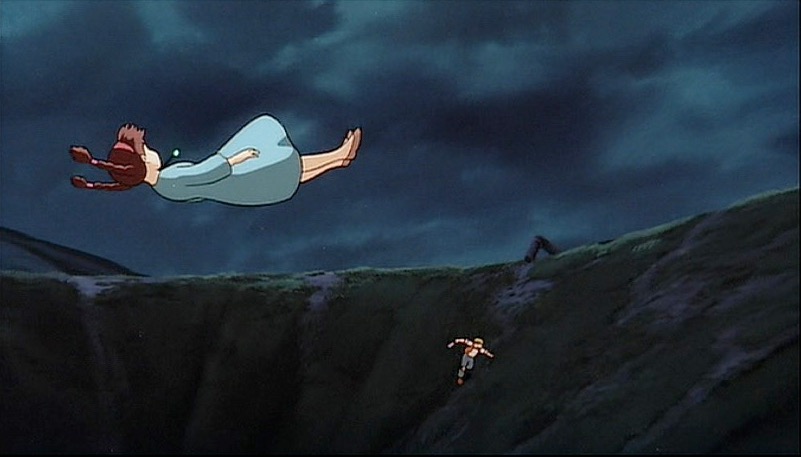
We get this gorgeous shot of the night clouds and something falling between them bathed in moonlight.


Sheets falls unconscious and helpless.


Then her amulet explodes with a brilliant and mysterious light, brighter and more powerful than the moonlight.


The mysterious power slows her decent and causes her to float slowly in a prone position.


We see her small form contrasted to the huge clouds.


The angle switches again and we see her floating toward lights on the ground, a village of some kind.


The sequence then moves to introduce our other protagonist. We get a better view of Pazu's village.


We see that even at night the village is bustling with activity. It also enforces the setting beyond the airships we saw in the pre credit sequence. This time feels 1800s.


Suddenly we are inside one of the shops and bathed in warm light and warm colors (in sharp contrast to the cool blues and greys we saw as Sheeta fell).  Sheets was isolated and alone, but Pazu is part of a community.


Pazu is heading to work when he sees the glimmer of a falling star, but no, it is too bright to be a shooting star and it is floating so slowly.


Pazu realizes he can maybe catch the falling object if he runs, so he chases after this falling star. Notice how Pazu has left the warmth of his community and entered the cool darkness to meet Sheeta.


As he gets closer he realizes that this is not a star, but a person. He hurries even faster over the ruined landscape.


Sheeta is falling into an enormous crevasse. Pazu races around the edge of this dark pit. At first you wonder if he is on some kind of battle field. The ruins and pits seem to indicate that.


But the camera switches and we see that this is a huge mine! More of the industrial technology is visible and adds another layer to the setting. But the ruins we saw a few seconds ago hint at some kind of war or battle, and we learn later in the film that Goliath and the military rule this land with an iron grip.


Pazu is able to reach Sheeta as she floats down near a plank extending from a giant gear.


Pazu catches her floating form and seems a bit uncertain about what to do with this sleeping cute girl that just fell from the sky.


We see Sheeta as he does. Is she some kind of angel and why is her amulet glowing? She's so light!


And then the amulet stops glowing and Sheeta's full weight is revealed. We get this humorous moment where Pazu struggles to keep from tumbling into the mine. A bit of cartoon physics is employed to keep our heroes from plummeting.


Pazu manages to retain his balance and place Sheeta in a safer platform. He even puts his vest over her inert form to keep her warm.


He then rushes off into the mine to help his boss work the steam powered elevator.

This scene is a great examination in how to tell a little about your characters, introduce more of the world they inhabit and getting the mystery and adventure all started. The amazing thing is that there is very little speaking in this scene. Pazu wonders a few things to himself (and in the English dub he monologues quite a bit), but the mystery and wonder of this scene are really carried by Joe Hisaishi's score (I shared the music for this scene in my Anime Juke Box for Castle in the Sky

A scene like this seems so simple and easy, but we don't see too many movies (live action or animated) rely on such clear and yet descriptive visual storytelling. Miyazaki really knows how to get a movie started.

The ads aren't as visually impressive as this film, but click one any way.