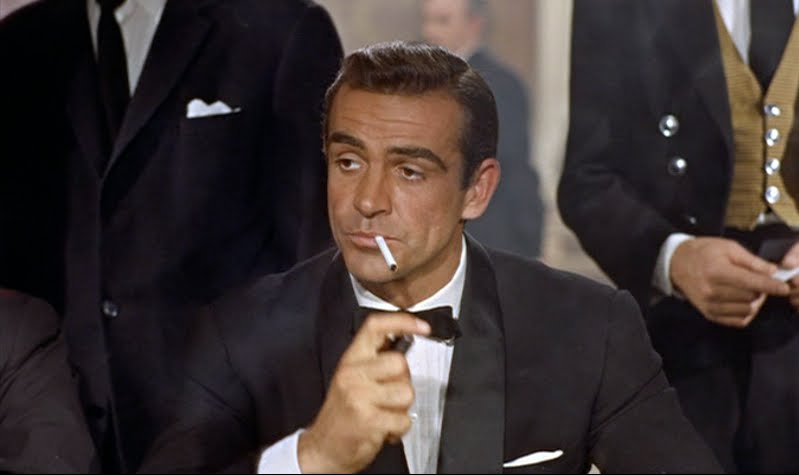
Showing posts with label Sean Connery. Show all posts

Friday, July 25, 2014

Thunderball (1965)

Introduction:
It is safe to say that by the time the mid-sixties rolled around James Bond was a household name, and the franchise was truly a juggernaut. Goldfinger was a huge success, and audiences just wanted more and more. The producers knew they needed to go bigger and more spectacular. This movie would be the Bond movie to end all Bond movies. But in the race to create the biggest and the best, would they end up with a misfire no one saw coming?

Summary:
That evil organization of terrorists known as SPECTRE is at it again. This time they hijacked a plane with two nuclear warheads. They threaten to blow up two major cities unless their ransom is paid. MI6 pulls in all of its top agents to stop this heinous plot, and that means brining in James Bond (Sean Connery). Bond decides to start his search in Nassau, not just to work on his tan, but also to investigate the lovely Domino (Cloudine Auger). Her brother was on the plane that went down, and Bond thinks she may have some additional information.

Of course Bond runs into more than he bargained for. Turns out that the mysterious Largo (Adolfo Celi) may be in on the whole scheme, but he’s got Domino under his thumb. Bond will also have to match wits with the seductive and deadly Fiona Volpe (Luciana Paluzzi). It becomes clear that the missiles are somewhere near the Caribbean island, and 007 is going to have to fight to retrieve them, but will he a match for the full weight of SPECTRE’s forces, or will operation Thunderball fail in an atomic explosion?

Good Points:
  • Manages to go larger in scope but still keep the thrills
  • One of my favorite villainous women in the entire franchise – Fiona is wicked
  • John Barry gives us his most diverse and brassy Bond score

Bad Points:
  • Takes a while to really get going, lots of set up
  • Pretty much stays in one locale the whole movie
  • The underwater battle scenes may drive some viewers nuts

Overall:
When it comes to all out escapism for a 1960s James Bond film, you can’t beat Thunderball. It’s got some great action scenes, some of the sexiest babes of the franchise and a thrilling plot that keeps the stakes high and Bond’s mission vitally important. It does have a slower pace than the previous film, but all in all it is a winner in my book.

Scores (out of 5)
Visuals: 5
Sound: 4
Acting: 4
Script: 4
Music: 5
Direction: 4
Entertainment: 5
Total:  4

In Depth Review
Even while relaxing at the beach with a babe, Bond
can kill!
When it comes to Thunderball, the feeling really is, bigger is better. Eventually this film was dwarfed in scale by You Only Live Twice. But Thunderball manages a tough balance.  It is huge and yet stays on course with thrills and excitement. It includes some of the most classic scenes from the James Bond franchise and also pioneers some firsts in underwater cinematography.

Largo's only eye is the evil eye.
Thunderball is based on a concept that Kevin McClory and Ian Fleming came up with when James Bond was still only a character in novels. Because the two came up with the idea together, it ended up giving McClory rights to the story, and is the main reason we ended up seeing a remake of the film in 1983 called Never Say Never Again. The script for the film is very close to the novel that Fleming ended up writing. For me it makes it feel a bit closer to the first two James Bond films, Dr. No and From Russia with Love. The other reason for that is director Terence Young is at the helm again. Young asked for a break after the troubled production on From Russia with Love, but the studio was able entice him back for one more Bond adventure.

Fiona: being a bad girl never looked so good.
Young has a deliberate style, focusing on building tension over explosive action. This was put to wonderful use in From Russia with Love, but it does end up hurting Thunderball in the pacing department. One of the main issues with the film is the extended set up for the villains’ plot. It eats up nearly a half hour of the film. While it is important to get everything in place for the action to come, I think that reliance on Fleming’s novel actually hurts this portion of the film. I tighter way to script this plot heavy portion could have been found, and made the film move with greater momentum toward the climax.

This time the villain has gadgets too!
But one of the side effects of taking your time is that you can show off the visuals. Of the 60s Bond films, this movie really has some of the most amazing visuals (topped only by the scope of You Only Live Twice). Most of the action takes place in the Bahamas, and the result is a film steeped in tropical imagery and underwater action. Thunderball used state of the art underwater cameras to capture some amazing action scenes as well as sequences around coral reefs. The amount of underwater footage ended up surpassing the impressive work done by Disney for 20,000 Leagues Under the Sea. All this state of the art equipment was really put through its paces, and it gives Thunderball its own look and feel.

Every evil board room in every movie is based
on this one.
Production designer Ken Adam returned. His visual style really defines the 60s Bond films and while locations shooting really ends up taking the cake here, Adam does create some interesting and impressive sets. The most memorable is the SPECTRE boardroom where the villains plan their dastardly plot. This scene has inspired countless other films (and parodies). Adams spartan but futuristic set is a big reason for it. He also designed the set for MI6 briefing where all the 00 agents learn about the mission. It’s an impressive room, and one that fits the look of British opulence.

Thunderball marks a few firsts for the James Bond saga. This is the first 007 film to be filmed in Panavision for a 2.35 aspect ration.  This was done to make the film look bigger of course, but was also a perfect showcase for the underwater footage that was being heavily featured in the film. This required a few updates, such as the gun barrel sequence, which had to be re-filmed. In an odd bit of trivia: the man in the gun barrel sequences for Dr. No through Goldfinger was not Sean Connery. So Thunderball marks the first time Sean Connery appeared in the gun barrel sequence.

Floating naked beauties. It all started here.
This is also the first time Maurice Binder worked on the opening titles for a James Bond Film. Binder’s work became synonymous with James Bond. He worked on all the opening credits for the James Bond films until Goldeneye. For Thunderball includes all his trademarks, naked silhouettes, vibrant colors, and creative editing around the music. While I like some of Binder’s work for later films a bit more, it is neat to see how he started out his style for these.

The only negative aspect to the visuals are moments of poor rear projection, but that is an issue that plagues all the early Bond films. The action scenes are all pretty impressive. One of the best is the entire pre-credit sequence, featuring Bond punching a widow in the face and escaping from a French chateau via jetpack. Then you also have the full on underwater battle at the end of the film, but I’ll talk a bit more about that later.

Sound effects in these early Bond films are pretty good for their time. Thunderball provides some added challenges with all the underwater action. Some creative sound effects were created for the film, but much of those scenes are actually supported more by the score.

Underwater mayhem!
John Barry returns for his third James Bond score and this is one of my favorite efforts of his from the 60s. Thunderball sports the most number of themes and motifs of any of the Barry scores. You get the traditional James Bond theme, the 007 theme introduced in From Russia with Love, the title theme, an underwater motif and a searching motif. Originally this film had another theme song, called Mr. Kiss Kiss Bang Bang, supposedly named after the Japanese nickname for James Bond. The song is never performed in the final version of the film, but Barry uses the theme quite liberally through out the score, and it is highlighted when Bond visits the Kiss Kiss Klub. With all these themes to work with Barry gets to mix, match and manipulate them all. The score is a blast to listen to, with heavy use of brass, making this the boldest of his scores. He uses his 007 theme for most of the final underwater battle turning into an almost melodic piece to match the slowed motion of the fighters. The theme song itself is performed with verve by Tom Jones, and is a song that is either about Bond or the villain Largo – argument still rages among James Bond fans.
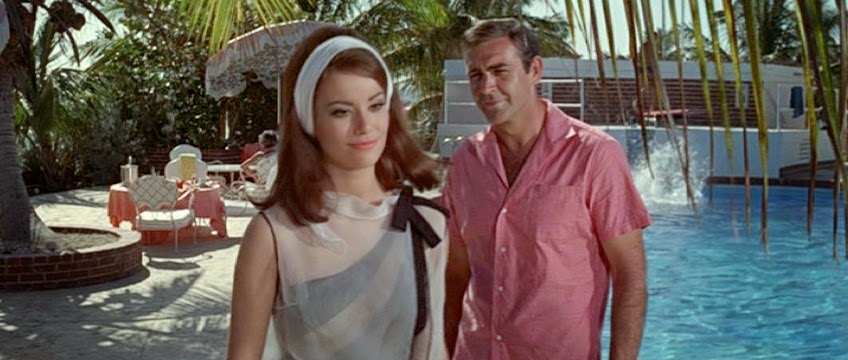
"What sharp little eyes you've got." "Wait till
you get to my teeth."
For my money this is one of Connery’s best performances as Bond. He really plays the part of the professional in this one, always staying one step ahead of Largo and his plot. His interaction with Domino is genuinely warm, something that was missing from Goldfinger, which seemed a bit more playful. To be honest, Connery ends up looking a bit bored in the next two Bond films he is in. So for me, this is his last performance where he seems genuinely engaged in the character. Auger makes for a fine love interest. She’s very lovely looking, but she also brings a touch of sadness to the character. It’s a shame she ends up pushed to the side a bit as the film progresses, but she does a solid job over all.

Yeah Largo, Fiona would shoot you if she had too.
When it comes to the villains, I have mixed feelings. Largo is intimidating and brutish, but I don’t get the feeling of cunning from him. The plot requires Celi to give Largo a genial but cruel edge. Well the cruel comes across very well, but he doesn’t seem as suave as the film wants him to be. I still think Largo is a fairly strong Bond villain, but not one of the best from the decade. But his henchwoman Fiona – wow! Now she pretty much steals every scene she’s in. Paluzzi is sultry and wicked. I love the way she manipulates the men around her, and even manages to make Bond look foolish. In some ways, I really wish the film had turned her into the mastermind of the plot, with Largo as her minion (like the inspired twist in The World is NotEnough). I’m always sad to see Fiona get killed two thirds of the way through the film. Thunderball shines a little less once she’s gone.

Poor Q never gets to enjoy a holiday,
The supporting cast does a fine job as they always do. Desmond Llewlyn gets a bit of fun as Q while he attempts to equip Bond in the field, muttering the whole time. We also get a new Felix Leiter in this film (this role is rarely ever filled by the same actor twice). This time we get Rik Van Nutter, and he’s not bad, but the part seems a bit shoehorned in. Both Bernard Lee and Louis Maxwell return as M and Moneypenny. They get to fret and worry about the mission back in London, and provide the film with most of the “ticking clock” moments.

Thunderball is not high on everyone’s list and one of the main complaints I see leveled at the film is the final battle sequence. It does last quite a while and it occurs entirely under water. From a technical point of view this battle is really amazing. The submersible equipment they use in this scene is pretty nifty looking.  Pretty much any way you can imagine men in scuba gear battling is covered. You get harpoons, knives, explosives and masks being ripped off. They even throw a shark into the mix.

Jet packs for everyone! Oh wait, that's Moonraker.
For a lot of folks the intensity of the film really loses a lot momentum with all the underwater action. Since all the motion on the screen is literally slowed down, it does end up making the film feel longer in places. But I feel that the crew was also showing off the amazing cameras. The Bahamas presented them with some wonderfully clear water, and the footage is really impressive. In the end, I think Young could have trimmed some of it to keep the urgency in the film.

"When you're a Jet, you're a Jet all the way."
But I can’t blame Young for being excited with the footage, and so I usually don’t let it bother me. Besides, he does end up bringing James Bond a bit back to earth after the comic book fun of Goldfinger. While the film deals with holding the world hostage for a nuclear threat (a staple of the Bond films pioneered here), the action centers mostly on Bond as he uses his wits and guile to discover and undo Largo’s plot. The only side effect is that Bond in Thunderball has retained the immunity to damage that he obtained in Goldfinger. But still, this movie feels more like a thriller than a series of set pieces. I think it has as much to do with Flemings story being the core as it does with Young’s direction.

So what it all comes down to it, Thunderball is easily one of my favorite Connery Bond flicks. I like the larger than life scope, but the fact that it stays true to the thriller roots. The caveat of the underwater action seems to the make or break item for this movie. And I understand why it doesn’t work for everyone. But for me it’s a fun summer Bond film, one of the best of the era.

One more shot of Fiona. :)

Monday, June 17, 2013

Goldfinger (1964)


Introduction:
How do you write a review for what many consider  the quintessential James Bond movie. It is considered the king of the Connery flicks (and for many the best James Bond film ever made). It is the very definition of iconic. So really, should I spend any time going over what everyone else already knows? Of course I will! I’m going to write reviews for every Bond movie. Besides, I think it’s time to scrape off some of that gold paint and see a bit of the tarnish underneath. Oh yeah… I’m going there.


Summary:
British super agent James Bond (Sean Connery) is just trying to enjoy some relaxation in Miami when his superior M (Bernard Lee) gives him a new assignment. Bond is to observe Auric Goldfinger (Gert Frobe) a wealthy industrialist who they suspect is in the gold smuggling business. Bond quickly gets on Goldfinger’s bad side when he seduces Goldfinger’s pretty assistant Jill (Shirley Eaton). Before you can say “most famous film image of the 1960s”, Jill is covered in gold paint and Bond Is standing over her lifeless body.

Well Bond isn’t going to take this lying down. He goes after Goldfinger and soon uncovers a diabolical scheme to raid Fort Knox! With some help from the pretty Tilly (Tania Mallet) and a super car, Bond attempts to stop the plot. But against him are Goldfinger’s dangerous agents, Oddjob (Harold Sakata) and Pussy Galore (Honor Blackman). Does Bond have any hope of bringing Goldfinger to justice?

Good Points:
  • Hits all the key elements that you expect in a James Bond film
  • Honor Blackman is alluring in her role
  • The Astin Martin nearly steals the show

Bad Points:
  • Drops the serious thrills in favor of silly spectacle
  • Bond spends the second half of the movie hanging out
  • The script could have used a few more passes

Overall:
The James Bond series hits the formula in this film, and it would inspire many of the sequels as well as countless imitators. It’s a fun flick, but a long way from the edgy thrillers leading up to this film. The script has plenty of loose threads and random moments. While I don’t hold this is a high point, it’s a perfectly average outing for 007.

Scores (out of 5)
Visuals: 4
Sound: 3
Acting: 4
Script: 2
Music: 4
Direction: 3
Entertainment: 3
Total:  3

In Depth Review
It was the kiss of death, from Mr. Goldfinger.
A lot of people LOVE this movie. When it comes to king of the James Bond series, Goldfinger tends to be on top. As I mentioned before, nearly every scene is iconic in some way. It’s fun, a bit breezy, a bit over the top and has some very funny and quotable lines in it. In so many ways, this film was the perfect fit for the perfect time. It was this film that turned James Bond into a phenomenon.

Because of all that, it’s really hard to look at the film objectively, or in comparison to the other James Bond films around it. The Bond series is very much a snapshot of popular culture. With this film – Bond became popular culture, and held that position for the next couple movies. I think that is why so many people connected with it, and with Sean Connery as their James Bond.

But that doesn’t mean only people who caught Goldfinger in theaters are the big fans. I’ve met plenty of people my age and younger who adore the film. Most of the time, it is their first exposure to James Bond and it becomes a kind of keystone for them. All other Bond films are measured against it.

But I believe that as entertaining as the film is, it isn’t the best James Bond film, or even the best Sean Connery film, or even the best Bond film of the 1960s. It lies solidly in the middle of the pack.

No Mr. Bond, I expect you to die.
The visuals are one of the most impressive things about the film. Ken Adam did an amazing job with the set design and would only top it in You Only Live Twice. His set for Fort Knox is stellar, looking impressive and a bit fantastic. The shimmering gold lighting and illuminating the bars all around James and Oddjob during the final battle are like something out of a dream. Equally impressive is Goldfinger’s rec-room/war room. With Its sliding panels, trapdoors and rising and falling furniture, it’s the perfect man cave for a megalomaniacal villain.  Then there is the laser room, easily one of the most iconic visuals in the film, with its sole table in the center of darkness, as the shiny machine prepares to whittle Bond down to size. Last but not least is the first time we see Q’s laboratory. This scene made such an impression that it was considered mandatory inclusion in every Bond film until Casino Royale in 2006.

This leads into the camerawork in the film. Goldfinger has so many memorable visuals in it, and that goes in large part to Ted Moore’s cinematography and framing. The golden girl draped across the bed is immediately stamped into our minds. The low angle, the lighting plays up the beauty and horror of the scene. I already mentioned the laser scene, but the high angle for the establishing shots, not to mention the close ups on the laser and it’s progress are striking. The entire finale sequence at Fort Knox includes many visual highlights. Strangely enough, whenever I think of this film, my mind goes right to the aerial photography of Pussy’s pilots flying over the military base around the fort. Combined with John Barry’s brassy score, this moment always stands out. Finally you have the framing of the battle around and inside the fort, with the camera capturing the scope of Adam’s sets as well as the action in front of us.

Operation Grand Slam has nothing to do with Denny's.
As usual the sound effects work in the Bond film meets the needs of the production. These early films didn’t have some of the spectacular sound work of the later flicks (especially from Goldeneye on). But the musical score by John Barry is often considered the first “true” James Bond score. Barry helped pen the title theme, and uses it as the theme for the film. He integrates Monty Norman’s James Bond theme into the score at key moments and even comes up with a sinister motif for Oddjob. From Goldfinger to The Living Daylights Barry’s signature sound would be the frame for all the James Bond films. Even when different composers tackled the series, they would end up relying on the mold Barry created here.

From an acting standpoint, you’ve got a solid cast. Connery seems to be having a good time in the role, comfortable with the character and the lighter tone of the film. I think he’s a bit better in Thunderball, because the role is a bit meatier. Matching him is Honor Blackman as Pussy. I love her tough gal performance. She doesn’t take any flack from Bond and seems to be a perfect match for him. Of course she has to melt in his arms by the end, but while she’s his foil, she does a great job.  Gert Frobe is a bit tougher to judge. He was dubbed over and so you have to judge his physical presence more than anything else. He’s got the sinister, confident and jovial villain down pat. It was such a memorable performance that it would be cloned in many imitations (and even a few sequels).

Silent henchmen and caddy, Oddjob does it all.
The supporting cast is great too, with Sakata being an intimidating presence as Oddjob. Shirley Eaton is sexy and likable as Jill Masterson who would become the golden girl. Tania Mallet as her sister Tilly is just as good as the revenge driven sibling. Back in London we get solid performances by Bernard Lee and Louis Maxwell. But the real surprise was Desmond Llewellyn as Q. The part was greatly expanded from his appearance in From Russia With Love. Here he is a foil for Bond and does a great job in the part. Again, it became a necessity to have Llewellyn in the part that he appeared in every James Bond film by MGM until 1999’s The World is Not Enough (with the exception of Live and Let Die).

Where Golfinger ends up falling a bit short is in the script. And that’s not to say the actual dialogue itself. There are plenty of classic lines from this film, and many that have become some of the most beloved lines in the James Bond canon. No I’m talking about the way story is constructed and executed.

It's Pushy!
From an early point on director Guy Hamilton decided to change the tone of this particular James Bond movie. He wanted to make it less inspired by Hitchcock, as From Russia With Love obviously was. He decided to make the whole thing more light and more like a comic book. This may be why certain plot elements aren’t really fleshed out or seem to go nowhere.

With the focus firmly on getting Bond into and out of scrapes, this allowed the writing team to come up with the first full pre-credit sequence. Unlike the one from the previous film, Goldfinger’s pre-credit sequence acts like a short Bond film. It gives us everything we could want, and sets the tone of the film. There’s action, explosions, a hot girl, Bond acting suave and Bond with a seagull on his head. It even ends with a classic post kill quip.

I got to admit this was a great way to start the movie. Once the movie proper kicks in, the first hour or so is actually handled fairly well. The introduction to Goldfinger is classic. I love how Bond outmaneuvers him in the card game, and then again during the golf game. Once he gets into the Goldfinger’s refinery and we get the great car chase, it seems like the movie is shaping up well.

Settle in James, you'll be stuck here a long time.
Things start to go badly when the movie arrives in Kentucky. Goldfinger catches sight of Felix (Cic Linder) casing the place and keeping an eye out for Bond. So Goldfinger decides to keep Bond around, visibly walking around with Pussy. This convinces Felix that Bond is in no danger. This whole sequence seems a bit pointless. It ends up slowing the forward momentum of the story. Too much time is spent with Bond in captivity and sitting around making smart remarks and not much else.

The weakest bit of writing in Goldfinger comes during the scene where our villain gathers all the mob bosses together, tells them his entire plot and then kills them. If he was just planning on killing them, why bother to tell them his plot? You can write it off as his ego forcing him to gloat. But it’s just bad screenwriting. The scene only exists to allow Bond to hear the plot and then get the word to Felix. There had to be a better way to get that information. Instead we get a fairly messy scene that leads to another pointless (but cool scene) of Oddjob getting rid of the last gangster, ironically named Solo (Martin Benson).

The Bond vs. Oddjob battle is a classic.
Once the action moves to Fort Knox, it gets better. Bond still spends most of the sequence chained to a metal box, but the stakes are high and it’s fun to watch Goldfinger’s plan in action. When Bond manages to free himself it feels like a James Bond film again, and the ending is good. I still think Goldfingers final scene is bizarre and hilarious. I’m not sure if that was the intention, but it’s one of the goofiest villain deaths in the canon (only supplanted by the bizarre death by inflation in Live and Let Die).

The second hour of the film always annoys me. It’s too messy and lacks momentum. The thing is, it fits the more cartoony and breezy tone that Hamilton wanted. You aren’t supposed to think about the movie that hard, just enjoy the ride. And most folks do.

"You've been a very naughty screenwriter."
But the side effect is that there is very little danger in this film. The most intense scene Is the laser sequence. Compared to the tense capture scene in Dr. No or the brilliant game of wits on the train with Grant in From Russia with Love, this movie is much less concerned with danger and more with spectacle. It’s that element that really turned Bond into a phenomenon. I’m not complaining, I love Bond flicks when they pull out all stops like Thunderball or The Spy Who Loved Me. But the thing is, I like both of those movies more than Goldfinger. They have better momentum, and a better understanding of what they are trying to accomplish.

But at the same time Goldfinger was the first of it’s kind of film. Even more than Dr. No it is really the beginning of the James Bond legacy, and so it deserves that distinction and everything that goes with it. But I feel that I can’t be called the best of the best. 

Wednesday, August 22, 2012

From Russia with Love (1963)


Introduction:
Following the success of Dr. No the creators behind the James Bond series knew that they had franchise in the making.  They picked one of Flemming’s better books, gathered a good supporting cast, and secured a larger budget.  Terrance Young was brought back to direct, and Sean Connery was back as Bond.  All the ingredients were in place to create a movie that would be bigger and better than the previous.  Does From Russia With Love fit the bill or does it suffer a sophomore slump?

Summary:
Head of the British Secret Service, M (Bernard Lee) discovers a lovely Russian cipher clerk wants to defect and take a top secret coding device with her.  Her only stipulation is that secret agent; James Bond (Sean Connery) is the one that helps her.  M and Bond suspect a trap, but they go along with the plan.  Bond is sent to Istanbul where he meets the head of British spy operation named Kerim Bey (Pedro Armendariz).  Bey promises to help Bond and lovely Tatiana Romanov (Daniela Bianchi) escape via the Orient Express.  The trap is sprung when Rosa Klebb (Lotte Lenya) and “Red” Grant (Robert Shaw), set out to ensure that Bond and Romanov die in shame the decoding device falls to SPECTRE.

Good Points:
  • Connery’s chemistry with Bianchi and Armendariz makes this movie work.
  • Location work in Istanbul and Venice is beautiful.
  • The movie has a gritty tense feel to it. 
Bad Points:
  • The movie moves at a slower pace until the chase kicks in. 
  • There is a bit of padding in the beginning of the film. 
  • The James Bond theme is overused for just about everything.
Overall:
With this Bond film we get a great mix of espionage and fantasy. The stakes are high, the tension builds up well and everything feels bigger than the previous film. It ends up being one of the best Bond films of the 60’s and secured the fate of the franchise.

Scores (out of 5)
Visuals: 4
Sound: 4
Acting: 4
Script: 5
Music: 4
Direction: 5
Entertainment: 5
Total:  5

In Depth Review
I know that many people consider this to be the best James Bond movie. I can see why they think that. From Russia With Love marks the last time Sean Connery got to play James Bond as a normal man.  From Goldfinger on he became more over the top and archetypal.

In terms of visuals, this movie improves with excellent location shooting in Istanbul, Venice and Scotland.  Istanbul provides the bulk of the films most exotic scenes.  The city’s mystery is captured with scenes of the Bosporus, the bazaars and the interior of the Hagia Sophia mosque. Venice is featured for the first time in a James Bond film (it pops up again in Moonraker and Casino Royale).  While most of the filming was done for rear projection work, there are some establishing shots in the famous city. Scotland does some doubling as Italy and the Yugoslavia.  This film started the globe hopping tradition of James Bond.  By the time the Moore films rolled around, James Bond was traveling to three continents in one adventure.

For the most part, the sets go for a more realistic look. The best examples are used for the cars on the Orient Express.  These create a cozy and yet claustrophobic setting for some of the key moments in the film.  They are recreated with such skill, that most viewers believe the scenes were filmed aboard the train.  Bloefeld’s yacht interiors are stylish yet believable.  On the flip side, Kerim Bey’s office and the chess tournament have a bit of the Ken Adam feel to them.  The chess tournament especially uses open space and a chess motif that makes it one of the more memorable sets in the film. The only place where the visuals fail a bit is in the rear projection.

Sound work is also impressive for its time.  Per the norm, gunshots and explosions get the best treatment.  The real highlight is the battle between Grant and Bond.  The crunching, smashing and shattering adds to the violence of the scene.

For the first time John Barry offers his score to a James Bond film.  It seems to be a perfect match.  Barry uses a brassy, jazzy score that incorporates three separate themes.  The first is the popular James Bond theme, first utilized in Dr. No. Barry uses what sounds like the same version of the theme from the previous film as well as working it into his unique pieces.  The theme song From Russia With Love sung by Matt Monroe is used for the end credits, but a sassy instrumental version is used for the opening titles.  The piece also acts as the romantic music used for Tatiana and Bond.  The final piece is one that is a personal favorite of mine, the 007 theme.  It shares many similarities with the James Bond theme but its more action oriented. I particularly love the steady driving rhythm of the piece.  It is utilized several times, and would pop up again in Thunderball and Moonraker. The only downside to the music is that the James Bond theme is used for everything.  Bond opens a door, cue the theme.  Bond wanders down a street, cue the theme.  Bond sits down, cue the theme.  It’s very heavy-handed.  Barry tones this down in his later movies, but in a way it reminded me of David Arnolds work on Tomorrow Never Dies.

In From Russia With Love, Connery is still very strong, but not quite as relaxed with the character as he would be in Goldfinger.  It’s a difference in tone that not only affects Connery’s performance but the whole movie as well.  This isn’t a bad thing, it’s just different from the James Bond that evolved later.  Here Connery plays the part more naturally.  James Bond is well aware of this being a trap, and does his best to enjoy the adventure, while keeping his eyes peeled.  His confrontation with Grant (before the fight erupts) is cautious, measured, and a bit frightened.  Bond knows he’s caught, and he’s hoping he can make it out of this alive.  I’m convinced this performance has much to do with director Terrance Young, who seemed to understand James Bond’s character very well.

Daniela Bianchi provides Tatiana Romanova with a perfect mixture of alluring beauty and naiveté that not only entrances Bond, but the audience as well.  Her voice was dubbed over for most of the film, but her expressive eyes and body language work wonders.  Her part is key to the story, but it’s also a bit underwritten (especially compared to the depth given to her character in the novel).  However her performance works for the film.

Pedro Armendariz as Kerim Bey gives us a warm and likable performance.  He comes across as very capable in his skills as a British contact in Turkey, but more than that, he creates a real friendship with Bond.  It’s an extremely effective performance, especially in the first portion of the film.  Here we are given plenty of character moments but at the cost of padding out the film.  Pedro’s performance helps us forgive the padding and enjoy his repartee with Bond.  To find out that the actor was deathly ill and died during the production of the film was amazing.  His performance doesn’t seem hampered by illness in the least.

A trio of villains faces off against our heroes.  The most physical threat to Bond comes in the form of Donovan “Red” Grant played by Robert Shaw.  I was familiar with Shaw’s work in Jaws.  So it was amusing for me to see him as the cold and dangerous assassin.  Shaw plays the part very calm, focused and cunning.  He uses opportunities to his advantage and when he makes contact with Bond on the Orient Express, he keeps the British Agent fooled.  In a way he’s probably one of the most dangerous opponents Bond faced in his 60’s film.  We wouldn’t see his like till Necros took on Bond in The Living Daylights.

Lotte Lenya as Rosa Klebb is one of the most memorable characters in the film.  Not only does her no-nonsense attitude combined with her short stature work, but her choice of poisoned shoe is an interesting weapon.  As Bond continues to foil her plot, she reminded me of Le Chiffre in Casino Royale.  There is an air of desperation to her performance, knowing that if she fails Bloefeld in capturing the Lector, she’ll be dead.  Her meeting with Tatiana is also very well done, and sets her up for the end sequence with Bond.

Also of note is Vladek Sheybal as the chessmaster Kronsteen.  He plays the part slimy and confident, a good mix.  We also get Walter Gotell as Morzeny.  I mention him because the actor returned as General Gogall in TheSpy Who Loved Me and every Bond film up to The Living Daylights.  Here his character is more of a thug.  I also have to mention that this film introduces Bloefeld as the mastermind (and the first villain with an evil cat).

Back in London we have the usual suspects.  Bernard Lee and Lois Maxwell continue the classic performances that they originated in the previous film.  The main difference is that Desmond Llewelyn appears as Major Boothroyd of Q branch for the first time in the series.  He delivers the part as a straightforward employee merely showing James Bond the new piece of equipment that he will using.  We won’t get to see the classic performance of Q until Goldfinger.  Still it’s good to see all the familiar parts filled out.

Just watching From Russia with Love and not really knowing much behind the troubled production, it comes across as a well-made film, one that sticks fairly close to the novel, but is just different enough to keep thing interesting.  The script was altered mostly in the case of the villains.  In the novel, the Russians were the masterminds behind the plot.  SPECTRE didn’t have anything to do with it.  The addition of SPECTRE ties back to Dr. No and at the same doesn’t make this film too topical (especially with the cold war in full swing at the time of its release).

For the most part of the script works well enough, but there is a bit of a problem (one that’s actually based of the book).  By introducing the villains of the film in the beginning and setting up the plan intended to entrap Bond, it diffuses some of the mystery.  The story might have worked better if we hadn’t really known what was going on with Tatiana or Grant.  This would have worked as a surprise (for some) when things fell into place at the end.  After all Bond knows he’s walking into a trap.  He’s just not sure what pieces are arrayed against him.

However in defense of the script is the fact that we are introduced to Grant in the beginning and when he shows up throughout the movie he acts like “Hitchcock’s Bomb”.  We see him, we know he’s going to go off, but tension and suspense is created by not knowing when it will occur.  The only thing I don’t like about this strategy is that it ends up front loading the movie with too much exposition.  Some directors might be able to make this work to their advantage.  Others, like Terance Young have a slower style to begin with.  With an exposition heavy first third this can slow the movie down too much.

Another interesting element I noticed in this viewing was how much the film deals directly with sex. That’s not to say that Dr. No avoided the subject, but here it really seems to be saturating the film. Sex is used as a tool, by Bond to get what he wants out of Tatiana, and by Tatiana to ensnare Bond. It is used as a weapon by SPECTRE when they record Bond and Tatiana’s lovemaking and plan to use it to destroy Bond’s legacy after they kill him. Bey has a bunch of sons at his disposal and plenty of women hanging around. Even the visit to the gypsy camp is based around two women fighting for the “love” of a single man. More then any of the following Bond films, sex is a key component of the plot and the texture to the film. Sure there were plenty of bad sexual puns and liaisons with women in the upcoming films, but sex was just an added spice. Here it is a key ingredient.

Even with the plot heavy first half, Young is able to keep From Russia with Love moving at a steady pace. He is helped by good performances from Connery, Armendariz, Bianchi, Lenya and Shaw.  But once the theft of the Lector device occurs he creates a masterpiece of tension that rarely slows down.  There’s plenty of action in the second half and most of it propels Bond and audience along. The first half has some good action scenes as well, the fight in the gypsy camp is a highlight for certain. But the true action climax is the battle between Bond and Grant – one that is often considered one of the best hand-to-hand battles in movie history.

As far as entertaining goes, this film meets all the expectations.  It’s a bigger adventure for Bond than Dr. No and yet it keeps itself grounded in glossy and fun reality, but avoiding the cartoony nature of the later Bonds.  If you watch From Russia with Love expecting the pace to be a bit slower in the first half, you’ll have a good time with the movie.  But if you go in expecting wall-to-wall action, or the over the top nature of You Only Live Twice, you could be disappointed. 

Friday, August 19, 2011

Dr. No (1962)


Introduction:
Dr. No started the longest running franchise in movie history. It’s hard to step back and imagine seeing the movie for the first time, without ever knowing James Bond. So sitting down with Dr. No pits it against some serious expectations. But if you come at this film with a bit of history on your mind, you’ll find a very enjoyable sample of spy cinema in the early ‘60s.

Summary:
After a British secret agent and his secretary are ruthlessly killed in Jamaica, Head of the British Secret Service, M (Bernard Lee) dispatches his best agent, James Bond (Sean Connery) to investigate. It seems that something mysterious is happening on Crab Key Island. Anyone who comes snooping around ends up dead. CIA operative Felix Leiter (Jack Lord) suspects the infamous Dr. No (Joseph Wiseman). As Bond investigates with the help of Quarrel (John Kitzmiller) and the lovely Honey Rider (Ursula Andress), he uncovers a plot to topple American rockets. Will he be able to stop it before it’s too late, or will Dr. No silence him first?

Good Points:
  • Sean Connery makes it his movie.
  • The settings in Jamaica and in Ken Adam’s sets are excellent.
  • The movie serves as a good introduction to the world of James Bond.
Bad Points:
  • Plays much more like a conventional thriller than a super spy film.
  • James Bond is the most fleshed out character.
  • Some of the visual effects are not convincing.
Overall:
Viewed in comparison to its brothers Dr. No is an average James Bond adventure. Sean Connery’s acting and Terrance Young’s polished direction make the film work. While it’s an entertaining watch, it really serves as a starting point. The Bond movies of the ‘60s got better after this one, but it’s great to see the film that started it all.

Scores (out of 5)
Visuals: 4
Sound: 4
Acting: 4
Script: 3
Music: 3
Direction: 4
Entertainment: 3
Total: 3

In Depth Review

Dr. No is a tough film to review. I’m struggling to find the right perspective on it. Should I judge it against the other films of the MGM Bond series? Should I view it as the first of the series, and accept its limitations? I chose a balance between the two. I comparing it to the other films with the understanding that compared to the high tech visuals of The World is Not Enough, Dr. No was going to look primitive. But film basics can be judged easily enough.

The amazing thing about Dr. No is that you can see all the elements of the Bond formula being started here. The visuals are no exception. Location work takes place almost entirely in Jamaica, highlighting some of the most breath taking and visually exciting spots on the Caribbean island. Especially noteworthy are the Crab Key locations. The wonderful waterfalls that cascade down the beach are simply beautiful.

Luckily for the creators of the film Ken Adam was on hand to create his sets. Right from the beginning he presents a mixture of ultra-modern with larger than life visuals. The results have been sets that stand out in your mind (most obvious with his work on Fort Knox in Goldfinger and the volcano base in You Only Live Twice). Here he creates the casino in which we are introduced to Bond. It has the perfect mix of elegance and opulence that you expect in a Bond film. Perhaps the most memorable set from the film is Dr. No’s apartment. It set the standard for the look of a villain’s lair. His control room (where he faces off against Bond) is filled with screens, chrome metal, glowing lights and a huge illuminated globe.

As nifty as these sets are, one always stands out to me whenever I see it. It’s the room where Professor Dent (Anthony Dawson) reports to Dr. No. It’s a large, round room with a grid skylight that forms an interesting web like shadow on the wall. There is a single chair on one side of the room where Dent is interrogated. On the other side is the table with the poisonous spider. This single image of Professor Dent in this cold and dangerous room always enters my mind when someone mentions Dr. No.

Unfortunately modern audiences are going to find some faults in the film. Most of this comes from the dated effects work. The worst offender is the rear projection used in the car chase. It’s so fake looking that I felt bad for Sean having to react to the silliness as if he was in real danger. The other element is the “dragon” that appears in the film. It just looks out of place in what is mostly a gritty thriller. Maybe in a later Roger Moore film it would have worked. It always surprises me when that “dragon” shows up. I keep blocking that part out.

The sound work for the most part it’s really good. This is a Bond movie so the explosions, hand to hand battles and bullets should sound good. Dr. No starts the fine Bond tradition of having the villain’s lair explode at the end of the movie. As far as explosions go, this is a good one. There are a few minus points though. Obviously the sound work is a bit dated, and lacks the clarity and crispness of later films. Also there is a strange… I don’t know… groovy sound effect when Bond is inside the air ducts attempting to escape from Dr. No’s cell. It’s a weird moment. I’m also not crazy for the music box sound effect for the gunbarrel sequence. This odd tinkling sound effect is dropped for the familiar gunbarrel music in From Russia With Love.


That brings me to the score. There are two key elements to the music of Dr. No. One is the use of Jamaican bands and songs. The most used song is “Underneath the Mango Tree”. Memorably, Honey Rider sings it when she first appears. It also finds its way into the score, popping up here and there, especially when Bond is interacting with the gals. There’s also the infectious “Jump Up” song played at the bar scene.

But the real stand out is Monty Norman’s James Bond Theme. It is used for the opening titles and makes an immediate impression. According to what I’ve pieced together (and I could be wrong), Monty Norman actually recycled a song he had written for a musical into the James Bond theme. He gave the piece to John Barry who orchestrated it into the theme we know today. There has been much argument over who really wrote the James Bond theme. In a way it’s telling that John Barry was asked back to work on the James Bond film scores in From Russia with Love and beyond. Monty Norman gets song credit. With that said, the James Bond theme is used a lot in this movie: too much. It seems to be the only bit of music that they really had on hand for the action scenes. But compared to the fully scored films (and John Barry’s work in particular) the music is only average for a Bond movie. But that theme is really something else.


Dr. No is probably the most James Bond centric of the early Bond films. The movie falls almost completely on Connery’s shoulders and he is up to the task. His introduction in the casino is classic. You understand just about everything you need to know about him in that scene and the way he plays against Sylvia Trench (Eunice Gayson). As the film continues you learn more and more about Bond. With the final confrontation with Dent, we have the completely fleshed out character of James Bond. Then it’s off to Crab Key for the adventure part of the story.

Connery is suave and cool with an undercurrent of intensity. At this point Bond wasn’t the superman he would evolve into, so there is fear and anger in his performance, especially after Dr. No captures him. Connery is solid as Bond in his first time out and he would improve in each film, reaching the definitive portrayal in Goldfinger. That third film adds to the performance is a layer of supreme confidence that would be taken to ridiculous extremes by the time You Only Live Twice rolled around. Here James Bond is more realistic, more gritty and more believable. Does he capture the role as presented in the books? Not really. Timothy Dalton really nailed that aspect of the character, turning James Bond into a brooding agent who was very good at his job, but held a darkness within him. Connery never seems to capture that darkness. But the scripts don’t really call for that. It’s interesting to compare the performance of Bond in this film with 2006 reboot, Casino Royale. There are many similarities. The main difference is that the newer film has a script that puts Bond through his paces, something that Connery never really enjoyed.


In most James Bond films, the main three performances are James Bond, the main Villain and the love interest. In Dr. No, James Bond overshadows everyone else. He is given the most screen time and the most fleshed out part. This renders even the key parts of villain and love interest as more of a supporting role than anything else.

With little to do but look sexy and follow Bond around Ursula Andress does the best she can with the part of Honey Rider. She’s merely the beautiful woman that Bond encounters, saves and ends up with at the end. The movie can be sliced into thirds and each third has a Bond girl in it. Andress just happens to be the one at the end of the film and gets the title of Bond Girl. She’s good, but far from the best of the ‘60s. Her iconic walking out of the sea still has a great impact, but after that, she’s little more than eye candy.


Joseph Wiseman makes Dr. No as interesting and menacing as possible for such an underwritten part. Wiseman’s screen presence is undeniable. The best dialogue in the film is the banter with Bond during the dinner scene. Wiseman also set the standard for the cultured, calm and dangerous villain that would be associated with Bond. It’s a shame that he wasn’t introduced in a later film where his character could have really been explored and probably yielded a greater performance. He remains memorable as a villain, but in the long line he gets overshadowed.

Bond’s supporting team in London makes their first appearance here. Bernard Lee establishes M right off the bat. He plays the part with a crisp no nonsense fashion. He is very much a soldier, one who knows the job, and sends his best man to get it done. Lois Maxwell also nails the part of Miss Moneypenny. Her banter with Bond is classic stuff and set the example for all her future appearances (up to 1985’s A View to a Kill). Rounding out the cast is Peter Burton as Major Boothroyd. In his only appearance in the Q part he does a solid job. The part is very dry and wouldn’t be spiced up until Goldfinger with a stellar performance by Desmond Llewelyn.

Filling out keys roles in the supporting cast are a capable Jack Lord as Felix Leiter. He’s good, but not particularly stand out. Of the ‘60s actors who played the role, he’s probably the best one. Anthony Dawson is very good as the dangerous Professor Dent. John Kitzmiller gets a fairly good role as Quarrel. It’s a bit condescending now (the poor islander superstitious about the cursed island) but he plays the part well enough that you feel bad when Quarrel meets his fate.


For the women you get two more good parts. Eunice Gayson is the playful gambler Sylvia Trench. Her repartees with Bond in the Casino, as well as her brief scene in his flat are great character moments. She also returned in From Russia with Love. For the part of the femme fatale, you get Zena Marshall as Miss Taro. She mixes sex appeal and cunning. You know she’s up to something and it provides another test for Bond to pass.

Finally I have to acknowledge director Terrance Young. According to many, Young was responsible for so much of the look and feel of Dr. No, that the James Bond franchise really owes him an enormous debt. He polished Sean Connery’s performance, giving him the smoothness to hide the rugged survivor underneath. He gave the dialogue a little flair, adding bits about the champagne, the clothes, even the cigarettes used by the characters in the film. Most of all he crafted a movie that had all the adventure, sex appeal, danger and fun that the producers wanted. My only issue with Young’s work on the film is the pacing. Part of this is the exposition heavy first half of the script, but part of it is just how Young paced his films. The next two Bond films he worked on From Russia with Love and Thunderball have the same problems. They slow down quite a bit around the exposition, but work very well in character driven or action driven scenes. I must say that the James Bond films of Terrance Young are superior to the most of the following Bond films with the exception of Peter Hunt ‘s work in On Her Majesty’s Secret Service.


Obviously I enjoyed Dr. No. Some of it come from seeing how the Bond franchise started and knowing where it’s gone and where it is. But beyond all that, it’s an entertaining film. It has James Bond as a spy in a thriller. It’s got a danger to it that would carry over into the next film. It’s a refreshing change from some of the more comic book-like adventures that followed.