Summary:
It all starts with a short
film called Why Study Industrial Arts?
This flick follows Joe as tries to explain to his buddy Bill why industrial
arts courses in high school are worth the time and may lead to viable career
opportunities. The boys get advice from the wood shop teacher as well as the
basketball coach. In the end Joe convinces his doubting buddy that being handy
with tools is a truly wonderful thing.
Once upon a time there lived
a monotone pilot named Harry (Anthony Cardoza) and his jumpsuited wife Beth
(Kevin Casey – no that is not a typo). They ran a skydiving school in the
middle of the California desert. While both of them enjoy coffee a great deal,
the spark is gone from their marriage. That is why Harry is fooling around with
the local floozy, Suzy (Marcia Knight). But Suzy has another beau hanging
around, the simple minded Frankie (Titus Moede). He used to work for Harry, but
kept showing up to work drunk.
So Harry fires Frankie, gets
in a fistfight with him, and Suzy feels slighted by this. So she hatches a
crafty plan to get revenge on Harry. Meanwhile Harry’s old army buddy Joe shows
up looking for work. He gets hired, but soon starts making googly eyes at Beth.
Beth finds him attractive because he enjoys coffee almost as much as she does.
I’m not even mentioning the strange party, the endless skydiving scenes and
that bizarre folks who just seem to show up all to watch the perils and
tribulations of The Skydivers.
Movie Review:
 |
| The Industrial Arts course is a hive of activity. |
For Centron no topic was off
limits for their short films. Why Study
Industrial Arts is very typical of their work. It focuses on two high
school teens as they explore the topic at hand and get advice from teachers and
parents to guide them along the right path. It uses the typical Centron stark
black and white photography. But unlike some of the more creative shorts, like Cheating, this movie has a pretty
standard set up and direction.
One of the interesting
elements to the short is its use of montage. You get three of them in the film,
as Joe narrates his feelings about industrial arts, or while his shop teacher
describes the types of jobs that utilize training in industrial arts. I don’t
remember seeing so many montages in a Centron short before, and they offer some
of the best riffing material. But before I get to that, let’s look at the
feature film.
Coleman Francis wanted to
make movies. He had been an actor for a number of years even appearing as the
deliveryman in This Island Earth,
but what he really wanted to do was direct. The three films he created are some
of the most unique and fascinating in the Mystery
Science Theater library. No, they aren’t good, but they are odd little
creatures that keep the viewer wondering the simple question… why?
 |
One of these fine folks doesn't like coffee as much
as the others. |
If you are going to start
with any of Francis’ movies than I suggest you start with Skydivers. It was his second film in the director’s chair, and it
is overall the most cohesive and entertaining. It lacks the epic scope of Red Zone Cuba (or Night
Train to Mundo Fine if you prefer) and it is more accomplished than The Beast of Yucca Flats. It has
characters, an overarching plot and even a climax of sorts. None of these
elements are handled well, but the final result is watchable.
One of the first things
you’ll notice in Skydivers is the
camera work and editing. There are a lot of close ups on faces, but framed from
a low angle and often with too much background looming behind the floating
heads. These often look like insert shots, but if you watch these films enough
(and only a MST3K fan would do such
a crazy thing), you’ll see that these shots are edited from other scenes.
That’s when you realize the editing in the film is really hacked, slashed and
chopped. Scenes seem to lurch from one moment to another; inserts are placed,
and then jumped past (creating an almost montage effect, but without any
rhythm). The editing doesn’t cause too much confusion, which is a lucky thing,
but it is disconcerting none the less.
 |
Typical Francis framing of a closeup. No matter how
it is framed Tony Cardoza always looks the same. |
Sometimes I feel bad about pointing
out the faults of actors in a low budget film. I know the director can’t afford
the best, he makes due with what he can pay for. But Skydivers really suffers because the performances are so weak. The
crux of the film is the tension and drama between Harry and Beth. I think
Francis was trying to get us to care about the couple and want them to find
some way to get their relationship back on track. The only problem is that the
actor playing Harry is really one of the worst I’ve seen. Tony Cardoza just can’t
seem to muster a single emotion. He constantly looks sleepy, bored or just
plain confused about what he’s supposed to be doing. He delivers almost all his
lines in a dreary monotone, even when he’s supposed to be angry, or excited or
amused. He generates 0 chemistry with Suzy and 0 tension with Beth. A plank of
wood would have been a better casting choice. But then you see that Cardoza was
one of the producers, so maybe it isn’t too surprising that he is in the film.
Titus Moede as Frankie isn’t
too bad. He plays the simple-minded but lovesick loser well enough. I think
Francis hoped he would come across as a bit of a bad boy, but Moede just
doesn’t have the presence for it, no matter how big his motorcycle is. He works
better as stooge for Suzy. You almost feel sorry for the poor dope at the end
of the film. Tomlin as Joe is pretty bad. I get the feeling that he was
someone’s friend that decided to help out and be in the movie. He can’t deliver
lines, he misses his cues a few times and he just seems a bit confused by the
whole thing. Unlike Cardoza, who just seems to be bored and maybe half asleep,
I think Tomlin isn’t a professional actor, and was doing the best he could with
no experience in front of a camera.
 |
Suzy the floozy squares off agains Beth the... um...
coffee fan? |
The ladies in Skydivers fare a bit better. You can
see that Casey is trying to make Beth work, but some of the dialogue is
absolutely dreadful. Francis’ scripts tended to meander around sputtering into
a pointless void, often leaving the actors without much to work with. One
perfect example is the scene where Beth and Joe first meet. Casey works fine
with the initial greeting, but afterward, when the lines go on and on about
coffee, she just seems vacant and alone. Knight does vamp it up as Suzy and of
the main cast she is the best. You can see she’s playing Frankie and she even
lets her simmering rage show when she executes her plan of revenge.
The music appears to be
stock tracks that were edited almost as brutally as the film itself. Francis
overlays some interesting musical choices, many times they sound at odds with
the visuals on the screen. It seems like a heavy-handed job and creates a kind
of surreal disconnect to the film. The band, the Night Jumpers, aren’t too bad
actually. They perform a couple of peppy numbers at the bizarre party and provide
a little bit of joy to the dreary visuals of the film.
So for the most part it
seems that none of the elements of the film work as they should. But the film
is watchable for that very reason. Any scene with Cardoza acting is a joy to
watch, because he is so wooden and the other cast members struggle to make it
work. Or you marvel at the disconnect of the cheery child like score as a plane
rolls on a runway in a barren and bleak landscape. Or maybe you’re wondering
why coffee is mentioned so many times and seems to be a plot point that just
never got fleshed out (don’t worry it shows up in Red Zone Cuba too). You can tell Francis was trying to craft an
entertaining film, but he just couldn’t make it work.
 |
| "Your cheeks are really flapping today Bill!" |
Proof of this comes with the
filming of they skydiving scenes, which are done fairly well. You can tell that
these skydivers are pros and are doing some pretty interesting stunts; all the
while some cameraman is filming all this stuff. You get several scenes, so the
film does live up to the title The
Skydivers, but as interesting as some of the jumps are, really it’s the
same thing over and over again. Plane goes up, guys jump out; they do some mid
air antics, and then pull the chutes and land. Yes there is an accident and the
infamous acid in the chute scene, but both of these are edited so poorly that
they have little to no impact. Instead the stunt skydiving is most interesting
camera work in all of Francis’ filmography.
The other element I love
about this film are all the strange and random folks who show up, deliver a
line or two, or just show their mugs for the camera and are never seen again.
There’s a strange guy with a guitar, a random gent taking pictures for no
reason, a man holding a chicken and you even have Coleman Francis himself
playing a spectator. But the party scene is the king. So many oddballs show up:
a bizarre man in a kilt and sporting a horrible mustache, a super skinny guy
who can’t stop dancing, and my favorite the blonde Amazon who grabs the skinny
guy and flings him around like a toy. Who are these people? Why are they at the
party? Why aren’t they in the rest of the movie? Who cares, they make the whole
thing that much more fun to watch.
The Skydivers gives you everything you expect in a Coleman Francis film: the bad
editing, the horrible performances, meandering dialogue, obsession with coffee
and small aircraft, scenes in the desert and an appearance by Francis himself.
But what makes this film superior to his other two films is the simple fact
that you can watch it, follow it and actually find it entertaining on some
level. It also means that of the three Coleman Francis films that Mike and bots
tackled, this gave them the most to work with.
Episode Review:
 |
Joe dreams about the wonders of wood shavings.
And is it just me, or does he look like a young
George Lucas? |
Season six of Mystery Science Theater 3000 sticks in
my mind as the Coleman Francis season. The team tackled all three of his films
in that year. This trial by fire proved that the riffing team was up to the challenge
of taking on some of the dreariest, most incomprehensible and aimless of films
ever put to film. They could turn them into riffing gold. While I think The Starfighters gave them their first
real test, The Skydivers was a close
second, and it gave them a taste of the pain that would be Red Zone Cuba and The Beast
of Yucca Flats.
One of the things that
really gets the episode rolling is the wonderful riffing on the Why Study Industrial Arts? short. It
has to be in my top ten riffs for shorts in the whole MST3K series. The topic
alone gives the boys plenty of fuel for riffing. When the title appears Crow
reads it aloud and then adds, “Because you’re bad at math?”
 |
| "I can't get this thing back in my pants, Earl." |
But the riffing gold comes
from the three montages in the short. The first shows various actions taking
place in a shop class: cutting planks with a table saw, working with leather, using
a chisel and even a close up wood shavings. Joe narrates how much he likes the
shop class, “the smell of wood shavings, the feel of chisel against wood, the
sound of the table saw.” The boys can’t help it. They start adding all kinds of
lines to the list, including “The piercing scream of a freshman” or “I like to
sneak in at night and lay on the table saw.” Tom asks, “What about girls, young
man?” Crow answers for Joe by saying “No. Chisel.” Joe sums up by saying, “And
it feels good, because I’m a craftsman”… to which Mike adds, “And not a
killer!”
Yeah they get dark with this
one, but that seems to be the case with most of the shorts. Why Study Industrial Arts? continues to
deliver the laughs, with the next couple montages and the “semi-nude club” that
appears around the basketball coach. Even if the feature doesn’t float your
boat, you’ll get plenty of laughs from the short.
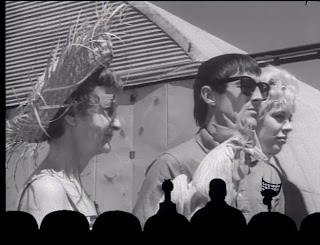 |
| Huck Finn and a guy holding a chicken. |
But what about The Skydivers? As bad as this movie is,
and make no mistake it is a bad movie, it does provide Mike and bots with
plenty to work with. From the poor acting choices, the odd pacing, hideous
editing, deranged musical selections, random characters appearing and
disappearing and the close up of flapping skydiver cheeks, the boys have a
great time with this one.
But all of Coleman Francis’
films have a very dreary feeling to them. Even when the film tries to shine a
little joy on the screen, it fails. I still haven’t been able to put my finger
on how he managed it, but Francis’ films are all dower. Skydivers ends on a down note, with Harry dying and Beth left alone
on the airfield. But the characters are so thin that it is impossible to care.
And yet, you feel that part of your soul has died along the way.
What I’m trying to say is
that all of Francis’ films can be stifling and overpower folks who are not
ready for them. The Skydivers is the
best of the bunch, but it still manages to feel depressing. This can make it
hard for some viewers to get past the pain of the movie and enjoy the riffing.
 |
Coleman Francis makes his cameo. The woman next
to him would appear in "The Beast of Yucca Flats". |
But Mike and the bots go
after the film full bore. They unleash a steady stream of riffs and use the
jumbled pacing and editing to their advantage, often delivering devilishly
quick quips for quick shots. One of my favorite is when a woman with a straw
hat is shown on the screen for about five seconds. Tom manages to use his old
woman voice and say, “I’m Huck Finn I tell you!” It’s delivered with perfect
timing and you almost have to jump back and see if you saw and heard that.
They boys mock the film
making elements in Skydivers. Crow
feels, “Someone with attention deficit disorder edited this film. Mike says,
“It seems like they forgot to have things happen in their movie.”
They tackle Beth’s complicated
hair, with a couple of good quips. When she nearly crashes a plan as she
attempts to take off Mike has her say, “I saw my hair in the mirror and I
panicked.” Later on Mike adds, “I predict that in the finale she jumps from the
plane without a parachute and her hair opens up!”
One of the airplanes has
what looks like a face, and Mike creates a Pee Wee Herman inspired voice for it.
He declares it Petey Plane and adds all kinds of silly comments to the proceedings.
 |
"Hey did Death come up and play chess with any
of you guys?" |
The party scene provides
some of the best riffing. All the bizarre folks give Mike and the bots so much
to work with. Crow is fascinated with the Amazon gal, and gets excited whenever
she’s on the screen. As we watch all the folks twisting to the music, the
camera gives us a nice long shot of a polka dot behind shaking. We keep
returning to this rear end and Tom observes, “Right here. That’s the butt of
choice”. Mike agrees, “Yes. It won the Palm de Butt at Cannes.”
I could go on and on but you
get the idea. There is a lot to work with here and even when Mike says, “It’s
not The Right Stuff it’s just some
stuff”, you get the feeling that there is more than enough stuff to make this
one heck of a riffing session.
 |
Mike is made ill after seeing Dr. Forrester's victory dance.
Nice outfits guys. |
The host segments in this
episode take a strange turn. Things start off with Tom Servo refitting himself
into a planetarium projector. Crow ruins the show by repeatedly asking about Uranus.
The Mads declare a swing choir competition! Everyone dresses up in hideous
costumes, sings silly songs and make general fools of themselves. It’s pretty
funny. At the first break, the bots attend an industrial arts class run by
Mike. Crow ends up not following proper safety precautions and cuts himself in
half. At the next break, Crow finds himself in a double jock lock – a feat that
has to be seen to be believed. He won’t ask for help, because this will come up
again and he needs to figure a way out. When we return from the theater the
next time Crow is admiring his new car. Tom Servo flies by in a plane and blows
it up. What a jerk! The final segment revolves around Tom and Crow both tangled
up in parachutes while Mike tries to read a letter. Not sure why they decided
to heap abuse on Crow, but there you go.
Even if the host segments
are all over the place, the short and the film make this episode a winner. The Skydivers provides plenty of laughs
if you are willing to accept the punishment of a Coleman Francis movie. But
things would only get more disturbing in their exploration of his bleak world.
I give this episode four
acid covered chutes out of five.
This episode is available on The
Mystery Science Theater Collection Volume 1.


 Also of note is Vladek
Sheybal as the chessmaster Kronsteen.
He plays the part slimy and confident, a good mix. We also get Walter Gotell as
Morzeny. I mention him because the
actor returned as General Gogall in TheSpy Who Loved Me and every Bond film up to The Living Daylights.
Here his character is more of a thug. I also have to mention that this film introduces Bloefeld as
the mastermind (and the first villain with an evil cat).
 Just watching From Russia with Love and not really
knowing much behind the troubled production, it comes across as a well-made
film, one that sticks fairly close to the novel, but is just different enough
to keep thing interesting. The
script was altered mostly in the case of the villains. In the novel, the Russians were the
masterminds behind the plot.
SPECTRE didn’t have anything to do with it. The addition of SPECTRE ties back to Dr. No and at the same doesn’t make this film too topical
(especially with the cold war in full swing at the time of its release).


