Showing posts with label virtual reality. Show all posts

Friday, June 20, 2014

Avalon (2001)

Introduction:
Between Ghost in the Shell and Ghostin the Shell 2: Innocence, Mamoru Oshii tackled a live action science fiction film. It wasn’t his first crack using a non-animated medium. But this was the first time a Japanese production team was going to film in Poland with a Polish cast and crew. You can bet this movie was going to be like nothing you’ve seen before.

Summary:
In a dystopian future, the game Avalon is a huge hit. It creates a virtual reality world at war, where players can team up to complete missions and win cash. The best players and teams can make quite a living off of the game. There’s just one little snag: it is illegal and dangerous. Players have been known to go insane or brain dead while playing.

Ash (Malgorzata Foremniak) is one of the best players of Avalon, but she always works alone. Once she was part of Team Wizard, but after a mishap the team disbanded with a lot of bad blood. One day Ash runs into a former teammate, Stunner (Bartek Swiderski) who claims that their old team commander Murphy (Jerzy Gudejko) attempted to access the ultimate level hidden within Avalon. Unfortunately Murphy is now a drooling vegetable. Ash decides that she will succeed where Murphy failed, attempt to find the secret level, and achieve the impossible prize – to see a world that lies beyond the game, a place that my truly be Avalon.

Good Points:
  • Wonderful cinematography and visual execution of themes
  • Creates an oppressive atmosphere for much of the running time
  • An impressive and often propulsive score by Kenji Kawai
Bad Points:
  • Some budget limitations keep the world from feeling complete
  • Oshii’s slow pacing and obsession with hound dogs returns
  • May actually have worked better as an animated film
Overall:
Oshii takes his exploration of perception of reality into the live action realm, and the results are impressive. He creates an atmospheric film with a lot of symbolism hidden away in the visuals. The action scenes do lack punch, and his slow pacing will drive some viewers nuts. But the final result is a film that creates an interesting world and characters that are hard to forget.

Scores (out of 5)
Visuals: 4
Sound: 4
Acting: 3
Script: 4
Music: 4
Direction: 4
Entertainment: 4
Total:  4

In Depth Review
Ash in her Avalon avatar mode.
Coming hot on the heels of The Matrix I remember this film suffering a lot in comparison to the big budget American blockbuster. I don’t think the advertising, which focused on the action scenes helped. Even anime fans who were familiar with Ghost in the Shell and knew something of of Oshii’s style (and quirks) were let down. Avalon just wasn’t the movie they were expecting. Yes, I’m putting myself in that camp.

My first viewing of the film left me puzzled by the whole experience and feeling that the director was spinning his wheels a bit. But the funny thing is, a lot of the imagery of the film stuck with me. I finally decided to revisit the film as part of my examination of Oshii’s work, and I was surprised by how much my expectations had hurt my initial viewing of the film. Seeing Avalon as a bridge of sorts between the two Ghost in the Shell films puts the whole thing in perspective.

Ash in the virtual reality interface for Avalon.
Let’s explore the plot before diving into the visuals, because thematic elements tie strongly to the style the Oshii attempted in this film. Ash is a true gamer. She wants to be the best player of Avalon, period. To do this, she must find the level: Special A. All the rumors she hears lead her to believe that a series of unique events must occur for the level to be revealed. She has to see a glitch in the game known as The Ghost. This ghost of a little girl must be shot, and then the player can proceed to Special A. But to even find The Ghost, the player must be part of a team that includes a character type called a bishop. But bishops are high-level players that rarely interact with teams. The second half of the film deals with Ash finding a bishop, joining a team and finally getting to Special A to complete the most dangerous mission.

The first half of the films follows Ash as she plays the game, showing us how good she is and how much she plays. We get a glimpse of her life away from the game, and how empty it seems. During this portion of the film she runs into Stunner, and we discover a bit about her past on Team Wizard. She visits Murphy’s brain dead body, and we see a hospital filled with glassy eyed bodies – other victims of Avalon? During these scenes we get to know Ash - a woman who always appears to be in control and confident with her place in the world. But it is also obvious that the events leading up to the break up of Team Wizard have impacted her.

The yellow tinged world of reality... or is it?
One of the most unique things about Avalon is the yellow filter used for most of the film. It appears in various degrees throughout the movie. When we are seeing Ash in her real life, the filter is lightly applied. The effect is that everything has a kind of washed out almost sepia look to it. Reds stand out quite a bit, but they are rarely seen. All the interfaces in the film are yellow or orange (a trait shared with Ghost in the Shell 2: Innocence).

But once Ash enters Avalon the yellow filter dominates the visuals. This world seems a bit brighter than the real world, but it is still a war torn place with ruins dotting the landscape. All the life we see in this world, including the trees, grass and other players is awash in this bright yellow light.

Eventually that yellow filter vanishes, and the result is remarkable. Colors that we’ve spent nearly an hour and half without bombard the viewer: blues, greens and purples. It actually reminded me of a similar event that occurred in Boogeipop Phantom, which saved the cooler hues for the final episode or key moments.

Ash exploring the secret level.
In addition to the stark color changes that occur in the film, Avalon differentiates between the three worlds with production design.  The level Special A: is essentially Warsaw in the year 2001. This is a vivid contrast to the broken down world Ash lives in, and even the gaming world, that is always filled with the smoke of war and shadowed by ruins. When Ash arrives in Special A, she is given an actual gown to wear and a symphony to attend. Things she would never experience in her world or with the normal game of Avalon.

The movie is essentially bookended by long sequences of Ash wandering her world. In the first half we see her in her regular routine, her gaming, and caring for her dog (whom she treats much better than she treats herself). It seems strange to spend so much time watching her do these things while the plot is in standby mode until she meets Stunner. But the scenes in Special A show us a mirror of the earlier scenes. In this case, Ash is not comfortable in her world, she is the outsider, and yet she is intrigued by what she sees. Foremniak plays it all very subtly, but her eyes show you that this world of Special A is something she falls in love with. Ash is a very different person in both these sequences, even if the sequences themselves seem all too similar.

The game of Avalon is a brutal one.
One of the main reasons Avalon was filmed in Poland was to give the movie a unique feel from typical Japanese films. It works really well, feeling like we are in a world that is unfamiliar. Warsaw has a very European feel to it, and Oshii selects locations that feel aged and lost. In addition Oshii was able to make a deal with the Polish military. So the tanks, helicopters and weapons you see in the film are real functioning equipment. This brings a level of realism to the game sequences.

But to keep things virtual, there are some computer effects thrown in. A few of the vehicles you see are obviously mecha designs, like the citadel machine that Ash and her team face near the end of the film. There is also a neat effect when players get killed in the game, they break into component digital parts. Very reminiscent of both Tron and Tron Legacy. There are also times when the visuals play with the computer imagery, like when Ash literally walks behind some smoke on the battle field and it all goes from a 3D immersive cloud, to a flat 2D set of pixels.

Ash takes no prisoners in the game world.
The budget constraints do peek through on a few occasions. The world seems very claustrophobic at times, but that works well with the story. It happens frequently enough that you get the feeling that there is more going on, but that they just didn’t have the budget to show it. The yellow filter does manage to hide the seams in some the scenes. The action scenes suffer in places because of budget limits. It often feels like Oshii is using edits to cheat around the fact that he couldn’t damage the borrowed equipment or the locations they were shooting at. It is just obvious enough to make those scenes feel a bit clunky, something that rarely happens in his animated films. For those reasons, I would be curious to see what Avalon could have been like in an animated format.

The acting is a bit hard to judge. I’ve seen this movie with the original Polish dub and English subtitles. For my revisit I watched the English dub. Like most of Oshii’s other films, there are some really talky sequences in this movie.  Watching the film in Polish feels more natural but keeping up with the subtitles can be a chore. The English dub is a real mixed bag. Most of the voice actors have Eastern European accents, and for some reason it just doesn’t work. I kept getting pulled out of the movie by the accents and the mismatched lip flaps. Usually I can look past that kind of thing, but this time it was tough. Still, the story seemed to flow a bit better with the English dub and I could focus more on Oshii’s visuals.

A haunting empty game world, but so similar to her
real one.
The sound effects work is pretty solid. Some of the in-game stuff is creative, and gives an additional element of the unreal. But the real star of the audio show has to be Kenji Kawai. This score is much like his score for Ghost in the Shell 2: Innocence – cold but driving forward. He uses some electronics in this score and it works wonderfully. But the big difference is where the Ghost in the Shell series used ancient Japanese songs as it’s base, Kawai focuses on an Eastern European symphonic sound. This fits Avalon like a glove and makes this one of his most accessible scores for an Oshii film. The final confrontation plays against a symphonic concert with some massive choral performances. It really works wonderfully in the film and also as a stand-alone listen. Kawai and Oshii work together so well, and this film really proves that.

Like Oshii’s other films, each element of filmmaking plays a part in the larger message and themes he is exploring. Once again we come back to perception of reality, a concept he has been exploring since Urasei Yatsura 2:Beautiful Dreamer. Much like Ataru in the dream jumping finale of that silly movie, Ash travels from reality to reality, seeking out an answer to a question she didn’t know she was really asking – which world is my reality? Oshii’s long scenes allow us to soak up the atmosphere and feel of each of the three worlds. And like Ash we begin to feel that Special A, must be the real world. It has all the color, all the excitement, all the “reality” that her life and her game doesn’t have.

"Hey there babe. How about a ride?"
And yet, there’s that hound dog again screwing things up. Why is this dog even in the movie? The easy answer is that Oshii is obsessed with basset hounds. But there is a thematic reason too. As I mentioned we see that Ash cares for her dog much better than she cares for herself. She gets it the best food she can afford. She obviously loves the little guy. When he disappears about halfway through the film, she becomes very distraught.

But Avalon throws us a visual curveball. The hound reappears in Special A, physically in a car passing by (but the camera makes sure we get a good look at him watching Ash). Then, a basset hound is featured on all the posters for the symphony where Ash makes her final reckoning with fate. Seeing her dog catches her eye and draws her to the symphony, sure. But why was the hound selected as the key image for a symphonic concert? Suddenly we have to wonder if this Special A world was built by Ash in a subconscious way. Or maybe it was designed to draw her into a trap. Remember she runs into Murphy in this world, but back in her home world, he is a drooling vegetable. Will Ash suffer the same fate if she stays here? Finally the hound could just be a visual clue the audience that Special A is where Ash will find what she’s looking for – her lost dog and her lost life.


Ash entering the final level? Or ending her life?
Oshii’s movie is like much of his other work. You’ll either enjoy his visual style, his slow evolution of the story and the lengthy dialogue scenes that seem a bit too full of exposition. Or you’ll find the whole thing to be dull and visually unappealing. For some folks the yellow filter is going to be too much to get around. I think that Avalon is a unique film, and one that has a lot of interesting elements. It stands out from the crowd and I certainly found it to be one of the more intriguing science fiction movies I’ve seen in the new millennium. It makes a perfect double feature with David Cronenberg’s eXistenZ.

Tuesday, January 21, 2014

Tron (1982)


Introduction:
Back in 1982 this movie must have seemed like a long shot. But Disney's animation had fallen on hard times, and the company was trying all kinds of unique stuff to get their name back in the theaters. Not all of it worked (Watcher in the Woods I'm looking at you). For some folks the animation and films from this period in the company’s era are a dark mark. But in so many ways Tron was ahead of its time, and yet it was timeless.

Summary:
Kevin Flynn (Jeff Bridges) has a score to setting with SVP of Encom corporation Ed Dililnger (David Warner). Dilinger stole some of Flynn’s innovative video games and passed them off as his own. Flynn left the company in a rage, but has been trying to hack into Encom’s system to find proof of the theft ever since. Unfortunately, Dillinger’s new Master Control Program (MCP) is blocking him at every turn. So Flynn enlists the help of fellow programmers Lora (Cindy Morgan) and Alan (Bruse Boxleitner). But before you think this is going to be about corporate espionage, things get wild.

The MCP isn’t going to take any of Flynn’s shenanigans and uses a laser to suck Flynn into the computer (it was the 1980s and lasers could do anything). Now Flynn finds himself in a digital world where programs live their lives to serve their users. In this world the MCP is a tyrannical despot that rules with an iron fist. His minion Sark (also David Warner) captures trouble-making programs and makes them play in video games, until they are destroyed. Flynn teams up with two programs Tron (Boxleitner again) and Ram (Dan Shor) to escape from the game grid and contact “Alan 1”. With a program upgrade Tron may be able to shut down the MCP once and for all.

Good Points:
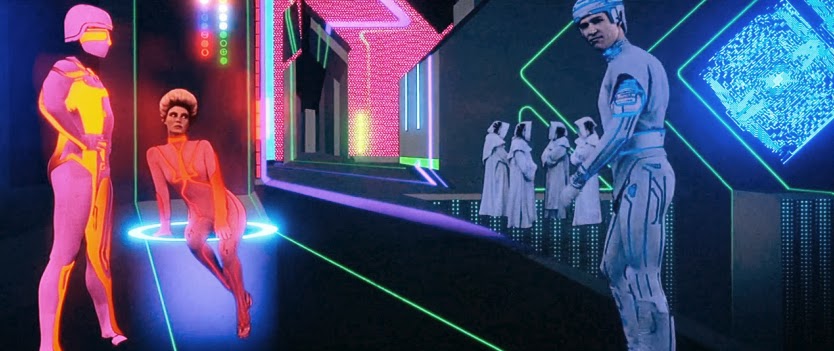
  • An amazing visual look for the virtual world
  • Uses the standard hero’s quest to make the concept more accessible
  • An innovative and fitting score by Wendy Carlos 
Bad Points:
  • Takes forever and a day to really get rolling
  • Over-explains the premise (for the less computer savvy folks of 1982)
  • May be too silly in concept for some viewers. 
Overall:
For me Tron is an amazing feat of creativity. It is a visual wonder, especially considering it was made in 1982. It commits to its premise (no matter how goofy it may see) and sells it completely with a complete world created in visuals, sounds and music. The basic story is a hero quest, and yet there is an overlay of spirituality at it’s core that adds another layer to the film. It’s slow start with heavy exposition can be a chore to get through, and the final stakes (stolen video game ideas?) may seem a bit petty, but all in all it’s an impressive film that was way ahead of it’s time and is still entertaining.

Scores (out of 5)
Visuals: 5
Sound: 5
Acting: 3
Script: 3
Music: 4
Direction: 3
Entertainment: 4
Total:  4

In Depth Review
A image that could only come from the 1980s.
When I saw Tron in the theaters in 1982,  was a kid, still in elementary school. I thought it was the coolest damn thing I’d ever seen. And that means it even surpassed The Empire Strikes Back as my favorite movie for a while. I’m sure Return of the Jedi a year later supplanted it, but I never forgot Tron and the movie has been a favorite ever since.

Watching it now, I’m simultaneously blown away by how ahead of its time it was, and how quaint it seems. This movie predated all the hacker, virtual reality and “cyber” films of the late 1990s and early 2000s. It’s the first movie that I know of where the heroes are nerdy cubicle drones. No other movie at the time embraced the Atari video game revolution in quite the same way. So in that way it predates all those video game films that flooded cinemas in the 1990s. And as entrenched in technology as the film is, it deals with spirituality and freedom: including freedom from technology.

Revenge of the nerds, indeed!
While computers had been around for decades before this film, they hadn’t taken over a story in a major film before. And not only computers themselves, but the corporate culture that surrounded them.  In some ways, Tron and The Matrix share the same basic DNA. Both are about rogue corporate cube drones that find a virtual world where they are believed to be something more powerful than the oppressive (and mechanical) beings in control of the world. With two decades of computers, video games and anime to work with the audience of 1999 was willing and able to keep up with The Matrix and the additional layers it added to the theme. But in 1982, these concepts were cutting edge. Even novels like William Gibson’s Neuromancer, wouldn’t come out till 1984. And Gibson’s novel is often considered the birth of cyberpunk, which Tron could easily fall into.

So I believe part of the reason the film didn’t resonate with people is that it just didn’t seem to be part of their lives. By the time The Matrix rolled around, nearly everyone had a personal computer or video game system of some kind, and the internet was becoming a fixture in public consciousness. People were comfortable with idea of programs, hackers, discs and system upgrades.

Atari meets Star Wars with a heavy dash of 80s neon
and fluorescents.
But beyond that Tron does have some issues that keep people from enjoying it. The biggest is that it takes a long time for Flynn to get into the computer world, and for the action and visual wizardry to really kick in. We get a couple of teasers showing the computer world, but they happen quickly and probably confused folks when they first saw the film. After these glimpses, we get a long series of scenes discussing corporate politics, scientific lasers, and a visit to Flynn’s arcade in all its early 1980s glory. All this exposition moves at a snails pace in an attempt to hold the hands of viewers were probably novice computer users. The side effect is that the pacing in the first third really drags.

The other issue with the film is that the basic story that occurs inside the computer is your typical hero myth, the same on we’d seen done in Star Wars, and that made the huge impact on genre storytelling. The band of heroes fighting against a tyrannical rule was already a staple, and was feeling a bit stale to some viewers. Added to this is the fact that Tron is a pretty straight arrow character. He wants to do what is right, always chooses the best path and is frankly a bit bland. He’s certainly a hero of the 1950s mold, square jawed, and honest.

The deadly Recognizers swoop in for the kill.
Contrast this to popular heroes of the early 1980s. Luke Skywalker was also a good guy, but in Empire Strikes Back we saw his impatience, his over confidence and self doubt make him more human and relatable. Then there were Harrison Ford’s two characters, Han Solo and Indiana Jones. Both were characters with shades of grey to their occupations, rough and ready, but also capable of making mistakes. Tron has no shades of grey, and doesn’t make mistakes. He’s just too perfect to be interesting.

In that aspect Tron feels old fashioned, a criticism thrown at the other sci-fi epic Disney attempted in the same era The Black Hole. But I think this was done to directly counter the bizarre and unique world being created. It was an attempt to give the audience something relatable beneath all the visual pop. This same approach is what George Lucas achieved with Star Wars.

In the 1980s, if evil had a name it had to be
David Warner.
Here’s the thing, even though the film is named after Tron, he isn’t our protagonist. He’s a supporting character to Flynn. Flynn is much more in the mold of the 1980s hero. His laid back attitude masks an intensity about his work. Bridges does a good job playing the part, really lighting up when he describes his past work, or when he’s hacking into Encom. Otherwise, Flynn tries to play it cool, even when he’s in the game world. But his amazement and enjoyment of the world around him comes through. Flynns goal becomes surviving and escaping the computer world. But he also sees the dangers of the MCP and how it’s tyrannical hold over the “free programs” is wrong.

On top of this, Flynn is a user transported to a computer world. Essentially, he’s a god among mortals. At first he keeps this fact to himself, but begins to use his powers to manipulate the world around him. It’s these powers that set him apart from his fellow travelers. While Flynn doesn’t have a huge personal change in the film, we do see him develop feelings for the programs. He tries to save and help them, not just because it will help him in the long run, but because he sees them as real people. He tries to give some comfort to a dying Ram midway through the film. He accepts his role as a god like avatar and makes a sacred promise (of sorts) to help Tron defeat the MCP.

Tron prepares to contact his "user" using a floppy...
sorry identity disc.
Tron is filled with spiritual dialogue and imagry. The input/output towers are like churches, where programs can communicate with their users. The entire scene where Tron contacts “Alan 1” is filmed and musically scored as a moment of a being touching his creator. The more we and Flynn see of this, the more we understand how important his placement into this world is. The MCP could not have made a worse enemy than to bring a living god among an oppressed people. The film even ends with Flynn sacrificing himself to destroy the MCP.

Flynn’s powers are the only thing that set him apart from the other programs.  His personality also makes him unique. Tron, Yori and Ram are all single note characters, but that is because they are programs with one function. They maybe put in different circumstances and deal with those circumstances as best they can, but unlike their human counterparts, we don’t see much variation in their responses to events. In fact some of the looks they give Flynn reflect how odd they see him.

Flynn faces a difficult choice in the climax
of the film.
In this aspect I have to give props to Boxleitner and Cindy Morgan, who give their human roles and program roles very different approaches. I like how Boxleitner gives Alan a bit of nerdy anger, first at being shut out from his pet project and then that he has to interact with his girlfriends ex-boyfriend. It contrast well with Tron’s no-nonsense heroic attitude.

As a whole the acting in Tron works well. Bridges gets the juiciest part, and seems to be having a blast In the role. Playing counter to him is David Warner, the go to actor for villainous roles in the 1980s. Here he provides three performances. He’s calculating and cold as Ed Dillinger. He’s brutal and ruthless as Sark, the physical villain in the computer world who does his best to kill Tron and his cohorts. Warner’s voice was also digitized and used as the MCP. The phrase “End of Line” in the deep digital baritone became an Internet meme nearly two decades later.

The light cycle race has become an iconic moment
in 1980s film scenes.
Perhaps the element of Tron that I appreciate the most is the complete world they created for the film. Inspired by arcade games from the early 1980s, neon colors and the futuristic design of Syd Mead and Jean ”Moebius” Giraund, you have a movie that looked like nothing before and nothing really afterward (and I’m including Tron: Legacy in that statement). The innovative set and vehicle design is really something else.  Everyone remembers the light cycles from the film, but the tanks and recognizer vehicles are just as impressive. I also like Sarks huge airship that ranks right up there with Darth Vader’s Star Destroyer in intimidation value.

The costumes are creative, but sometimes seem a bit silly. I love the glowing circuitry on the bodies, and the guard characters look really cool in their faceless approach. But Sark’s headdress seems a bit elaborate, and Dumont’s (Barnard Hughes) bishop inspired hat is more phallic looking than anything else. His appearance always makes me chuckle, even though I know that’s not what was intended. Then there’s the odd ball programs Flynn runs into later in the film: very creative looking, but incredibly silly all at the same time.

The Las Vegas of the Grid, Flynn is a stranger in a
strange land.
But the digital artists that created the computer world did some amazing things with Tron. The whole thing has a scope to it that feels enormous and real. Vistas seem to stretch into infinity with moving lights and various landscapes. The entire solar sailor sequence is an amazing example of early computer animation used to create a whole world. We constantly see things that hint at further adventures around a corner, or another story taking place down another energy beam. This ranks right up there with the worlds created for Star Wars and Blade Runner in completeness and visual interest.

To match this are all the sound effects for the world. This wasn’t just creating a digitized voice for the MCP. It was creating and altering sounds for everything we see on the screen. The only real guide was that this had to sound like it occurred in an arcade game of the period. They nailed it, with the light cycles, tanks and recognizers each making unique and creative sound effects. Sark’s massive ship gets the appropriate rumble of course. But other things like the sounds of the discs and even characters derezzing lends to the feel that this is it’s own world, with it’s own rules. Even the characters footsteps sound different in this world.

Traveling by Solar Sailer always looked cool!
The final element was the musical score. Innovative electronic music artist Wendy Carlos was brought on board. She had worked on films before, notably on Kubrick’s A Clockwork Orange and The Shining. But this may be her most innovative and impressive score. She took the sounds and “music” of the arcade and Atari games of the time, and fused those electronic sounds with a full orchestra. She creates a theme for Tron, an action motif and a wide array of minor themes that pop up during the film. The music becomes a very real part of the world, crossing the line into sound effect and then back. Her piece for the end credits integrates a full organ for the added tie to the spiritual aspect of the story. All told, her score to Tron is one of the most unique of the 1980s and a perfect fit for the film (as are the two songs provided by the rock group Journey).

For me the only real downsides are the direction and script. I know part of the difficulty in making this film was ensuring the audience of 1982 would be able to follow it. The results were mixed, some folks were still confused by the film, other found it too slow going in the first third. These days it comes across a bit quaint and clunky in places. But I think that all in all it works fairly well but could be polished a bit more, made a bit tighter and it might be remembered fondly by more folks.


I know nostalgia plays a big part of why I love watching Tron. I hadn’t seen it in many years, but when Tron: Legacy came out on DVD they had a nice package with the original film. So I watched it and was surprised by how well it held up and how distinctive and complete the world they created for this film was. Many elements of visual effects were pioneered in the late 70s and early 80s, and some of them didn’t survive the computer graphics revolution of the 1990s. But Tron provides a glimpse of a fusion of both types of effects work and how they can be used together to provide an amazing whole. This is something Peter Jackson used to great effect in his Lord of the Rings trilogy, and obviously films like The Matrix and Ghost in the Shell were influenced more directly by Tron. So if you haven’t seen this film in a few years, I recommend you give it another chance. I think you’ll be surprised by how good it actually is.

Monday, September 16, 2013

Paprika - 2006


Introduction:
Back when Inception came out in theaters audiences were thrilled by the concept of dream warriors diving into other people’s dreams and obtaining secret information. But anime fans felt like they had seen this story only a few years earlier. Where director Christopher Nolan kept a tight rein on the rules and dark visuals of his dreamscapes for Inception, director Satoshi Kon used the chaos and surreal nature of dreams to create a dynamic and colorful world where anything can happen. While the two films share many elements in common, Paprika is just as spicy as it name hints, and way more unhinged.


Summary:
Dr. Chiba (Cindy Robinson) and her colleagues have created the ultimate dream machine – the DC Mini. Put this little device on your head and you can experience another person’s dreams (as long as they have a DC mini on their heads). Not only is this a fun party favor, but it can also be used to help people with psychological problems and stress relief.

Then someone steals the prototype and begins messing around with it. Not all the controls were in place yet, and anyone who’s already used the DC Mini is now susceptible to experiencing a full-blown waking dream. Chiba and her team must find out who stole the DC Mini and stop them before they break down all the barriers between the dream consciousness and the real world, as we perceive it. Luckily there is a dream warrior named Paprika (Cindy Robinson again) who has a little experience in these matters. But is she in over her head?

Good Points:
  • Amazing animation makes the dream world come to life
  • Balances humor and action very well
  • Has some great creepy moments

Bad Points:
  • A few too many characters weakens some of the storylines
  • Some of the English voice acting is not up to the task
  • The ending is anticlimactic

Overall:
Kon takes many of the themes and concepts he explored in Paranoia Agent  and refines them down to a tighter story. The result is more coherent and streamlined, and yet still a bit clunky. Visually the movie is amazing, with Kon flexing his surreal muscles to great effect. But the ending falls a little flat. Still this is one of my favorites by the director and well worth seeking out.

Scores (out of 5)
Visuals: 5
Sound: 5
Acting: 3
Script: 4
Music: 5
Direction: 5
Entertainment: 4
Total:  4


In Depth Review
There is a riddle to be solved, but Paprika doesn't
have the answer.
In many ways, Paprika is the culmination of the imagery and themes that fascinated director Satoshi Kon. It deals with perception of reality and the way dreams fit into that reality. It deals with questions of identity, is the real person the one in the dream or the one that is awake? It deals with our ideas of the future and how it can twist into something we didn’t expect or want. And it does all this while moving at a breakneck speed, exploding with creative visuals and delivering thrills, chills and laughs.

Of all the films by Kon, this appears to have the largest budget, and that makes the visuals some of the most impressive in his cannon. His character design remains familiar, and you’ll see faces you recognize from Millennium Actress or Paranoia Agent playing different roles here. But there is a cleanness to the design that was lacking in the earlier works.

Sure people talking on cell phones in a movie theater
are annoying, but this dream parade is something else!
But my favorite moments are the dream sequences, where Kon always excels. The movie opens with a dream circus, as the police inspector Konakawa (George C. Cole) finds himself searching the big top for a criminal. As he cases the area we start to notice little things are off. An obvious male clown speaks with a woman’s voice, a mask on the back of a child’s head suddenly has eyes and watches him. Then the ring master points at Konakawa and he is bathed in a spotlight. He blinks in the glare of the light and then finds himself in a cage in the center ring, like a circus lion. Before he can react the crowd rushes him, and in a scene inspired by Being John Malkovich all the onlookers have his face – including women and children. They start to paw at him through the cage and the ground suddenly becomes soft, as he sinks into it amid the roaring crowd we can see the terror on his face.

So yeah, Kon captures the nightmare feeling perfectly. His visuals continue in the same vein, often mixing subtle surreal moments with over the top explosions of colorful animation and bizarre imagery. He maintains his technique of keeping the viewer off balance by shifting sequences, often in mid-line or as the camera turns. Because we are often in the dream world (or in the real world as the dreams start to leak in) it all makes some kind of sense. I marvel at his ability to perform these visual slights of hand and yet never lose the audience, and we’ve seen his skill at doing this from the beginning with Perfect Blue.

The deeper Paprika delves into dreams, the darker
they can become.
Perfect Blue got pretty twisted visually, but Kon’s films have never delved into the darkness too much since then. Well Paprika changes that. Nightmare images abound and there are some great creepy moments: the worst being when Paprika is captured and abused by one of the villains. The man is essentially reaching into Paprika and pulling out the naked and helpless woman inside. It is basically a rape of the consciousness playing out In front of us.

But contrast that to some of the scenes where you can tell Kon and the animators are just unleashing the creativity. The dream parade is one of those sequences that will probably stick in your mind whenever you think of the film, because it is so strange, colorful and unique that you can’t help but be impressed with it. Hundreds of fantastical characters dancing, cavorting and flying around down the center of Tokyo is not something you see in any movie very often. There are also scenes where the character revel in the freedom of the dream world, like when Paprika flies into Tokyo for the final confrontation, or when she jumps from sign, to computer screen, to truck artwork to t-shirt during the opening credits. There’s a playfulness in these scenes that invites the viewer to sit back and enjoy the ride.


To go along with the surreal images, Kon’s sound team goes into overdrive to combine the real world sounds with warped, altered and synthesized sounds to put everything off kilter. It’s really a masterful job and it adds quite a bit to the feeling that you are witnessing some bizarre dreams playing out in front of you.

Dr. Chiba explores an abandoned amusement park.
But is she awake, or deep in a dream?
But one of the big heroes of Paprika is composer Susumu Hirasawa. He sticks to his typical style of using electronics and synths to create a series of musical vignettes. Kon then used these to build into his film, taking pieces here and there to flesh out the whole film. Hirasawa does some interesting work with human voices (his own in many cases) editing, warping and layering them in various tracks over the orchestral samples and pure electronics. It’s an eclectic mix, but it works wonders in the film and it unique to the film. Because of the nature of the film, some of the material gets very atmospheric and dark. But the parade tracks, and the theme for Paprika herself are gems. I think found Kon perfect musical collaborator in Hirasawa and it’s a shame we won’t get any more collaborations.

In many ways Paprika is like a summary of Paranoia Agent in a thematic sense. It takes many of the same elements and ideas and concentrates them down into a single slick story. Without all the characters fighting for attention and different side roads that Kon went down in the television series, Paprika is both more focused and dynamic than the television series. Dr. Chiba and Paprika are the main characters, but the way they interact with Dr. Tokita (Yuri Lowenthal) and Dr. Osanai (Doug Erholtz) affect perceptions by all three characters.

Konakawa literally finds no footing as the dream world
warps around him.
The first couple of times I had a problem with the character of Inspector Konakawa, who seemed to be added into the film as a kind of heroic figure to swoop in at the end and save Paprika. And while that does seem to be the case, there is more going on. Much like Tokyo Godfathers, Konakawa explores the concept of dreams in the sense of aspirations. As a young man Konakawa dreamed of becoming a famous film director (Akira Kurosawa is directly referenced in the film). But life’s path lead him to police work. However his job is causing him serious anxiety issues, which is why he is working with Paprika using the DC Mini and dream therapy. And while Konakawa’s journey seems to be running along side the main story, instead of intersecting it, the final moments of the film deal with him. I love the nod to Kon’s previous films appearing as posters in the movie theater Konakawa visits at the end.

Always remember, in a dream, the difference between
falling and flying is a matter of perspective.
Aside from that there is also the issue of the finale. I’ve never been a big fan of the ending. From a thematic and conceptual point of view it should work, but the execution seems a little too easy in the end. It feels anticlimactic, and a bit of a letdown after all the different things we’ve seen up to that point. In fact Paprika’s amazing escape from the main villain seems to promise something a bit more. But then again, there is a giant naked woman on the screen, so that will be a great finale for some viewers.

These two elements keep the film from really nailing a top-notch grade. Paprika ends up being a bit uneven in the final analysis. I really enjoy it each time I watch it, and I love how Kon really got down to the center of the themes he’d been working on since Perfect Blue. But in the end I think Millennium Actress had a bit more heart to it. Still for a swan song, Paprika shows the animator developing his abilities and heading toward something more interesting. It’s a shame we didn’t get any more work after this.

Dr. Chiba chats with Paprika. But which is real
and which is the dream?
Let’s return to the original question, was Paprika better than Inception? I firmly vote for a big “Yes!” Nolan’s films always feel distanced and a bit cold to me. The fact that such strict rules were imposed on dreams in Inception took away from the very fact that they were dreams. It is the unpredictability of dreams that makes them so appealing and horrifying. It is something that Kon grasps very well and indulges in his film. Nolan did explore how choices can affect the subconscious and create serious mental problems. In Paprika we have a similar situation with Inspector Konakawa. And in this aspect, I think Nolan’s use of the character is better integrated into the story and works better with the ending. With that said, I enjoyed Inception. I still think it is Nolan’s best film. But compared to the wonderful world created by Satoshi Kon, well let’s just say I’d rather have Paprika visit my dreams instead of Leonardo Di Caprio. I think she’d be more fun.