Showing posts with label 1982. Show all posts

Friday, November 8, 2019

Score Sample: The Dark Crystal (1982)

2019 brought us a new television series based around the 1982 fantasy adventure The Dark Crystal. The television series outlines the events that lead up to the situation Jen and Kira find themselves during the earlier film. So yeah it is a prequel of sorts, but I'm just happy to see the amazing puppetry and sets brought to life. As a kid, I adored The Dark Crystal, as well as it's younger sister Labyrinth. So I've been enjoying the series quite a bit (still working my way through it at this point).

One thing that I don't think has been improved on is the amazing score from the 1982 film by Trevor Jones. In a lot of ways this is one of those forgotten fantasy scores that really deserves more attention, kind of like the work on Young Sherlock Holmes. Jones created a myriad of themes for The Dark Crystal and nearly every one of them is memorable in some way. He interweaves the themes all through the film and gives the world its own unique flavor.

He wrote a wonderful Overture piece that I'll share today, but really the whole score is worth seeking out for fans of big colorful fantasy adventure scores. It might even be my favorite work by Jones. So here is Overture from The Dark Crystal by Trevor Jones.


Tuesday, September 12, 2017

Movie Musings: The Strange Journey of the Star Trek Films - Part 1

Part One - The Original Series Cast

"So a Klingon, a Romulan and a Vulcan walk into
a bar..."
It is hard to argue Star Trek's legacy within pop culture. It’s characters and universe have endured almost as long as James Bond.  Every time I think we can count the franchise as down and out, along comes a new incarnation to bring it back to whole new group of fans yearning to explore strange new worlds.

One of the interesting things about the franchise is that its longevity is due in large part to the success of the feature films that were released starting in 1979 with StarTrek: The Motion Picture. While the television series is where the franchise started, if the films were not as successful as they were, Star Trek would be a fondly remembered relic of the 1960s.  In addition, we can see how Paramount, the studio that owns Star Trek, feels about the series depending on how they approach the films.

I think Decker wants his chair back.
In this two part blog, I’ll take a look at the ways the films were impacted by and impacted the franchise, and why they are important to its legacy. I won’t be going into too much detail on my thoughts on the films, but I will discuss critical reception (and perception of that reception) and how that affected the films.

The original series ended in 1969 after three seasons. While it was popular among science fiction fans, it never really exploded in popularity during its run. Instead Star Trek got syndicated and that is where the fanbase really started to grow. During the 1970s it was hard to avoid a rerun of Star Trek and even growing up in the 1980s, it felt like the series was always around.

Wait! There was a cat girl in Star Trek the Animated
Series! Sign me up!
An animated series followed in 1973 and 1974 that expanded the voyages a little bit, and allowed the writers to take the series in directions that would have been impossible with live action.  All this exposure of Star Trek in the 70s inspired Paramount to look into creating a new series of adventures with the same crew for Phase II. Production started and then a little movie called Star Wars erupted onto the screens, and suddenly Paramount shifted gears to turn Star Trek into a film franchise.

The increased the budget to a whopping 35 million dollars (of 1970s money). They pulled in acclaimed director Robert Wise and got their marketing into high gear. This was the turning point. If Star Trek: The Motion Picture was a failure, than the franchise was dead.

The moons of Vulcan are affecting her mind!
Critical and general response was average. But the combined fanbase of the 60s and 70s had been thirsting for new Star Trek adventures, and they went back to the theaters over and over again to see the film. For all it’s faults The Motion Picture has a huge visual scope, impressive visual effects and a wonderful soundtrack by Jerry Goldsmith. Seeing it in the theater is a real experience (one I actually had the pleasure of revisiting in 2012). There was also a frenzy of interest in space adventures because of Star Wars, so I bet a lot of little kids dragged their parents to see the film. In the end, the Motion Picture was a financial success.

Paramount felt confident in continuing the series as a film franchise, and moved forward producing Star Trek II: The Wrath of Khan. But they reduced the budget to a little over 11 million, and asked director Nicholas Meyer to make sure there was more action in the film (a criticsm of the previous film they wanted to avoid). Meyere delivered a film that is more visceral, goes back to the roots of the original series, and cranks up the action with some excellent visual effects and high stakes. The Wrath of Khan was an immediate hit, with excellent critical response and fan approval. It also did very well on VHS, a new medium that studios were just beginning to explore in 1982.

"Is that a giant worm in your hand, or are you just
happy to see me?"
So Paramount kept the same focus when it came to The Search for Spock in 1984. Once again the budget was increased to 17 million. But the focus on characters and the quest to bring Spock back to life helped pull viewers in the theaters to find out how it was all going to shake out. Director Leonard Nimoy obviously knew the series inside and out, and crafted a solid follow up to the previous movie. The film got average critical response and most people enjoyed it well enough. But the film had a dark undertone that surprised many viewers.

Do you think he's using colorful metaphors here?
Gears were shifted in the storytelling for the next film, Star Trek IV: The Voyage Home. Nimoy was back at the helm and the budget was given a bit of a boost (to 25 million) for some really impressive visual effects by Industrial Light and Magic. But the script involving time travel, saving the whales, and the crew interacting with the denizens of San Francisco circa 1986 was a blast. It was a fun movie with plenty of laughs and adventure all mixed together. Critical response was full of praise. But it was the success of the film with a wider audience that gave Paramount a view of what a successful Star Trek franchise could be. This was the most financial successful Star Trek film until the reboot in 2009.

In 1987, Star Trek: The Next Generation arrived on television screens. It was a new cast, new starship, hell it was a new century! Paramount understood that in order for the franchise to continue it would need to evolve. To do this, they needed to inject it with new blood creatively. Obviously the film franchise was still profitable, but a new television series could create new fans and lead to a new series of films.

It is like that Depeche Mode song, reach out and touch
face.
1989 brought the first good season of The Next Generation after its rocky start over the first two seasons. Meanwhile Paramount attempted to strike gold in the theaters again with William Shatner directing Star Trek V: The Final Frontier. Unfortunately the film was plagued with production issues, and arguments over the direction and tone of the script. Shatner wanted to go darker and more intense. Paramount wanted to keep it light and fun. The end result was a film that was critical and financial failure. Fans disliked the film for a whole host of reasons and rumor is that even Gene Roddenberry felt the film was not part of the official cannon. The movie also had the unfortunate release during one of the most crowded years in movie history. Batman, Ghostbusters 2, Indiana Jones and the Last Crusade and Back to the Future Part 2 were all battling for seats in the multiplexes. Someone had to lose and Star Trek “won” that honor. While it did eventually recoup it's 28 million dollar budget, no one was really pleased with the final film.

"No, it's not Tribbles. The joke only works if
the Klingon asks the bartender first."
This did set off alarms at Paramount. They wondered if the aging cast was losing their audience appeal. But they also learned some lessons. Budget cutting your special effects heavy films is not a good option. So they turned back to Nicholas Meyer who did so well with The Wrath of Khan to helm Star Trek VI: The Undiscovered Country. In a cunning bit of synergy, the plot for the film directly impacted events in The Next Generation episodes Unification with Nimoy making a special appareance as Spock in the two-part adventure. Meyer brought back high stakes, tension and excitement to the series. The plot was inspired by world events, and with the increased budget (to 30 million) the movie looked great. Meyer’s script balances humor and tension better than the previous film did. Even with all that, the movie was also declared the final voyage of the full cast from The Original Series. All those elements stirred together made The Undiscovered Country a critical and financial success in 1991.  It was a win for Paramount and the franchise. But everyone knew it was time to switch gears.

In part two of this post, I take a look at the trails and Tribble-ations of the films featuring the case of The Next Generation and Beyond...


"Just imagine it. We are all animated, and there's
a cat girl in a red uniform! That is my vision."

Thursday, November 10, 2016

Score Sample: The Beastmaster (1982)

Continuing to listen to a lot of fantasy film music from the 1980s as I work on my fantasy novel for National Novel Writing Month. So many good scores to pick from, it gets tough to settle on what to listen to for the evening. I picked up the score to The Beastmaster earlier this year, and I've had it on pretty regularly while working on the background and the novel itself.

The score to The Beastmaster was written by Lee Holdridge, a composer you don't hear too much about these days. He never became a huge name like Williams, Goldsmith or Horner, but worked steadily over years, eventually moving from films to television miniseries where he was nominated and won a number of Grammy awards in the 90s and 00s.

His score to The Beastmaster is similar if feel to Clash of the Titans, and features a great heroic theme as the main focal point. It is very memorable and certainly one of the top themes of the genre in this decade. Holdrige also created some unique themes for the playful ferrets that feature in the film, as well as romantic love theme. He has some robust action music as well. This is a great score to write to, and I'm very happy to have it my collection. The deluxe version contains the score as it appears in the film, as well as the unique tracks performed and edited for the original album release in the 80s. There is also an excellent suite designed and rerecorded by Charles Gerhardt on there. It's a great package for any fan of the score.

So here A New Kingdom from Lee Holdrige's impressive score to The Beastmaster!


Friday, December 5, 2014

Score Sample: Blade Runner

When it comes to electronic scores, especially in the 1980s, you really couldn't escape Vangelis. The man had been working with electronic soundscapes since the 1970s, and had scored a documentary or two. But his real break hit in 1981 with Chariots of Fire. The score was popular and won him an Academy Award for best film score. Now you could argue the appropriateness of the music for the subject matter of the film (and how it could have beat the score to Raiders of the Lost Ark), but that is not the subject of today's blog.

Instead I want to talk a bit about his score to Ridley Scott's Blade Runner. Scott is one of those directors who is not very good with his score choices (at least for most film score fans). But I can't argue with his selection of Vangelis for this film. Blade Runner relies heavily on its mood and atmosphere. A huge part of that comes from Vangelis' score. Almost completely electronic, the score uses a mix of dissonant material, middle eastern singing, noire style blues and even an old tyme 30s radio show ballad. The result is a score that is very much part of the world it evokes. While I think Jerry Goldsmith could have composed something just as interesting for Blade Runner, I just can't imagine the film without Vangelis' score. The two are really linked together. Here is one of my favorite tracks, the synth sax tune called Blade Runner Blues, and this video includes shots over modern Tokyo just for kicks. Enjoy!


Tuesday, January 21, 2014

Tron (1982)


Introduction:
Back in 1982 this movie must have seemed like a long shot. But Disney's animation had fallen on hard times, and the company was trying all kinds of unique stuff to get their name back in the theaters. Not all of it worked (Watcher in the Woods I'm looking at you). For some folks the animation and films from this period in the company’s era are a dark mark. But in so many ways Tron was ahead of its time, and yet it was timeless.

Summary:
Kevin Flynn (Jeff Bridges) has a score to setting with SVP of Encom corporation Ed Dililnger (David Warner). Dilinger stole some of Flynn’s innovative video games and passed them off as his own. Flynn left the company in a rage, but has been trying to hack into Encom’s system to find proof of the theft ever since. Unfortunately, Dillinger’s new Master Control Program (MCP) is blocking him at every turn. So Flynn enlists the help of fellow programmers Lora (Cindy Morgan) and Alan (Bruse Boxleitner). But before you think this is going to be about corporate espionage, things get wild.

The MCP isn’t going to take any of Flynn’s shenanigans and uses a laser to suck Flynn into the computer (it was the 1980s and lasers could do anything). Now Flynn finds himself in a digital world where programs live their lives to serve their users. In this world the MCP is a tyrannical despot that rules with an iron fist. His minion Sark (also David Warner) captures trouble-making programs and makes them play in video games, until they are destroyed. Flynn teams up with two programs Tron (Boxleitner again) and Ram (Dan Shor) to escape from the game grid and contact “Alan 1”. With a program upgrade Tron may be able to shut down the MCP once and for all.

Good Points:
  • An amazing visual look for the virtual world
  • Uses the standard hero’s quest to make the concept more accessible
  • An innovative and fitting score by Wendy Carlos 
Bad Points:
  • Takes forever and a day to really get rolling
  • Over-explains the premise (for the less computer savvy folks of 1982)
  • May be too silly in concept for some viewers. 
Overall:
For me Tron is an amazing feat of creativity. It is a visual wonder, especially considering it was made in 1982. It commits to its premise (no matter how goofy it may see) and sells it completely with a complete world created in visuals, sounds and music. The basic story is a hero quest, and yet there is an overlay of spirituality at it’s core that adds another layer to the film. It’s slow start with heavy exposition can be a chore to get through, and the final stakes (stolen video game ideas?) may seem a bit petty, but all in all it’s an impressive film that was way ahead of it’s time and is still entertaining.

Scores (out of 5)
Visuals: 5
Sound: 5
Acting: 3
Script: 3
Music: 4
Direction: 3
Entertainment: 4
Total:  4

In Depth Review
A image that could only come from the 1980s.
When I saw Tron in the theaters in 1982,  was a kid, still in elementary school. I thought it was the coolest damn thing I’d ever seen. And that means it even surpassed The Empire Strikes Back as my favorite movie for a while. I’m sure Return of the Jedi a year later supplanted it, but I never forgot Tron and the movie has been a favorite ever since.

Watching it now, I’m simultaneously blown away by how ahead of its time it was, and how quaint it seems. This movie predated all the hacker, virtual reality and “cyber” films of the late 1990s and early 2000s. It’s the first movie that I know of where the heroes are nerdy cubicle drones. No other movie at the time embraced the Atari video game revolution in quite the same way. So in that way it predates all those video game films that flooded cinemas in the 1990s. And as entrenched in technology as the film is, it deals with spirituality and freedom: including freedom from technology.

Revenge of the nerds, indeed!
While computers had been around for decades before this film, they hadn’t taken over a story in a major film before. And not only computers themselves, but the corporate culture that surrounded them.  In some ways, Tron and The Matrix share the same basic DNA. Both are about rogue corporate cube drones that find a virtual world where they are believed to be something more powerful than the oppressive (and mechanical) beings in control of the world. With two decades of computers, video games and anime to work with the audience of 1999 was willing and able to keep up with The Matrix and the additional layers it added to the theme. But in 1982, these concepts were cutting edge. Even novels like William Gibson’s Neuromancer, wouldn’t come out till 1984. And Gibson’s novel is often considered the birth of cyberpunk, which Tron could easily fall into.

So I believe part of the reason the film didn’t resonate with people is that it just didn’t seem to be part of their lives. By the time The Matrix rolled around, nearly everyone had a personal computer or video game system of some kind, and the internet was becoming a fixture in public consciousness. People were comfortable with idea of programs, hackers, discs and system upgrades.

Atari meets Star Wars with a heavy dash of 80s neon
and fluorescents.
But beyond that Tron does have some issues that keep people from enjoying it. The biggest is that it takes a long time for Flynn to get into the computer world, and for the action and visual wizardry to really kick in. We get a couple of teasers showing the computer world, but they happen quickly and probably confused folks when they first saw the film. After these glimpses, we get a long series of scenes discussing corporate politics, scientific lasers, and a visit to Flynn’s arcade in all its early 1980s glory. All this exposition moves at a snails pace in an attempt to hold the hands of viewers were probably novice computer users. The side effect is that the pacing in the first third really drags.

The other issue with the film is that the basic story that occurs inside the computer is your typical hero myth, the same on we’d seen done in Star Wars, and that made the huge impact on genre storytelling. The band of heroes fighting against a tyrannical rule was already a staple, and was feeling a bit stale to some viewers. Added to this is the fact that Tron is a pretty straight arrow character. He wants to do what is right, always chooses the best path and is frankly a bit bland. He’s certainly a hero of the 1950s mold, square jawed, and honest.

The deadly Recognizers swoop in for the kill.
Contrast this to popular heroes of the early 1980s. Luke Skywalker was also a good guy, but in Empire Strikes Back we saw his impatience, his over confidence and self doubt make him more human and relatable. Then there were Harrison Ford’s two characters, Han Solo and Indiana Jones. Both were characters with shades of grey to their occupations, rough and ready, but also capable of making mistakes. Tron has no shades of grey, and doesn’t make mistakes. He’s just too perfect to be interesting.

In that aspect Tron feels old fashioned, a criticism thrown at the other sci-fi epic Disney attempted in the same era The Black Hole. But I think this was done to directly counter the bizarre and unique world being created. It was an attempt to give the audience something relatable beneath all the visual pop. This same approach is what George Lucas achieved with Star Wars.

In the 1980s, if evil had a name it had to be
David Warner.
Here’s the thing, even though the film is named after Tron, he isn’t our protagonist. He’s a supporting character to Flynn. Flynn is much more in the mold of the 1980s hero. His laid back attitude masks an intensity about his work. Bridges does a good job playing the part, really lighting up when he describes his past work, or when he’s hacking into Encom. Otherwise, Flynn tries to play it cool, even when he’s in the game world. But his amazement and enjoyment of the world around him comes through. Flynns goal becomes surviving and escaping the computer world. But he also sees the dangers of the MCP and how it’s tyrannical hold over the “free programs” is wrong.

On top of this, Flynn is a user transported to a computer world. Essentially, he’s a god among mortals. At first he keeps this fact to himself, but begins to use his powers to manipulate the world around him. It’s these powers that set him apart from his fellow travelers. While Flynn doesn’t have a huge personal change in the film, we do see him develop feelings for the programs. He tries to save and help them, not just because it will help him in the long run, but because he sees them as real people. He tries to give some comfort to a dying Ram midway through the film. He accepts his role as a god like avatar and makes a sacred promise (of sorts) to help Tron defeat the MCP.

Tron prepares to contact his "user" using a floppy...
sorry identity disc.
Tron is filled with spiritual dialogue and imagry. The input/output towers are like churches, where programs can communicate with their users. The entire scene where Tron contacts “Alan 1” is filmed and musically scored as a moment of a being touching his creator. The more we and Flynn see of this, the more we understand how important his placement into this world is. The MCP could not have made a worse enemy than to bring a living god among an oppressed people. The film even ends with Flynn sacrificing himself to destroy the MCP.

Flynn’s powers are the only thing that set him apart from the other programs.  His personality also makes him unique. Tron, Yori and Ram are all single note characters, but that is because they are programs with one function. They maybe put in different circumstances and deal with those circumstances as best they can, but unlike their human counterparts, we don’t see much variation in their responses to events. In fact some of the looks they give Flynn reflect how odd they see him.

Flynn faces a difficult choice in the climax
of the film.
In this aspect I have to give props to Boxleitner and Cindy Morgan, who give their human roles and program roles very different approaches. I like how Boxleitner gives Alan a bit of nerdy anger, first at being shut out from his pet project and then that he has to interact with his girlfriends ex-boyfriend. It contrast well with Tron’s no-nonsense heroic attitude.

As a whole the acting in Tron works well. Bridges gets the juiciest part, and seems to be having a blast In the role. Playing counter to him is David Warner, the go to actor for villainous roles in the 1980s. Here he provides three performances. He’s calculating and cold as Ed Dillinger. He’s brutal and ruthless as Sark, the physical villain in the computer world who does his best to kill Tron and his cohorts. Warner’s voice was also digitized and used as the MCP. The phrase “End of Line” in the deep digital baritone became an Internet meme nearly two decades later.

The light cycle race has become an iconic moment
in 1980s film scenes.
Perhaps the element of Tron that I appreciate the most is the complete world they created for the film. Inspired by arcade games from the early 1980s, neon colors and the futuristic design of Syd Mead and Jean ”Moebius” Giraund, you have a movie that looked like nothing before and nothing really afterward (and I’m including Tron: Legacy in that statement). The innovative set and vehicle design is really something else.  Everyone remembers the light cycles from the film, but the tanks and recognizer vehicles are just as impressive. I also like Sarks huge airship that ranks right up there with Darth Vader’s Star Destroyer in intimidation value.

The costumes are creative, but sometimes seem a bit silly. I love the glowing circuitry on the bodies, and the guard characters look really cool in their faceless approach. But Sark’s headdress seems a bit elaborate, and Dumont’s (Barnard Hughes) bishop inspired hat is more phallic looking than anything else. His appearance always makes me chuckle, even though I know that’s not what was intended. Then there’s the odd ball programs Flynn runs into later in the film: very creative looking, but incredibly silly all at the same time.
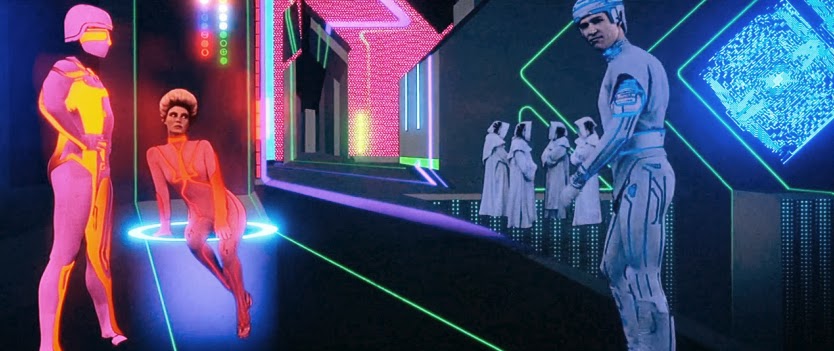
The Las Vegas of the Grid, Flynn is a stranger in a
strange land.
But the digital artists that created the computer world did some amazing things with Tron. The whole thing has a scope to it that feels enormous and real. Vistas seem to stretch into infinity with moving lights and various landscapes. The entire solar sailor sequence is an amazing example of early computer animation used to create a whole world. We constantly see things that hint at further adventures around a corner, or another story taking place down another energy beam. This ranks right up there with the worlds created for Star Wars and Blade Runner in completeness and visual interest.

To match this are all the sound effects for the world. This wasn’t just creating a digitized voice for the MCP. It was creating and altering sounds for everything we see on the screen. The only real guide was that this had to sound like it occurred in an arcade game of the period. They nailed it, with the light cycles, tanks and recognizers each making unique and creative sound effects. Sark’s massive ship gets the appropriate rumble of course. But other things like the sounds of the discs and even characters derezzing lends to the feel that this is it’s own world, with it’s own rules. Even the characters footsteps sound different in this world.

Traveling by Solar Sailer always looked cool!
The final element was the musical score. Innovative electronic music artist Wendy Carlos was brought on board. She had worked on films before, notably on Kubrick’s A Clockwork Orange and The Shining. But this may be her most innovative and impressive score. She took the sounds and “music” of the arcade and Atari games of the time, and fused those electronic sounds with a full orchestra. She creates a theme for Tron, an action motif and a wide array of minor themes that pop up during the film. The music becomes a very real part of the world, crossing the line into sound effect and then back. Her piece for the end credits integrates a full organ for the added tie to the spiritual aspect of the story. All told, her score to Tron is one of the most unique of the 1980s and a perfect fit for the film (as are the two songs provided by the rock group Journey).

For me the only real downsides are the direction and script. I know part of the difficulty in making this film was ensuring the audience of 1982 would be able to follow it. The results were mixed, some folks were still confused by the film, other found it too slow going in the first third. These days it comes across a bit quaint and clunky in places. But I think that all in all it works fairly well but could be polished a bit more, made a bit tighter and it might be remembered fondly by more folks.


I know nostalgia plays a big part of why I love watching Tron. I hadn’t seen it in many years, but when Tron: Legacy came out on DVD they had a nice package with the original film. So I watched it and was surprised by how well it held up and how distinctive and complete the world they created for this film was. Many elements of visual effects were pioneered in the late 70s and early 80s, and some of them didn’t survive the computer graphics revolution of the 1990s. But Tron provides a glimpse of a fusion of both types of effects work and how they can be used together to provide an amazing whole. This is something Peter Jackson used to great effect in his Lord of the Rings trilogy, and obviously films like The Matrix and Ghost in the Shell were influenced more directly by Tron. So if you haven’t seen this film in a few years, I recommend you give it another chance. I think you’ll be surprised by how good it actually is.

Tuesday, May 8, 2012

The Secret of NIMH (1982)


Introduction:
This one was a huge favorite when I was younger. I rediscovered it when I picked up the musical score by Jerry Goldsmith, and it brought back a ton of memories. I resisted seeing the actual film for a while, but eventually I saw in on Netflix download and I gave it a watch. Was it as good as I remembered?


Summary:
Mrs. Brisby (Elizabeth Hartman) is a field mouse living in a farmer’s field with her two daughters and two sons. She discovers that her son Timothy has pneumonia and at the worst possible time. The spring thaw has arrived and she must move her family to safety before the farmer’s tractor destroys her home. With the help of a goofy crow named Jeremy (Dom DeLuise) she contacts the mysterious Great Owl (John Carradine) who tells her to seek out Nicodemus (Derek Jacobi), an ancient rat who rules over a colony of his kind in the rose bush. But these mysterious rats have a dangerous past, one that ties directly to her husband. Will The Secrete of NIMH help or hinder our brave little mouse?

Good Points:
  • The animation and direction creates an amazing atmosphere
  • Goldsmith’s score is masterfully executed
  • A strong female main character 

Bad Points:
  • Gets very dark and scary in many places
  • The animal experimentation my disturb some viewers
  • Many changes from the original book 

Overall:
All in all, this movie really held up. Visually it is certainly impressive, with a quality to the animation that was certainly equal to what Disney was doing at the time. The darkness of the story as well as the settings really gives it a unique feel, and Goldsmith’s cinematic score adds to the excitement. DeLuise and much of the supporting cast add a dash of humor. The result is a well-balanced family adventure.

Scores (out of 5)
Visuals: 5
Sound: 4
Acting: 4
Script: 4
Music: 5
Direction: 4
Entertainment: 4
Total:  4

In Depth Review
Some people call this Bluth’s best film, and I’m inclined to agree with them. While his later films like An American Tail and The Land Before Time were more popular, The Secret of NIMH really feels like a complete world unto itself. The merging of vivid color with darkness creates visuals that hadn’t been seen in American animation prior to this, and were never really delved into again. In fact I’ve only seen this type of coloring used in Japanese anime and nearly a decade later. From an animation perspective, this film is a fine example of how effective hand drawn style can be.

The voice acting is also handled extremely well. Hartman just nails the role of Mrs. Brisby, making her warm and caring as a mother and passionate and brave as a hero. Without her excellent voice work the film would not have the effect it does. She’s on screen for nearly the entire film and never drops the ball. Jacobi is nearly unidentifiable as Nicodemus, adding a weakness to his voice that fits the ancient rat perfectly. He is the old wizard of this hero myth and plays the part perfectly.  Even DeLuise who does his same shtick here, is given just enough time on screen to provide some laughs and fun without derailing the film. Carradine as the Great Owl adds the perfect mixture of menace and wisdom that the role requires. Paul Shenar makes the wicked rat Jenner a nice mustache-twirling villain.

This is one of the first American animated movie scores that did not focus on mimicking the actions in the music. Up to this point, most of Dinsey’s scores accentuated comedy scenes and action scenes by having the orchestra provide a kind of sound effect for each movement. Instead Goldsmith tackled The Secret of NIMH like a film, scoring scenes based on the emotions the character is feeling, building dread by creating atmosphere with the music and accenting the heroics with full-bodied statements of the main theme. Most modern animated films are scored this way, but Goldsmith was the first to do it so successfully in this film (and again in Mulan).
 
If there is anything that doesn’t quite measure up it’s the overall story, which is pretty familiar to anyone who knows the heroic myths. All the beats are there, from Mrs. Brisby refusing the call to adventure, to her being captured and nearly killed, to using her newfound power to save the day. So there are no surprises here. But what makes these stories work is when they do something different with the trappings. Visually and musically the Secret of NIMH manages just that. It might get a little scary for little ones at times (the scenes with The Great Owl and Mrs. Brisby’s first exploration of the rosebush are dark and intense), but a happy ending awaits the viewer. Can’t ask more much more than that.

Friday, April 13, 2012

The Thing (1982)


Introduction:
Another movie I hadn’t seen in years, but remembered fondly. The movie freaked me out so much that I was actually a little afraid to revisit it. But the Lovecraft podcast I listen to mentioned it on several occasions, so I figured it was time to check out The Thing again.

Summary:
An American Antarctic expedition finds themselves facing something much worse than cold weather. A chance encounter with survivors of a Norwegian expedition brings what appears to be a disease into the camp. But it becomes rapidly apparent that some kind of alien creature with the ability to appear human is running amok. The expedition is cut off from the outside world and each member suspects the others of being the invader. How far will these men go to survive the hunt for The Thing. The ensemble cast includes Kurt Russel, Wilford Brimley, Keith David and Donald Moffit.


Good Points:

  • Amazing visual effects – a real star of pre CG age
  • Balances atmosphere and thrills perfectly
  • Beautiful and bleak all at the same time

Bad Points:

  • The overall grimness of the film may be too much for some viewers
  • The dog massacre will upset animal lovers
  • Gets really gross with the mutilations

Overall:
Holy crap is this movie still scary. It’s a great combination of slow building terror and masterful special effects. While the story itself isn’t anything too new, the execution is what makes this work. Carpenter creates a truly bleak film, which has viewers jumping at shadows. Lots of folks say this is his best film – I think I agree with them.

Scores (out of 5)
Visuals: 5
Sound: 5
Acting: 4
Script: 4
Music: 4
Direction: 5
Entertainment: 5
Total:  5

Curious about a full review, sent me an email and I’ll make additional thoughts to this review.