Showing posts with label AIC. Show all posts

Thursday, July 19, 2012

Tenchi Muyo (1992)


Introduction:
When it comes to huge names in Japanese animation in the 1990s, it is tougher to get bigger then Tenchi Masaki. This six episode series kicked off one of the biggest franchises of the time and inspired countless other shows. But just who the heck is Tenchi and why do we not need him?

Summary:
Teenager Tenchi Masaki (Matt Miller) was spending a quiet summer at the family shrine working with his grandfather Katsuhito (Jay Hopper). Intrigued by a legend about a cave near the shrine, Tenchi sneaks inside and starts exploring. He comes across a legendary sword and a sexy blue haired demon named Ryoko (Petrea Burchard). After chasing Tenchi around (and blowing up his school), Ryoko takes a shine to the young man. This is going to cause nothing but trouble.

You see Ryoko isn’t a demon at all, but a space pirate wanted in several star systems. Pursuing her is the princess Ayeka (Jennifer Darling) and her little sister Sasami (Sherry Lynn), as well as the intergalactic criminal Kagato (Michael Scott Ryan). Following Kagato is the bumbling Galaxy Police officer Mihoshi (Ellen Gerstell) ready to capture both lawbreakers. Throw in the mad scientist Washu (Kate T. Voigt) and a rabbit/cat hybrid that can turn into a spaceship (yeah you read that right) and you’ve got a space opera with plenty of action, laughs and cleavage to keep any anime fan happy.

Good Points:

  • Some imaginative designs for the spaceships and technologies
  • The script keeps the balance of adventure and comedy just right
  • There is a girl for any type of fan
Bad Points:

  • The overall plot isn’t terribly new or interesting
  • Tenchi himself is fairly one note
  • English voice cast is hit or miss in these early episodes
Overall:
This is the series that started the whole Tenchi franchise rolling, and that means it is a little rough in places. Some of the animation in early episodes is a bit odd looking, some the storytelling is off kilter. Even some of the characters aren’t quite there yet. But episode three seals the deal. It’s light hearted, funny, has a little skin and hints at the space adventure in the next few episodes. The rest of the series keeps that mix and the result is a good time.

Scores (out of 5)
Visuals: 4
Sound: 4
Acting: 3
Script: 4
Music: 3
Direction: 3
Entertainment: 3
Total:  3

In Depth Review

The title Tenchi Muyo can be translated a number of different ways, and since the Japanese love puns, it comes as no surprise that most of the translations fit the show in some way or other. It could mean “Heaven and Earth”, which fits Tenchi’s adventures on Earth and in space. It can be translated as “This End Up”, and was seen as a background gag in many anime from the AIC production company. Or it can mean “No need for Tenchi”. And honestly when most folks remember Tenchi Muyo it’s not because of the lead, but because of the girls.

Over six episodes Tenchi meets all the various women who will influence his life in future episodes of this particular series (and future franchise entries). The first episode put him together with Ryoko, who ends up being the party girl of the series. The second episode brings purple haired Princess Ayeka, the prim and proper love interest. It also introduces the incredibly cute Princess Sasami, who ends up being the most grounded of the girls, even if she is the youngest. The third episode presents us with Ryo-Oki, the cabbit/spaceship. Yes she’s mostly a mascot in the series, but the episode itself gives us more time with Ayeka, developing her character. Mihoshi arrives in episode four, and the villain Kagato is revealed at the same time. Episode five is where Kagato finally reveals his plot and abducts Ryoko. The final episode brings Tenchi facing down Kagato, and introduces us to Washu the scientist and “mother” of Ryoko.

So the overall plot dealing with the antagonist only gets rolling in episode 4, and that is the first problem viewers may have with this series. The first three episodes revolve around Tenchi meeting Ryoko and Ayeka, and getting into all kinds of comedic adventures with them. Sure there are chases and escapes, energy bolts flying around and even torture, but it’s all done with wink and a grin. If you come into Tenchi thinking that it will be a nonstop romp of space action and adventure, these first three episodes will come as a bit of surprise.

But the tone never really changes. This is a fun series, because it is going for a bit more humor over the action and adventure. Much of the humor is derived from three things: Tenchi interacting with aliens Tenchi interacting with aliens that happen to be hot girls, Tenchi interacting with aliens that are hot girls that are into him. Like any teenage boy, Tenchi is certainly interested in the girls but he’s a bit shy, and finds their antics alarming most of the time.

There is also plenty of humor mined from the conflict between Ayeka and Ryoko. They wouldn’t get along in the best of times, but the fact that they both fall for Tenchi just compounds the issues. As the series progresses, this relationship is warped around in all kinds of ways – even turning to a grudging respect at times. What is nice is that in this series, both women are fairly grounded, escaping some of the over the top shrillness that would make later incarnations of the series a chore to watch.

Then there’s Mihoshi, who is around for klutzy comedic relief. She’s involved in lots of physical comedy, as well as moments where she gets so flustered that she forgets a crucial instruction or action. Is it a coincidence that she's a blonde? While handled mostly for laughs, it also becomes a plot point now and again (and it worked really well into the finale for these six episodes). In later incarnations, Mihoshi would get dumber and dumber until she was basically a vegetable with breasts. Here, she’s still a likable character.

Tenchi’s father and grandfather are also around for laughs. The dad has a strange obsession with his son getting laid and tries to help out as much as he can. This character trait was dropped after this series, thankfully. The grandfather appears to be a tired old man, but is really a master warrior with a secret past. This past comes into play in the second half of this series, as well as plays into future installments. It was a unique twist that presents some interesting story opportunities.

This balance of humor and space action is what really makes the series a fun ride. But visually there’s a lot of interesting stuff going on. The creators do some wonderful things with Ayeka’s ship and technology. They are all based on living trees, and her guardians are huge cylinders of wood. Trees and nature play a large role in the series and the royal family of the planet of Jurai. Contrast this to Ryo-Oki the furry little cat/rabbit that turns into a huge crystal powered starship. The fact that the mascot doubles as a death dealing craft is something you’d only find in anime (a similar thing happened in El Hazard where the cat could turn into “living armor”). Then there are more traditional starships like those used by the Galaxy Police and the behemoth used by Kagato, with its steel corridors and labyrinthine passageways.

There are also some well-animated action scenes, especially at the end when Ryoko leads the charge into Kagato’s ship. Lots of full motion combat and very little of the cost saving panning over still frames that anime can rely too heavily on.

The English voice acting is a mixed bag. Back in the day it caused some controversy. The first three episodes are a little rough, with Miller and Burchard still getting a feeling for the characters. Darling however does an excellent job right out of the gate making Ayeka sound snobby and proper all at once. The entire cast gets better as the series goes along, and by the time they hit the second series of the OAV they will be right in the grove. However Darling, Burchard and Voigt have all been criticized for sounding too old for the young ladies they are playing. I can see that, but at the same time all three ladies make it work, and it actually ends up adding a bit of nuance to the characters. There are plenty of jokes about how old Ryoko really is and how she’s all over Tenchi. In English, the fact that Ayeka doesn’t sound much younger than the space pirate makes her comments about Ryoko’s age even funnier. Washu is short and is always trying to act like a little kid. With Voigt’s voice added to the visuals I end up laughing more than with the Japanese actress. This is all a matter of taste, but I really like the English cast, and the fact that Pioneer managed to keep nearly all of the cast for nearly all the English iterations of the franchise is a major feat.

The rest of the sound track works well enough. The musical score is typical of AIC's work, mostly synth material. The comedy music is typical stuff, and the heroic action music works well enough. The opening theme music is catchy, and the end J-pop song is cute. The sound effects are interesting because they seemed to be mined from the Skywalker sound archive, just like El Hazard.

What is hard to appreciate now is that this series was released on video, episode by episode over a span from September 1992 to March of 1993. Each episode is about 30 minutes long. This was just the way it was done in Japan back in the day, and in North America we usually ended up with two episodes per tape, not much better. I’m not sure if that lag time made the whole series seem a bit more impressive or what, but Tenchi really appealed to anime fans on both sides of the ocean.

I think a big part of the appeal was viewers putting themselves in Tenchi’s place. Not only does he have hot alien gals fawning all over him, but he gets to use a powerful sword and energy weapon and save the world from a deadly foe. There is more than a little bit of Star Wars at play here (from the energy swords to the sound effects borrowed directly from the Lucasfilm library). But the whole thing never feels stale. Sure it is familiar, but there’s enough humor to keep things light and fun. This was followed by a one-shot episode, The Night Before the Festival and then by a second series of OAVs.

Sunday, September 12, 2010

El Hazard : The Magnificent World (1995)


Introduction:
Back in 1992 Japanese animation studio AIC and Pioneer combined to make a fun and clever sci-fi romp called Tenchi Muyo!: Ryo Oki. It was a hit and propelled a similar concept, but this time with a bent more toward fantasy. The result was a series that surpassed its inspiration, but never really was as popular as its creators hoped.

Summary:
One night a strange woman appears in the bizarre ruins recently found under a Japanese high school. She speaks to student Makoto Mizuhara (Eddie Frierson) and tells him that she’s slept for thousands of years only to awake at this moment to see him again and send him to El Hazard. Before Makoto can ask her what the heck she’s been smoking, the woman blasts the entire school with a blue beam of energy. Makoto finds himself in another world along with his teacher Mr. Fujisawa (Michael Sorich). The two are picked up the royal family of Roshtaria, and soon find themselves on a quest to save the kingdom. Along the way they find that two other students have been transported over. Nanami Jinnai (Lia Sargent) is grateful to be alive and with her friends. But her brother Katsuhiko Jinnai (R. Martin Klein) has joined the enemy and is bent on domination of El Hazard. Adventure and antics quickly ensue, and each of the earthlings finds that they have some special power to use. But will they ever be able to return home from El Hazard: The Magnificent World?

Good Points
  • Keeps a spirit of fun and humor throughout
  • Has one of the funniest dub scripts written for a 90’s anime
  • Lots of female anime gals in skimpy clothing
Bad Points
  • Suffers from padding in certain places
  • Some of the sex jokes and cross dressing can get old
  • None of the characters ever get fully fleshed out
Overall
El Hazard: The Magnificent World is one of the most fun and entertaining anime series of the 90’s. Most of that has to do with the hilarious dub script and actors who are up for it. Everyone gets into the parts and throws themselves in with Klein nearly stealing show as Jinnai. A clever final act twist adds a bit of poignancy to the series and gives it a good ending. While not a sterling example of Japanese animation, it is always entertaining and knows exactly how to deliver the goods.

Scores (out of 5)
Visuals: 4
Sound: 4
Music: 3
English Voice Acting: 5
English Script: 5
Direction: 4
Entertainment: 5
Total: 5

In Depth Review

I’ll admit right away to having a certain bias toward the show. It was one of the first anime series viewed when I delved back into the medium in the mid 90’s. So it generates a lot of nostalgia. However, I can say that every time I watch it, I find it almost as entertaining and fun as the first time I popped it into my VCR. These days, I see that the show is out of print on DVD in the U.S. and hardly anyone talks about it. Part of that is because of the dismal sequels and spin offs that followed the first series.
In many ways El Hazard isn’t groundbreaking or new. The concept of humans being pulled into another dimension and attempting to survive has been around since the early days of fiction. Japanese animation went to this story well numerous times, with another successful series in the 90’s called The Vision of Escaflowne. But what makes this series so entertaining is the combination of script and voice acting. Just watch the Japanese dub to see what I mean.

The world design of the series is a unique combination of Arabian Nights, meets giant bugs, meets energy weapons, swords and sorcery. There are robots and technology, but no one on El Hazard really knows how to use it. Most of the combat is hand to hand or magic based. This type of world is very popular in Japanese animation and video games. Not only do you get our robots and laser guns but you get magic and marital arts. It works here a bit better than other incarnations I’ve seen. We are told that the world of El Hazard was technologically advanced but destroyed itself with its super weapons: The Eye of God and the Demon Goddess. The survivors abandoned the technology and embraced magic.

However there are certain deign elements that aren’t so interesting. The Eye of God is basically the Death Star from Star Wars with a few more protrusions and not filled with Stormtroopers. Some the vehicles are also inspired by George Lucas’ famed trilogy. It doesn’t help that the production company seemed to mine Skywalker Sound for many of the sound effects used in the series. The costumes are designed around the lines of Arabian Nights with that special anime ability to show off enough curves and skin for the females to keep male viewers drooling. It gets a bit gratuitous at times, but the creators knew who would be watching.

The music takes the Arabian Nights theme further sounding like it could have been composed for The Thief of Bagdad in places. It’s all done on synthesizers and sometimes gets into a droning style for suspense moments. The mixture works really well at times and less at others. The two end themes will test the endurance of even the most ardent fan of Japanese pop. They are performed in English but go from annoyingly cute to gratingly shrill.

For the most part the series director keeps the story moving along. There are a few moments of padding here and there, but nothing to stop the story cold. The first episode takes a little time to really get going, but be patient. The second episode hooks you with the adventure and comedy blend.

In Japanese El Hazard is a fun adventure with some humor, mostly mined from the fact that Mokoto happens to look just like the missing Princess Fatora. After some negotiations, he masquerades as the princess. The idea of a young Japanese man dressing as woman and pretending to be a princess holds a lot of humor to a Japanese audience as opposed to an American one. We see it as funny, but not in the same way a Japanese audience might. When you watch it in its original language the jokes center around the fact that he’s in drag. That’s it.

Another element of comedy comes from Fatora’s servant girl Alielle. Turns out she’s more than just a servant; she was Fatora’s lover. With Fatora gone Alielle is… well horny. She ends up hitting on and groping all the women she encounters. Again most of the jokes center on Alielle saying “ooh she’s cute” and then grabbing the woman’s breast. Some of it is funny, but most of it just kind of sits there.

Then there is the romance angle. Mokoto is a nice enough guy and this causes a few of the gals in the film to fall for him. Back on earth Nanami has a few lines about how she likes Mokoto. But there is also the fire priestess Shayla-Shayla, who has conflicted feelings about Mokoto. And then there is Ifurita, the deadly weapon. She’s a machine in the shape of a women (of course) who can blow up cities with a single well placed burst from her staff. But Mokoto, who’s special ability is to be able to operate El Hazard technology is able to understand her. And this creates a bond between the two, something that drives the finale and creates a very cool twist at the end.


Now usually I’m all for a direct translation of a Japanese script into English for anime. Get it as close as you can and keep it understandable. But with comedies, I’ve found that Japanese humor doesn’t always translate, especially the dialogue. So I’m willing to let the English dub get a little more freewheeling. It worked well from Ranma ½ and it works wonders here.
In English Mokoto’s discomfort dressed as Fatora is very funny with his voice actor Eddie Frierson capturing all the angst and embarrassment with his voice. His struggle to stay in character even when things are going horribly wrong is played with great skill. He even allows the character to show a bit more emotion when he discovers the only way to save El Hazard from destruction. It’s a powerful moment and Frierson really gets into it with his voice.

Alielle also gets a lift with her dialogue. When she first sees the priestess Shayla-Shayla standing on the cliff in kick-ass mode, in Japanese she said… “cute”. In English she purrs “Ohhhh, red hair!” This turns into a joke later when Fatora asks if Alielle has been faithful to her. “What about the red head?” she asks, as if this has come up before.

Those are the most basic examples and I could go on and on. Mr. Klien’s performance as Jinnai trumps his Japanese counterpart easily. He adds an extra bit of insanity to the voice and the laugh, transforming the young man from a power hungry jerk into a deranged nut job. It actually fits the animation of Jinnai a lot better and creates some hilarious moments all based on the over the top performance. Anyone who’s seen this series will always remember Jinnai and that laugh.

I also love Lia Sargent as Nanami. She’s got a very cute voice and she gets some hilarious lines when she deals with Mokoto and her brother Jinnai. Sargent worked on anime voice -overs for years and she’s always excellent, usually conveying innocence, kindness and perkiness just with her voice. Nanami isn’t her juiciest role, but it’s one of my favorites by her.

Last but not least is Michael Sorich as the drunken schoolteacher, Mr. Fujisawa. He gets so many good lines and delivers them with energy. He practically steals all the scenes he’s in and maybe one of may favorite comic characters in anime. Again, his acting seems to fit the character animation better than the Japanese voice actor and just elevates the humor to a new level. Great stuff.
You’ve got a great combination of adventure and comedy. They mix well and even when things get serious in the final episodes, the writers don’t forget to have Fujisawa or Jinnai get a couple good lines in.

I see some mediocre reviews for El Hazard and it usually turns out that the reviewers watched the Japanese version. I can see how it just doesn’t have the same appeal. Some of the animation isn’t the best. You get that panning over still frames that anime uses so often. You get reused power-up scenes for the priestesses. And some of the battle scenes happen off camera. These flaws melt away when you see it in English and it fires on all cylinders.

If you can rent it or find it, give the series a try. I hope it becomes available again, with that dub, because it still remains one of the most entertaining concoctions in anime and one of the reasons this medium flourished in the 1990’s.

And because I didn't have enough to say - check out my Nostalgia Nugget about the demise of the this show due to poorly executed sequels.

Saturday, September 11, 2010

Nostalgia Nugget - The Demise of El Hazard


AIC and Pioneer created Tenchi Muyo and El Hazard and got two popular shows out of the deal. Both series were ended with enough wiggle room to create more adventures and explore the worlds. Instead the studios took a different path that ended up degrading the memory of these stories. In the case of El Hazard it was fatal.

A second Original Animated Video was commissioned after the popularity of the first. It was released in 1997 and called El Hazard the Magnificent World 2. Elements of the story were funny, with Mr. Fujisawa getting married to the priestess Miz, and Nanami and Mokoto trying to adapt to life on a new world. But the main thrust of the story has to do with Jinnai finding another ancient weapon and trying to destroy the kingdom of Roshtaria again.

This is a case of serious rehash, with very little material that wasn’t already explored before. The relationship between Mokoto and Ifurita is abandoned and we get more of what we saw before, but with less comedy and less adventure. Even the English dub cast can’t do much with this. It’s a poor sequel that did nothing to further the story; just let the wheels spin some more.


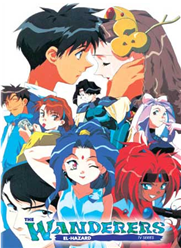
Next up was a television series in 1995 called El Hazard: The Wanderers. I had hoped this would be a series of adventures that follows Mokoto in his quest to find a way to get back home. Instead it’s a retelling of the first story! It starts with the four humans at the high school, and follows as they get sucked into El Hazard.

What’s the point of that? Well a few things are changed. First off all the characters got a lot cuter and lot dumber. Mokoto who was always a little dense when it came to women is downright moronic here. He’s good with machines and creates the machine that sucks them into El Hazard. Ifurita is around, but she's a total ditz and doesn't show up till around halfway through the series. Jinnai is crazier, but stupider turning him into a villain who is not threatening at all. Really suffering is the Princess Rune Venus, who was noble but soft hearted in the original story. Here she’s younger, dumber, and so cute you want to slap her. All the sexual jokes and comments are gone. Alielle is still around, but she’s just a servant in the castle. She really serves no purpose at all other than to make obvious comments and act cute.

Again the English voice actors make this worth watching, but barely. They get into the parts and have some funny lines. My favorite moment is when Mokoto gets so fed up with Jinnai’s threats that he mocks him, even down the laugh. But the series is so bland in the adventure and comedy department that it feels like a waste. Tenchi Muyo had a similar transformation when it was brought to television, but it managed to work because the main villain was a real threat and the adventure worked most of the time.


Finally the creators went back to the original continuity with a new television series El hazard: The Alternative World in 1998. This picks up after the second OAV with Fujisawa and Miz married and a new priestess being trained in the ways of water manipulation. The series stars off well with a lot of the old humor coming back and Alielle’s horny brother showing up. Ifurita even has a cameo appearance, driving Mokoto to find a way to get to her.

Then it all derails as our main cast including Alielle, the three priestesses and the novice and the Jinnai are transported to another world! Seriously? Of all the adventures you could come up with this is where you decide to go? What about the Phantom Tribe? What about finding clues to getting back to earth? Nope. We go with another world and more fish out of water antics. The new world isn’t terribly interesting, kind of a steam punk world combined with 1600’s look to the armor and weapons. The resolution of the story is rushed and lame. Even lamer is the tepid romance between Mokoto and the novice priestess. The final episode turns into one series of endless jokes about Fatora and Alielle trying to grope and rape the rest of the females in the cast. I think it was supposed to be funny, but I found it to be a rotten cherry on this nasty Sundae.

That series pretty much killed the show and El Hazard hasn’t had any new adventures. In a way I’m glad. If that was all the creators could come up with, than I’ll just watch the first series and enjoy that. But it annoys me that this story with so much potential was so mutilated in its other incarnations. Comparing to the other AIC juggernaut Tenchi Muyo which not only got two theatrical films, one direct to video film, and three television series up to 2002, I wonder if maybe El Hazard got off easy.

Check out the full review of the original show here.