Showing posts with label 1962. Show all posts

Tuesday, November 27, 2018

And Then This Happened... Samson vs. the Vampire Women

We all know who you need to call when there is something strange in the neighborhood. But who do you call when you have a silly looking bat floating outside your window? Who do you call when every time you look outside your daughter's window, there is a creepy woman staring at her? Well the answer is obvious, right?

I think you can also call the same number if your lasagna won't cook in your oven. You could also call him if you have issues with robots mocking every movie you put on your television. I think he also handles medical and legal advice, but I'll need to check out his website.

In any case, I think it is time to come up with a caption for this image from Samson vs. the Vampire Women (aka Santo Versus the Vampire Women).

And then this happened...


Wednesday, September 2, 2015

Score Sample: Taras Bulba

It has been a while since I featured a golden age film score on this blog for the Score Sample. Today I'm sharing a track I discovered last year, when I picked up a Charles Gerhardt rerecording compilation featuring the music of Franz Waxman. While the man isn't as well known as many of his contemporaries (such as Herrmann or Steiner) he has crafted some great scores for well known films including Sunset Boulevard, Philadelphia Story and Bride of Frankenstein. He even worked with Alfred Hitchcock on a couple of occasions for music used in Rear Window and Rebecca

Today I'm focusing on his work on the 1962 film Taras Bulba featuring Yul Brynner and Tony Curtis. Bernard Herrmann called the score one of the best ever written, and if you know Herrmann... well that is saying something. One of the highlights of the score is the track The Ride to Dubno. It is one of the most bombastic and energetic tracks of the era, and certainly a challenge to perform. In 2011 the city of Prague Philharmonic accepted the challenge and rerecorded the entire score for Tadlow records. Enjoy this amazing track and the talented musicians performing it.


Friday, May 30, 2014

The Brain that Wouldn’t Die (1962) – MST3K Review


Summary:
Dr. Bill Cortner (Jason Evers) is a brilliant surgeon who saves lives with his daring and innovative techniques. But this skill comes at a cost. He is obsessed with full limb transplantation, and experiments with cadavers and his hapless assistant Kurt (Anthony La Penna) in his spare time. He is very close to being able to transplant a dead arm to a living body with no nasty side effects. He’s about to show his girlfriend Jan (Verginia Leith) his secret laboratory when the moron goes and crashes his car. Bill is thrown clear, and so is Jan… well her head anyway.

Bill races with Jan’s head back to his hidden lab and using his secret serum he manages to resurrect Jan’s head! Now all he needs is a body. Bill figures it is time for an upgrade so he starts looking for all the smokin’ hot girls he can find, and decide which one he will decapitate and bring back to his lair. In the meantime, Jan is not pleased with her fate. But she discovers that the serum has given her telepathic abilities. She can communicate with one of Bill’s mistakes hidden in a closet. Will Jan cause havoc before Bill can find a body, or will he end up facing his former love: The Brain That Wouldn’t Die.

Movie Review:
"So he's a scientist you see."
Take your basic mad scientist concept right from Frankenstein, throw in a healthy dose of ogling women’s bodies, and cap it off with a mutated creature ripping a man’s arm off and you’ve got this fine film. But let’s be honest here, anyone who loves black and white drive-in monster flicks has at least seen still images of Jan’s severed head in the pan. This classic horror image has gone on to inspire imagery in films like Reanimator and The Man with Two Brains. Is the concept kind dumb? Sure it is, but it is also a lot of fun.

I’ve actually seen a tamer edit of this film, which moves a bit better in the pacing department. Gone are all the scenes with Bill attempting to pick up sleazy women. Instead it is much leaner and meaner approach. But the crew of Mystery Science Theater went for the longer cut of The Brain that Wouldn’t Die and I have to say it was a wise choice.

Visually the film has some interesting moments. When Bill retrieves Jan’s head, the whole scene is filmed with a frantic hand held approach. Surprising to see in a black and white B film. We also get lots of point of view shots, usually as Bill sizes up his victims. But we get a few shots from Jan’s severed head angle.

"I hate ALL MEN!" Yes, yes, you've said it
three times already.
But there are also a bunch of odd insert shots, usually of Bill staring into space, or looking smug. They seem to be thrown into the film at random, maybe to break up the two shots or something. I’m not sure. But it is very reminiscent of Coleman Francis work in Red Zone Cuba or Skydivers.

Overall the special effects are low budget fun. Jan’s head in the pan is pretty nifty. The make up effects for the mutant, and the bloody violence as Kurt and Bill get attacked are handled pretty well. I was surprised by the amount of gore in the film. Didn’t know we were getting into that much blood letting until the later 60s. On the flip side, the operation that opens the film is pretty laughable, especially the patients vinyl skull.

The sound effects work well enough. But the music in The Brain and Wouldn’t Die is a curiosity. When Bill is cruising for a new body, the score kicks into some saxophone heavy jazz. I’m not sure what they are trying to imply here, but I kept waiting for a 90s Skin-a-max movie to kick in. The music used for the creepy moments is stock stuff. If you’ve seen enough of these movies you’ll probably recognize it. Most of it works fairly well actually.

Kurt does his Johnny Tremain one man show.
The acting tends toward over the top. Evers goes in full mad scientist mode: arrogant, cocky, superior and prone to lines with double meanings. It is the perfect performance for this kind of movie. Right along with him is the La Penna as Kurt the assistant. He gets more and more panicky and loud as the film continues. I love his ranting tirades at Jan as she goads and manipulates him. Kurt is pretty much an idiot (who else would let Bill cut off his hand and replace it with a corpse hand).

In the ladies corner you have Leith as Jan. It must have been a tough shoot for her, and I admire her dedication to this very silly movie. She has to talk in a raspy voice for about 85% of her dialogue. But she has the angry stare down pat. When she declares vengeance on Bill, you believe it. There is also Adele Lamont as Doris Powell. Doris is the unfortunate gal who Bill brings home to be the new body for Jan. Doris has a great body, but an angry boyfriend cut up her face. As a result she hates all men! She declares this on several occasions. Bill manages to convince her that he can help, but of course his help is just chopping off her head and tossing it away. Lamont plays the whole thing very broadly, and it is a bit of as shame since the character is supposed to be one you feel bad for. Most of the time I was just wondering how annoying she could really get.

As for the script… do I really need to discuss it? With a title like The Brain that Wouldn’t Die you pretty much get what you expect. The plot is ridiculous; the dialogue is extremely ripe and filled with great lines. It lacks the clumsiness of Ed Wood’s script work, but gives Bill plenty of dialogue with sinister alternate meanings. In it’s basic form, the script fits the title.

The 1962 model Floozy!
But the execution is where things get dicey. The 70-minute version moves along pretty well. But the 82-minute version fills time with Bill hitting on any floozy he can find. It’s a mixed bag, because these scenes don’t have much tension to them, but they also feature some of the funniest dialogue. When it comes to scares, the movie also doesn’t quite click. Jan’s severed head isn’t very scary at all, but the way the movie is filmed, I think we are supposed to think she is. Director Joseph Green does a better job building up some tension with the mutant in the closet and around Bill’s murderous plot. But the scenes with Kurt and Jan bickering feel like padding. But then again, the dialogue is hilarious and I wouldn’t want to loose that.

Is the movie an effective scare machine? Not really. But The Brain that Wouldn’t Die is a fun monster flick with a lot of riffing potential. It was the perfect first flick for Mike to tackle as the new host of Mystery Science Theater 3000.

Episode Review:
Jan in the Pan! Neck juice not included, some
disassembly required.
For fans of MST3K, the shift from Joel to Mike was a game changer. Things have mellowed over the years, but when this happened – man, it was brutal. Some people rejected Mike completely and never gave him a chance. Others immediately loved what he brought to the riffing and declared they were happier now that Joel was gone. Both of these groups are nuts! The show changed, but it gave us a new style of riffing and took things in unexpected and fun directions.

With Joel leaving, the crew at Best Brains decided to give the show a bit of a facelift. First off they had to create new opening credits (since the originals featured Joel in the visuals and in the song). They kept the same tune for the opening credits, but changed the lyrics to reflect Mike’s misadventures as they occurred in the episode Mitchell. These include Mike getting hit on the head with a clown hammer and shot into space. The new opening credits even feature a clip from this episode: The Brain that Wouldn’t Die.

Doris is not buying Mel Blanc's pick up lines.
The other visual change was tunnel sequence used in the series to show Cambot’s journey into the theater. A new tunnel was created and all the little puppets, bubbles and sliding doors were timed for the single shot. This new sequence would be used for the rest of the Comedy Central years of the series.

This was actually a great selection of movie for a transition episode. The Brain that Wouldn’t Die falls in the familiar territory for the writers. It’s black and white, a monster movie, it’s got a goofy mad scientist, silly music and ridiculous dialogue. Let’s keep in mind that Mike had been head writer for years, and had performed in front of the camera numerous times playing characters like Gamera, The Amazing Colossal Man and of course Torgo from Manos: The Hands of Fate. The big difference here is that Mike would be taking a center stage role. And he handles himself well.

"The road is attacking me!!!!"
The movie offers several sequences of visual fuel for the fire. One of my favorites is during the drive Bill and Jan take to the “country place”. A random bit of ADR declares “I have to hurry!” I’m assuming it is Bill, but it is really hard to tell, and is unrelated to the rest of the dialogue that you can’t help but laugh. The boys join in and then start commenting on editing of the car racing down the road, the assortment of street signs, and close ups of Bill’s face. Tom gets off some great timing lines with the signs “Stop? What stop? Curve? What curve?” Use these lines during your own road trip and see how your passengers react. When the crash occurs and Bill discovers Jan’s body, Mike says, “Oh no, honey roasted!” Bill then scoops up Jan’s head, wraps it in his coat and runs off with it, clutched under his arm. He looks like he’s going for a touchdown, and Mike can’t help but yell, “He’s at the forty, the thirty, no one can stop him!”

Of course with the title The Brain that Wouldn’t Die, things really get cooking when Jan’s head is placed in her pan with neck juice (Mike and Bots words, not mine), and she comes back to life. They dub her “Jan in the Pan” and they get a big kick out of her constant lamenting her fate. When Bill reveals Jan to his assistant Kurt, he says, “What you see is real.” Mike adds, “What you smell is unfortunate.” Later, when Jan and Kurt are verbally sparring, and Kurt is losing badly Tom imitates his bluster with a “Shut up you stupid little pan woman!” When Jan bemoans “Why did he let me die?” for the millionth time, Crow bursts out, “You still on about that? Well we got problems too lady!”

Awww, it's true love.
Meanwhile Bill is on the prowl for a sexy body, and the slimy saxophone music is in high gear. Tom declares that Bill must have his radio tuned to “K-PORN, sleezy slutty music all day long”. When Bill heads off to a bathing suit competition Mike and bots riff on just about everyone on stage. Bill then heads off to, what I think is supposed to be burlesque club, but it seems so small and cramped, it makes the club in The Incredibly Strange Creatures who Stopped Living and Became Mixed Up Zombies look like the Smithsonian. The dancer is doing her thing, and Mike and bots figure she is actually presenting the menu using interpretive dance, “This dance represents that there are no baked potatoes after five.”

The finale, in which Bill brings Jan her new body and Jan unleashes her final retribution features wall to wall riffing fun. As Doris is laying under a sheet, and her prominent chest is jutting forth, Mike asks as Bill “But honey, can you say no to these?” Her answer is to bring forth a monster that Crow declares “looks like Boo Radley!” The creature manages to grab Bill through a tiny hole in a door (don’t ask, just watch the movie. It actually makes some sense). The boys offer helpful hints to the monster, “You know just pull the door away and beat him to death with it.” At this point, Bill is no longer our wacky protagonist, but a grade A jerk. As the film ends with everyone trapped in a burning laboratory, we hear Jan laughing. Mike says, “Oh, it was a comedy!” Well Mike and the bots certainly made it funny.

Mike an the bots are proud of their hats for
Jan in the Pan
The host segments for The Brain that Wouldn’t Die are pretty good. Most of them deal with Mike attempting to adjust to his new surroundings. Things start off with Mike being trained by the bots. Tom: “Mark Singer walks out in a loin cloth, what do you say?” Mike: “Now I know why the show was called V.” For the invention exchange the Mad scientists have a device that can pop a kid’s balloons from a distance. Frank bursts into tears when his balloons pop. Mike shows off his umbrella with a gutter system attached, so your feet don’t get wet. At the first break, Mike tries to obtain control of the Satellite of Love from panels in the floor. All he ends up doing is squirting cheese everywhere. At least, he thinks its cheese. When they come back for the next break Mike and bots have created various hats for Jan. I love the lazy Susan hat that makes her the centerpiece at any party. When we come back, Mike and bots are discussing trust. It ends up with Mike sharing an embarrassing story, and the bots proceeding to ridicule him. After the movie ends, Jan in the Pan visits the satellite (courtesy of Mary Jo Pehl), and Mike ends up insulting her. Dr. Forrester decides to try to remove Frank’s head and keep it alive in a pan. Quoth Frank, “Here we go again!”

The Brain that Wouldn’t Die is a fun episode. The riffing is solid, the movie is ridiculously watchable and it makes for a great transition episode for the hosts. In the scheme of things, it sits in the middle of Season Five, but it is well worth seeking out.

I give it three heads in pans out of five.

Even Jan has to smile at this episode.

This episode is available on the single DVD from Rhino, but was also included on a disc with Mitchell in the Mystery Science Theater 3000 25th Anniversary Edition boxset.

Tuesday, July 9, 2013

The Trial (1962)


Introduction:

I first heard about this film in a book I have dealing with the movies of David Lynch. Lynch mentions it as a film that influenced his visual style as well as his interest in creating a particular mood in his films. Orson Welles directed the film so you know it’s going to at least look good, but can you really adapt a story by Franz Kafka into a motion picture?

Summary:

Josef K (Anthony Perkins) is going to have a bad day. He awakens to find himself under arrest for an unstated crime. Josef then attempts to find out what crime he’s committed, who accused him, or what the hell he’s supposed to do next. But instead of answers, he only finds more questions. Each new encounter fills him with a new level of dread. It becomes very apparent that no matter what he does, or who he talks to, his life is in danger.

Finally he meets with the famous advocate Hastler (Orson Welles) who hints that he may be able to save him, but at a price. Is this just another ruse, a new level to the unknown game, or is this Josef’s only chance at salvation. In the end The Trial may reveal that the crime Josef committed, was being ignorant of the crime in the first place.

Good Points:
  • Amazing visuals create an oppressive and disturbing atmosphere
  • Anthony Perkins does a great job in a difficult role
  • Leaves the viewer feeling like they are just missing the point

Bad Points:
  • Slowly paced and methodical in execution
  • The narrative is never clear
  • Leaves the viewer feeling like they are just missing the point

Overall:

Dark, paranoid and oppressive, the film succeeds in capturing the feeling a Kafka’s work. While the film never delves into true surreal cinema, it constantly keeps the viewer from knowing exactly what is going on, or why an event happens. Much like Josef we are in a dark wonderland that refuses to let us go. Its a wonderful exercise in creating a nightmarish atmosphere. But this will intrigue some viewers and alienate others.

Scores (out of 5)
Visuals: 5
Sound: 3
Acting: 4
Script: 4
Music: 3
Direction: 5
Entertainment: 4
Total:  4

Curious about a full review, sent me an email and I’ll make additional thoughts to this review.    

Friday, August 19, 2011

Dr. No (1962)


Introduction:
Dr. No started the longest running franchise in movie history. It’s hard to step back and imagine seeing the movie for the first time, without ever knowing James Bond. So sitting down with Dr. No pits it against some serious expectations. But if you come at this film with a bit of history on your mind, you’ll find a very enjoyable sample of spy cinema in the early ‘60s.

Summary:
After a British secret agent and his secretary are ruthlessly killed in Jamaica, Head of the British Secret Service, M (Bernard Lee) dispatches his best agent, James Bond (Sean Connery) to investigate. It seems that something mysterious is happening on Crab Key Island. Anyone who comes snooping around ends up dead. CIA operative Felix Leiter (Jack Lord) suspects the infamous Dr. No (Joseph Wiseman). As Bond investigates with the help of Quarrel (John Kitzmiller) and the lovely Honey Rider (Ursula Andress), he uncovers a plot to topple American rockets. Will he be able to stop it before it’s too late, or will Dr. No silence him first?

Good Points:
  • Sean Connery makes it his movie.
  • The settings in Jamaica and in Ken Adam’s sets are excellent.
  • The movie serves as a good introduction to the world of James Bond.
Bad Points:
  • Plays much more like a conventional thriller than a super spy film.
  • James Bond is the most fleshed out character.
  • Some of the visual effects are not convincing.
Overall:
Viewed in comparison to its brothers Dr. No is an average James Bond adventure. Sean Connery’s acting and Terrance Young’s polished direction make the film work. While it’s an entertaining watch, it really serves as a starting point. The Bond movies of the ‘60s got better after this one, but it’s great to see the film that started it all.

Scores (out of 5)
Visuals: 4
Sound: 4
Acting: 4
Script: 3
Music: 3
Direction: 4
Entertainment: 3
Total: 3

In Depth Review

Dr. No is a tough film to review. I’m struggling to find the right perspective on it. Should I judge it against the other films of the MGM Bond series? Should I view it as the first of the series, and accept its limitations? I chose a balance between the two. I comparing it to the other films with the understanding that compared to the high tech visuals of The World is Not Enough, Dr. No was going to look primitive. But film basics can be judged easily enough.

The amazing thing about Dr. No is that you can see all the elements of the Bond formula being started here. The visuals are no exception. Location work takes place almost entirely in Jamaica, highlighting some of the most breath taking and visually exciting spots on the Caribbean island. Especially noteworthy are the Crab Key locations. The wonderful waterfalls that cascade down the beach are simply beautiful.

Luckily for the creators of the film Ken Adam was on hand to create his sets. Right from the beginning he presents a mixture of ultra-modern with larger than life visuals. The results have been sets that stand out in your mind (most obvious with his work on Fort Knox in Goldfinger and the volcano base in You Only Live Twice). Here he creates the casino in which we are introduced to Bond. It has the perfect mix of elegance and opulence that you expect in a Bond film. Perhaps the most memorable set from the film is Dr. No’s apartment. It set the standard for the look of a villain’s lair. His control room (where he faces off against Bond) is filled with screens, chrome metal, glowing lights and a huge illuminated globe.

As nifty as these sets are, one always stands out to me whenever I see it. It’s the room where Professor Dent (Anthony Dawson) reports to Dr. No. It’s a large, round room with a grid skylight that forms an interesting web like shadow on the wall. There is a single chair on one side of the room where Dent is interrogated. On the other side is the table with the poisonous spider. This single image of Professor Dent in this cold and dangerous room always enters my mind when someone mentions Dr. No.

Unfortunately modern audiences are going to find some faults in the film. Most of this comes from the dated effects work. The worst offender is the rear projection used in the car chase. It’s so fake looking that I felt bad for Sean having to react to the silliness as if he was in real danger. The other element is the “dragon” that appears in the film. It just looks out of place in what is mostly a gritty thriller. Maybe in a later Roger Moore film it would have worked. It always surprises me when that “dragon” shows up. I keep blocking that part out.

The sound work for the most part it’s really good. This is a Bond movie so the explosions, hand to hand battles and bullets should sound good. Dr. No starts the fine Bond tradition of having the villain’s lair explode at the end of the movie. As far as explosions go, this is a good one. There are a few minus points though. Obviously the sound work is a bit dated, and lacks the clarity and crispness of later films. Also there is a strange… I don’t know… groovy sound effect when Bond is inside the air ducts attempting to escape from Dr. No’s cell. It’s a weird moment. I’m also not crazy for the music box sound effect for the gunbarrel sequence. This odd tinkling sound effect is dropped for the familiar gunbarrel music in From Russia With Love.


That brings me to the score. There are two key elements to the music of Dr. No. One is the use of Jamaican bands and songs. The most used song is “Underneath the Mango Tree”. Memorably, Honey Rider sings it when she first appears. It also finds its way into the score, popping up here and there, especially when Bond is interacting with the gals. There’s also the infectious “Jump Up” song played at the bar scene.

But the real stand out is Monty Norman’s James Bond Theme. It is used for the opening titles and makes an immediate impression. According to what I’ve pieced together (and I could be wrong), Monty Norman actually recycled a song he had written for a musical into the James Bond theme. He gave the piece to John Barry who orchestrated it into the theme we know today. There has been much argument over who really wrote the James Bond theme. In a way it’s telling that John Barry was asked back to work on the James Bond film scores in From Russia with Love and beyond. Monty Norman gets song credit. With that said, the James Bond theme is used a lot in this movie: too much. It seems to be the only bit of music that they really had on hand for the action scenes. But compared to the fully scored films (and John Barry’s work in particular) the music is only average for a Bond movie. But that theme is really something else.


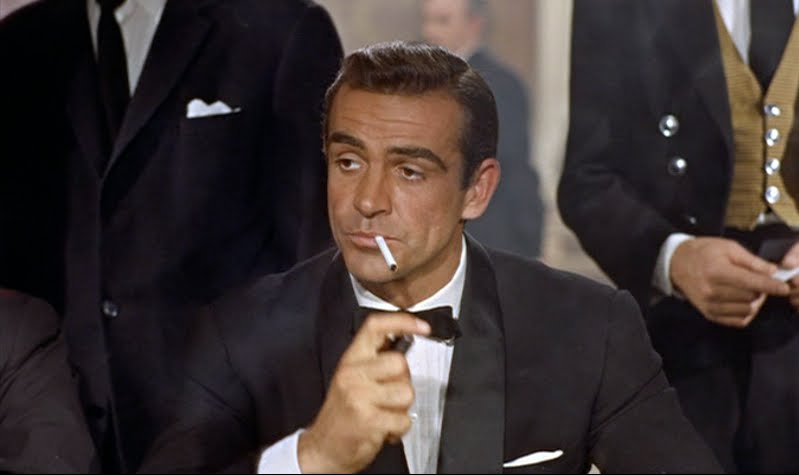
Dr. No is probably the most James Bond centric of the early Bond films. The movie falls almost completely on Connery’s shoulders and he is up to the task. His introduction in the casino is classic. You understand just about everything you need to know about him in that scene and the way he plays against Sylvia Trench (Eunice Gayson). As the film continues you learn more and more about Bond. With the final confrontation with Dent, we have the completely fleshed out character of James Bond. Then it’s off to Crab Key for the adventure part of the story.

Connery is suave and cool with an undercurrent of intensity. At this point Bond wasn’t the superman he would evolve into, so there is fear and anger in his performance, especially after Dr. No captures him. Connery is solid as Bond in his first time out and he would improve in each film, reaching the definitive portrayal in Goldfinger. That third film adds to the performance is a layer of supreme confidence that would be taken to ridiculous extremes by the time You Only Live Twice rolled around. Here James Bond is more realistic, more gritty and more believable. Does he capture the role as presented in the books? Not really. Timothy Dalton really nailed that aspect of the character, turning James Bond into a brooding agent who was very good at his job, but held a darkness within him. Connery never seems to capture that darkness. But the scripts don’t really call for that. It’s interesting to compare the performance of Bond in this film with 2006 reboot, Casino Royale. There are many similarities. The main difference is that the newer film has a script that puts Bond through his paces, something that Connery never really enjoyed.


In most James Bond films, the main three performances are James Bond, the main Villain and the love interest. In Dr. No, James Bond overshadows everyone else. He is given the most screen time and the most fleshed out part. This renders even the key parts of villain and love interest as more of a supporting role than anything else.

With little to do but look sexy and follow Bond around Ursula Andress does the best she can with the part of Honey Rider. She’s merely the beautiful woman that Bond encounters, saves and ends up with at the end. The movie can be sliced into thirds and each third has a Bond girl in it. Andress just happens to be the one at the end of the film and gets the title of Bond Girl. She’s good, but far from the best of the ‘60s. Her iconic walking out of the sea still has a great impact, but after that, she’s little more than eye candy.


Joseph Wiseman makes Dr. No as interesting and menacing as possible for such an underwritten part. Wiseman’s screen presence is undeniable. The best dialogue in the film is the banter with Bond during the dinner scene. Wiseman also set the standard for the cultured, calm and dangerous villain that would be associated with Bond. It’s a shame that he wasn’t introduced in a later film where his character could have really been explored and probably yielded a greater performance. He remains memorable as a villain, but in the long line he gets overshadowed.

Bond’s supporting team in London makes their first appearance here. Bernard Lee establishes M right off the bat. He plays the part with a crisp no nonsense fashion. He is very much a soldier, one who knows the job, and sends his best man to get it done. Lois Maxwell also nails the part of Miss Moneypenny. Her banter with Bond is classic stuff and set the example for all her future appearances (up to 1985’s A View to a Kill). Rounding out the cast is Peter Burton as Major Boothroyd. In his only appearance in the Q part he does a solid job. The part is very dry and wouldn’t be spiced up until Goldfinger with a stellar performance by Desmond Llewelyn.

Filling out keys roles in the supporting cast are a capable Jack Lord as Felix Leiter. He’s good, but not particularly stand out. Of the ‘60s actors who played the role, he’s probably the best one. Anthony Dawson is very good as the dangerous Professor Dent. John Kitzmiller gets a fairly good role as Quarrel. It’s a bit condescending now (the poor islander superstitious about the cursed island) but he plays the part well enough that you feel bad when Quarrel meets his fate.


For the women you get two more good parts. Eunice Gayson is the playful gambler Sylvia Trench. Her repartees with Bond in the Casino, as well as her brief scene in his flat are great character moments. She also returned in From Russia with Love. For the part of the femme fatale, you get Zena Marshall as Miss Taro. She mixes sex appeal and cunning. You know she’s up to something and it provides another test for Bond to pass.

Finally I have to acknowledge director Terrance Young. According to many, Young was responsible for so much of the look and feel of Dr. No, that the James Bond franchise really owes him an enormous debt. He polished Sean Connery’s performance, giving him the smoothness to hide the rugged survivor underneath. He gave the dialogue a little flair, adding bits about the champagne, the clothes, even the cigarettes used by the characters in the film. Most of all he crafted a movie that had all the adventure, sex appeal, danger and fun that the producers wanted. My only issue with Young’s work on the film is the pacing. Part of this is the exposition heavy first half of the script, but part of it is just how Young paced his films. The next two Bond films he worked on From Russia with Love and Thunderball have the same problems. They slow down quite a bit around the exposition, but work very well in character driven or action driven scenes. I must say that the James Bond films of Terrance Young are superior to the most of the following Bond films with the exception of Peter Hunt ‘s work in On Her Majesty’s Secret Service.


Obviously I enjoyed Dr. No. Some of it come from seeing how the Bond franchise started and knowing where it’s gone and where it is. But beyond all that, it’s an entertaining film. It has James Bond as a spy in a thriller. It’s got a danger to it that would carry over into the next film. It’s a refreshing change from some of the more comic book-like adventures that followed.