Tuesday, January 21, 2014

Tron (1982)


Introduction:
Back in 1982 this movie must have seemed like a long shot. But Disney's animation had fallen on hard times, and the company was trying all kinds of unique stuff to get their name back in the theaters. Not all of it worked (Watcher in the Woods I'm looking at you). For some folks the animation and films from this period in the company’s era are a dark mark. But in so many ways Tron was ahead of its time, and yet it was timeless.

Summary:
Kevin Flynn (Jeff Bridges) has a score to setting with SVP of Encom corporation Ed Dililnger (David Warner). Dilinger stole some of Flynn’s innovative video games and passed them off as his own. Flynn left the company in a rage, but has been trying to hack into Encom’s system to find proof of the theft ever since. Unfortunately, Dillinger’s new Master Control Program (MCP) is blocking him at every turn. So Flynn enlists the help of fellow programmers Lora (Cindy Morgan) and Alan (Bruse Boxleitner). But before you think this is going to be about corporate espionage, things get wild.

The MCP isn’t going to take any of Flynn’s shenanigans and uses a laser to suck Flynn into the computer (it was the 1980s and lasers could do anything). Now Flynn finds himself in a digital world where programs live their lives to serve their users. In this world the MCP is a tyrannical despot that rules with an iron fist. His minion Sark (also David Warner) captures trouble-making programs and makes them play in video games, until they are destroyed. Flynn teams up with two programs Tron (Boxleitner again) and Ram (Dan Shor) to escape from the game grid and contact “Alan 1”. With a program upgrade Tron may be able to shut down the MCP once and for all.

Good Points:
  • An amazing visual look for the virtual world
  • Uses the standard hero’s quest to make the concept more accessible
  • An innovative and fitting score by Wendy Carlos 
Bad Points:
  • Takes forever and a day to really get rolling
  • Over-explains the premise (for the less computer savvy folks of 1982)
  • May be too silly in concept for some viewers. 
Overall:
For me Tron is an amazing feat of creativity. It is a visual wonder, especially considering it was made in 1982. It commits to its premise (no matter how goofy it may see) and sells it completely with a complete world created in visuals, sounds and music. The basic story is a hero quest, and yet there is an overlay of spirituality at it’s core that adds another layer to the film. It’s slow start with heavy exposition can be a chore to get through, and the final stakes (stolen video game ideas?) may seem a bit petty, but all in all it’s an impressive film that was way ahead of it’s time and is still entertaining.

Scores (out of 5)
Visuals: 5
Sound: 5
Acting: 3
Script: 3
Music: 4
Direction: 3
Entertainment: 4
Total:  4

In Depth Review
A image that could only come from the 1980s.
When I saw Tron in the theaters in 1982,  was a kid, still in elementary school. I thought it was the coolest damn thing I’d ever seen. And that means it even surpassed The Empire Strikes Back as my favorite movie for a while. I’m sure Return of the Jedi a year later supplanted it, but I never forgot Tron and the movie has been a favorite ever since.

Watching it now, I’m simultaneously blown away by how ahead of its time it was, and how quaint it seems. This movie predated all the hacker, virtual reality and “cyber” films of the late 1990s and early 2000s. It’s the first movie that I know of where the heroes are nerdy cubicle drones. No other movie at the time embraced the Atari video game revolution in quite the same way. So in that way it predates all those video game films that flooded cinemas in the 1990s. And as entrenched in technology as the film is, it deals with spirituality and freedom: including freedom from technology.

Revenge of the nerds, indeed!
While computers had been around for decades before this film, they hadn’t taken over a story in a major film before. And not only computers themselves, but the corporate culture that surrounded them.  In some ways, Tron and The Matrix share the same basic DNA. Both are about rogue corporate cube drones that find a virtual world where they are believed to be something more powerful than the oppressive (and mechanical) beings in control of the world. With two decades of computers, video games and anime to work with the audience of 1999 was willing and able to keep up with The Matrix and the additional layers it added to the theme. But in 1982, these concepts were cutting edge. Even novels like William Gibson’s Neuromancer, wouldn’t come out till 1984. And Gibson’s novel is often considered the birth of cyberpunk, which Tron could easily fall into.

So I believe part of the reason the film didn’t resonate with people is that it just didn’t seem to be part of their lives. By the time The Matrix rolled around, nearly everyone had a personal computer or video game system of some kind, and the internet was becoming a fixture in public consciousness. People were comfortable with idea of programs, hackers, discs and system upgrades.

Atari meets Star Wars with a heavy dash of 80s neon
and fluorescents.
But beyond that Tron does have some issues that keep people from enjoying it. The biggest is that it takes a long time for Flynn to get into the computer world, and for the action and visual wizardry to really kick in. We get a couple of teasers showing the computer world, but they happen quickly and probably confused folks when they first saw the film. After these glimpses, we get a long series of scenes discussing corporate politics, scientific lasers, and a visit to Flynn’s arcade in all its early 1980s glory. All this exposition moves at a snails pace in an attempt to hold the hands of viewers were probably novice computer users. The side effect is that the pacing in the first third really drags.

The other issue with the film is that the basic story that occurs inside the computer is your typical hero myth, the same on we’d seen done in Star Wars, and that made the huge impact on genre storytelling. The band of heroes fighting against a tyrannical rule was already a staple, and was feeling a bit stale to some viewers. Added to this is the fact that Tron is a pretty straight arrow character. He wants to do what is right, always chooses the best path and is frankly a bit bland. He’s certainly a hero of the 1950s mold, square jawed, and honest.

The deadly Recognizers swoop in for the kill.
Contrast this to popular heroes of the early 1980s. Luke Skywalker was also a good guy, but in Empire Strikes Back we saw his impatience, his over confidence and self doubt make him more human and relatable. Then there were Harrison Ford’s two characters, Han Solo and Indiana Jones. Both were characters with shades of grey to their occupations, rough and ready, but also capable of making mistakes. Tron has no shades of grey, and doesn’t make mistakes. He’s just too perfect to be interesting.

In that aspect Tron feels old fashioned, a criticism thrown at the other sci-fi epic Disney attempted in the same era The Black Hole. But I think this was done to directly counter the bizarre and unique world being created. It was an attempt to give the audience something relatable beneath all the visual pop. This same approach is what George Lucas achieved with Star Wars.

In the 1980s, if evil had a name it had to be
David Warner.
Here’s the thing, even though the film is named after Tron, he isn’t our protagonist. He’s a supporting character to Flynn. Flynn is much more in the mold of the 1980s hero. His laid back attitude masks an intensity about his work. Bridges does a good job playing the part, really lighting up when he describes his past work, or when he’s hacking into Encom. Otherwise, Flynn tries to play it cool, even when he’s in the game world. But his amazement and enjoyment of the world around him comes through. Flynns goal becomes surviving and escaping the computer world. But he also sees the dangers of the MCP and how it’s tyrannical hold over the “free programs” is wrong.

On top of this, Flynn is a user transported to a computer world. Essentially, he’s a god among mortals. At first he keeps this fact to himself, but begins to use his powers to manipulate the world around him. It’s these powers that set him apart from his fellow travelers. While Flynn doesn’t have a huge personal change in the film, we do see him develop feelings for the programs. He tries to save and help them, not just because it will help him in the long run, but because he sees them as real people. He tries to give some comfort to a dying Ram midway through the film. He accepts his role as a god like avatar and makes a sacred promise (of sorts) to help Tron defeat the MCP.

Tron prepares to contact his "user" using a floppy...
sorry identity disc.
Tron is filled with spiritual dialogue and imagry. The input/output towers are like churches, where programs can communicate with their users. The entire scene where Tron contacts “Alan 1” is filmed and musically scored as a moment of a being touching his creator. The more we and Flynn see of this, the more we understand how important his placement into this world is. The MCP could not have made a worse enemy than to bring a living god among an oppressed people. The film even ends with Flynn sacrificing himself to destroy the MCP.

Flynn’s powers are the only thing that set him apart from the other programs.  His personality also makes him unique. Tron, Yori and Ram are all single note characters, but that is because they are programs with one function. They maybe put in different circumstances and deal with those circumstances as best they can, but unlike their human counterparts, we don’t see much variation in their responses to events. In fact some of the looks they give Flynn reflect how odd they see him.

Flynn faces a difficult choice in the climax
of the film.
In this aspect I have to give props to Boxleitner and Cindy Morgan, who give their human roles and program roles very different approaches. I like how Boxleitner gives Alan a bit of nerdy anger, first at being shut out from his pet project and then that he has to interact with his girlfriends ex-boyfriend. It contrast well with Tron’s no-nonsense heroic attitude.

As a whole the acting in Tron works well. Bridges gets the juiciest part, and seems to be having a blast In the role. Playing counter to him is David Warner, the go to actor for villainous roles in the 1980s. Here he provides three performances. He’s calculating and cold as Ed Dillinger. He’s brutal and ruthless as Sark, the physical villain in the computer world who does his best to kill Tron and his cohorts. Warner’s voice was also digitized and used as the MCP. The phrase “End of Line” in the deep digital baritone became an Internet meme nearly two decades later.

The light cycle race has become an iconic moment
in 1980s film scenes.
Perhaps the element of Tron that I appreciate the most is the complete world they created for the film. Inspired by arcade games from the early 1980s, neon colors and the futuristic design of Syd Mead and Jean ”Moebius” Giraund, you have a movie that looked like nothing before and nothing really afterward (and I’m including Tron: Legacy in that statement). The innovative set and vehicle design is really something else.  Everyone remembers the light cycles from the film, but the tanks and recognizer vehicles are just as impressive. I also like Sarks huge airship that ranks right up there with Darth Vader’s Star Destroyer in intimidation value.

The costumes are creative, but sometimes seem a bit silly. I love the glowing circuitry on the bodies, and the guard characters look really cool in their faceless approach. But Sark’s headdress seems a bit elaborate, and Dumont’s (Barnard Hughes) bishop inspired hat is more phallic looking than anything else. His appearance always makes me chuckle, even though I know that’s not what was intended. Then there’s the odd ball programs Flynn runs into later in the film: very creative looking, but incredibly silly all at the same time.
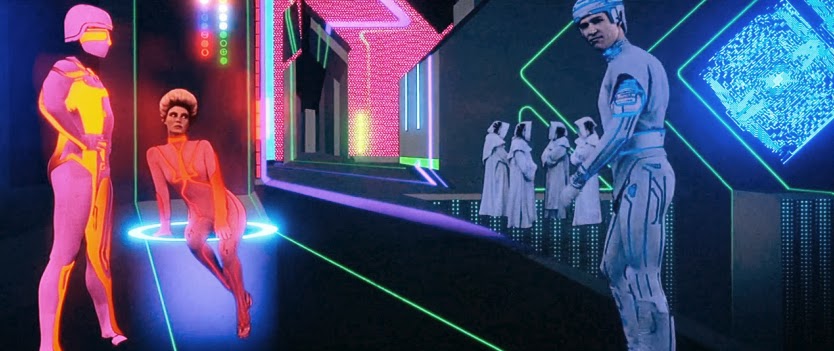
The Las Vegas of the Grid, Flynn is a stranger in a
strange land.
But the digital artists that created the computer world did some amazing things with Tron. The whole thing has a scope to it that feels enormous and real. Vistas seem to stretch into infinity with moving lights and various landscapes. The entire solar sailor sequence is an amazing example of early computer animation used to create a whole world. We constantly see things that hint at further adventures around a corner, or another story taking place down another energy beam. This ranks right up there with the worlds created for Star Wars and Blade Runner in completeness and visual interest.

To match this are all the sound effects for the world. This wasn’t just creating a digitized voice for the MCP. It was creating and altering sounds for everything we see on the screen. The only real guide was that this had to sound like it occurred in an arcade game of the period. They nailed it, with the light cycles, tanks and recognizers each making unique and creative sound effects. Sark’s massive ship gets the appropriate rumble of course. But other things like the sounds of the discs and even characters derezzing lends to the feel that this is it’s own world, with it’s own rules. Even the characters footsteps sound different in this world.

Traveling by Solar Sailer always looked cool!
The final element was the musical score. Innovative electronic music artist Wendy Carlos was brought on board. She had worked on films before, notably on Kubrick’s A Clockwork Orange and The Shining. But this may be her most innovative and impressive score. She took the sounds and “music” of the arcade and Atari games of the time, and fused those electronic sounds with a full orchestra. She creates a theme for Tron, an action motif and a wide array of minor themes that pop up during the film. The music becomes a very real part of the world, crossing the line into sound effect and then back. Her piece for the end credits integrates a full organ for the added tie to the spiritual aspect of the story. All told, her score to Tron is one of the most unique of the 1980s and a perfect fit for the film (as are the two songs provided by the rock group Journey).

For me the only real downsides are the direction and script. I know part of the difficulty in making this film was ensuring the audience of 1982 would be able to follow it. The results were mixed, some folks were still confused by the film, other found it too slow going in the first third. These days it comes across a bit quaint and clunky in places. But I think that all in all it works fairly well but could be polished a bit more, made a bit tighter and it might be remembered fondly by more folks.


I know nostalgia plays a big part of why I love watching Tron. I hadn’t seen it in many years, but when Tron: Legacy came out on DVD they had a nice package with the original film. So I watched it and was surprised by how well it held up and how distinctive and complete the world they created for this film was. Many elements of visual effects were pioneered in the late 70s and early 80s, and some of them didn’t survive the computer graphics revolution of the 1990s. But Tron provides a glimpse of a fusion of both types of effects work and how they can be used together to provide an amazing whole. This is something Peter Jackson used to great effect in his Lord of the Rings trilogy, and obviously films like The Matrix and Ghost in the Shell were influenced more directly by Tron. So if you haven’t seen this film in a few years, I recommend you give it another chance. I think you’ll be surprised by how good it actually is.

Thursday, January 16, 2014

Oh My Goddess (OAV) (1993)


Introduction:
This series was part of Animeigo’s one-two punch to show the North American anime market that Japanese animation was more than exploding heads, naughty tentacles, super powered robots and guys swinging swords the size of Chicago.  How would a romantic comedy with fantasy elements play to an audience that loved Akira?

Summary:
Keiichi Morisato (Scott Simpson) is a college freshman at the bottom of his dorm food chain. So while everyone else is out having a good time, Keiichi has to stay behind to answer the phone and take messages. Lamenting his fate and also getting hungry for dinner, he phones for some delivery. Instead he dials The Goddess Helpline. Within seconds a beautiful young woman climbs out of a mirror and says she can grant him a single wish. Keiichi figures this is part of an elaborate joke, so he jokes back, “I want you to be my girlfriend forever.” And his wish is granted.

Now Keiichi finds himself in the company of Belldandy (Juliet Cesario), a super sweet and super cute goddess, with mystical powers. Any time circumstances occur that may separate them, the holy contract that binds the two kicks in, and all kinds of magical shenanigans ensue. Things get even more fun when Belldandy’s older sexy sister Urd (Lanelle Markgraf) and younger bratty sister Skuld (Pamela Weidner) show up to help or hinder the relationship. What Keiichi doesn’t know is that a promise made in the past may end up taking Belldandy away from him on Christmas Day.

Good Points:

  • A fun set of characters and situations
  • The final two episodes handle the melodrama very well
  • The English voice cast is very good (for this era)
Bad Points:

  • If you’re not into romance in your anime, then keep away
  • Some of the characters may drive viewers up the wall
  • Fans of the manga may not like the changes for the OAV
Overall:
Based loosely on the manga, but with enough changes to take it into a new direction, this OAV series starts out as cute romantic fun. But the final two episodes take it into dramatic territory as the characters you’ve grown to like are put to the test (romantically of course). The English voice cast does a fine job with the material. Even if the animation isn’t as polished as it could be, the end result is a very entertaining show that wears its heart on its sleeve.

Scores (out of 5)
Visuals: 4
Sound: 3
Acting: 4
Script: 4
Music: 4
Direction: 4
Entertainment: 5
Total: 4

In Depth Review
Keiichi makes a great first impression.
If Kosusuke Fujishima has an enduring legacy in anime and manga, then it has to be Oh My Goddess (or Ah My Goddess as it is also known). The comic series has been running since 1989 and is still going strong. It inspired this original animated video (OAV) series, a couple of television series and a full length feature film. All this from a one off joke in Fujishima's other manga series You’re Under Arrest. The Goddess Belldandy appeared in one issue and Fujishima just took the idea and ran with it.

One of the things I like about the OAV is that is manages to capture all the major elements from the manga, sticking very closely to key storylines. But it is also different enough to not feel like a rehash. I love how it goes into a new direction in the final two episodes, but stays true to the characters. The ending is actually poignant and even though a happy ending is never in doubt, our two leads are put through quite a bit.

Now for those who are not familiar with anime genres, there is a whole set of shows that revolve around the "magical girlfriend". Sometimes she's from space, or a witch, or maybe just appearing out of a VHS tape like the creepy ghost in Ringu, but cuter and with less death. Anyway, this genre usually revolves around a hapless and hopeless young man who meets the "magical girlfriend" and falls for her. Of course all kinds of wacky, magical things happen. There's usually a love triangle or rectangle in there, or maybe it turns into a harem show (were a bunch of magical girls show up and fall for the protagonist). Oh My Goddess falls neatly into this genre, and is probably one of the most popular behind Rumiko Takahashi's Urusei Yatsura featuring everyone's favorite space demon/babe Lum. 

Kei and Bell share a quite moment. The lighting
in the park gives this scene of soft glow.
But I’m getting ahead of myself. Oh My Goddess uses Fujishima’s character designs to start with, but since the animation company is AIC (of Tenchi Muyo  fame), and this was made in the 1990s, the characters end up with a mix of that AIC look with the original character designs. It actually reminds me a bit of what happened with Gunsmith Cats. It’s a shame, because Fujishima’s style is pretty unique and very attractive. That’s not to say that the characters are hideous in their animated form, but they are a bit blander looking than in the manga.

In addition it looks like some cost saving animation was used in several places. The third episode features a motorcycle drag race. Fujishima is a motorhead of the highest degree and the manga is filled with car and motorcycle races and road trips. Keiichi is even part of the college motor club and several series plot points revolve around him dealing with the rival club and racers. So you expect a bit of that in the anime series. Unfortunately the racing montage uses a lot of still frames, empty backgrounds and tight shots of only the helmets of the racers filling the screen. Compared to the fully animated race scenes in You’re Under Arrest it’s a bit of a let down. I’ve also noticed that the character animation is inconsistent, especially from episode to episode.

Belldandy makes a startling discovery. I love
the way they capture the sunset in this sequence.
However the animation crew for Oh My Goddess does end up giving us plenty of animation for the magic spells, mystical encounters and decrees from heaven that frequently occur in the show. One of the most impressive occurs in the first episode, where Belldandy uses her powers to restore a ruined Buddhist temple to its former glory. But the most impressive visuals are the wonderful atmosphere and mood created by the backgrounds and lighting. There is a real romance to the entire series. The soft backgrounds, and colorful lighting help create this feeling. One of my favorite uses of lighting is during the second episode where Belldandy and Keiichi go to the beach (and Urd does her best to help them connect, only to fail spectacularly each time). There are some great scenes with the sunlight dancing on the ocean, sunset casting a burning orange light everywhere and a finale by moonlight. Great stuff, and it mirrors the conflicted emotions that Keiichi is dealing with.

Belldandy: so sweet that if you may need to brush
your teeth after each episode to avoid tooth decay.
This type of show doesn’t have a lot creative sound effects. Even the magical spells sound like they came from a standard library. It’s not bad work, but it doesn’t pop. The music is simple stuff, a bit over the top at times. It actually made me laugh when it started to sound like it came from a corny soap opera. Where the series does offer some musical highlights are in the songs featured in the series. The Japanese voice actresses who play the goddess perform these songs. All three ladies sing very well. Kikuko Inoue, who played Belldandy, has an especially sweet voice. These songs often fit the show well, and the opening and ending credits use songs from “the Goddess Family Club”. They are both very catchy and you might find yourself humming or singing along.

With a total of five episodes, each running about a half hour Oh My Goddess does a great job introducing the characters and giving them an entertaining series of adventures to experience. The first episode introduces us to Keiichi and his dorm mates. When Belldandy arrives on the scene and grants his wish things go badly very quickly. He lives in a men’s only dorm, and is kicked out for sneaking a girl inside. The rest of the episode deals with the two trying to find a place to stay and bonding as friends. Keiichi obviously hasn’t had a girlfriend before and is very awkward around Belldandy. While it isn’t spelled out so much in the OAV, in the manga it is very clear that Keiichi is very Japanese and Belldandy is very Western (most likely Scandinavian). So Keiichi is dealing with a foreign Goddess. But Belldandy is true to her word; she stays with him and becomes his best friend.

Urd: once described as being a few fries short
of a happy meal.
Episode two introduces the sexy goddess Urd, Belldandy’s older sister. She is sick of Keiichi’s pathetic attempts to woo Belldandy, and wants the two to hook up faster. So she offers to help. Belldandy is a domestic goddess (literally), who loves cooking, taking care of the home (or temple in this case) and spending time with Keiichi. Urd is into magic potions, alchemy and generally getting into trouble. She loves teasing Keiichi, often getting him to blush at her provocative behavior. But she isn’t interested in him. She is protective of her younger sister and just wants to see her happy. But she tends to act before thinking and it gets everyone in trouble. Urd also is probably the wittiest of the characters in the show, and has plenty of scene stealing lines.

Skuld: Left alone in heaven with a bunch of bugs,
she's going to make things difficult for Kei and Bell.
The third episode of Oh My Goddess deals with the youngest sister, Skuld. After the events of episode two, she is left behind in heaven and is lonely. When she finds out that Belldandy is in contract to a mortal. She’s annoyed. When she actually meets Keiichi and finds out that he’s a bit of a nerd, she loses it. Skuld wants her sister back and she’s going to stop at nothing to do it. Meanwhile Keiichi is selected by his Motor Club to participate in a motorcycle drag race. He has to construct the bike from scratch. In addition the upper classmen have made a bet with the rival motor club. The stakes are simple. If the rivals win, Belldandy joins their club. If Keiichi’s club wins, the rivals disband their club. Keiichi can’t let this happen, but Skuld sees the perfect opportunity to separate the two of them, and prove how big of a loser Keiichi is.

Skuld uses special glasses to see the dimensional rift.
The fourth and fifth episodes comprise one storyline. It all starts with a snowy day at the temple. When Keiichi goes down the hill to check the roads, he discovers that the snow is only on the temple. The rest of the city is snow free! Obviously some magic is at work. The goddesses determine that a system bug is loose in our world and is causing havoc. They destroy the bug, but more keep appearing. Skuld determines that a dimensional rift has opened up allowing the bugs to cross into the mortal world. What is causing the rift? It opens any time Belldandy and Keiichi get close. Once this news gets back to heaven, they cancel Belldandy’s contract with Keiichi and give her three days to put her affairs in order and return to heaven.

What is cuter than Belldandy? A flashback to Belldandy
as a little kid. Diabetics should not watch these scenes.
Keiichi can’t believe it and teams up with Urd and Skuld to find another solution. Meanwhile Belldandy, being the dutiful one, prepares for her departure. This includes erasing all evidence that she was ever in Keiichi’s life, including erasing his memories of her. But Belldandy is hiding something. As a child she made a promise, one that she broke. Even though she was only a child she is still a goddess. This means the promise is a holy vow. This broken promise has torn a hole in reality and is causing the rift. Belldandy can’t do anything to repair it without hurting Keiichi. Meanwhile Keiichi struggles with a series of odd jobs to buy something special for Belldandy for Christmas. Skuld and Urd end up bickering more than planning their scheme to keep Belldandy on earth.

Belldandy tries to explain to Skuld why she has
to stay on earth with that "loser" Keiichi.
I decided to give a summary of each episode because it plays into my discussion of the characters, acting and overall construction of the series. One of the most fun aspects of Oh My Goddess is the mix of Norse mythology with sci-fi futuristic technology. The supernatural aspect of this series is based on the idea that the entire universe is essentially one giant computer system. Belldandy and her sisters are high-level operators in that system. They are goddesses to us mortals, but still part of technological and bureaucratic system. In the manga they go into more detail with this, but the anime series does a good job by providing some shorthand scenes. One of my favorites is Skuld de-bugging the system. Basically she runs around with a giant hammer and squishes the rabbit-like bugs. Urd calls into the network to find out what is going on in heaven, and is put on hold. Talks of binding contracts, and the “ultimate force system” mix the computer and mythological concepts. Then there are the goddesses themselves, named after The Norns from Viking mythology. These three sisters drew and cut the lifelines of mortals and gods. They are often tied into time: Urd to the past, Belldandy to the present and Skuld to the future. While those powers don’t come specifically into play, they obviously affect the age of the girls.

Keiichi is normally a mellow guy, but when Belldandy
is recalled to heaven, he demands an explanation.
The English dub cast does a very good job. This was an early dub from Animiego and those dubs could be hit or miss. Simpson gives a solid performance as Keiichi, balancing the awkward nature of the character with a nice gentle demeanor. However, when things start getting darker in the final two episodes Simpson meets the challenge giving Keiichi more determination. He won’t accept Belldandy’s return to heave lying down. He has a great scene in the fourth episode where his frustration bubbles over and confronts Belldandy about the broken vow.

All three actresses who play the leads in Oh My Goddess are also very good. Cesario may have the toughest part, because Belldandy is so sweet, so kind and so loving, that she’s a bit bland. She also cries at least once in each episode, but Cesario is able to make each of those moments different. The warmth in her performance really sells the character and her vocal chemistry with Simpson makes the romance work well. Belldandy is one of those characters that will either annoy the heck out of viewers or become completely endearing to them. She's so gentle and kind, that she can be a bit of a doormat. I think Cesario's real challenge was making Belldandy more relatable and less simpering than the character ends up appearing at times. It was a tough job, because Cesario only had her voice to use to pull it off. But she does it well. She adds some conflict to the performances where Belldandy breaks down in tears. She's not just sad, but struggling with an inner dilemma. We don't understand what this might be until the final episode, but this nuance keeps Belldandy from becoming a 2D character (something that happens in the manga series surprisingly). 

"You're nothing but a mean old fungus head, and
I hate you! Bleeeehhhhh!"
Markgraf as Urd and Weidner as Skuld get the flashier parts. Markgraf has the steamy, sexy voice down pat, and matches Urd's alluring animation. But she also captures the impatient and a reckless side of the character too. The second episode gives her the most screen time to work with. But she also has plenty of humorous interplay in the last two episodes. Urd has all the great lines in the series and Markgraf delivers them perfectly. Weidner nails the bratty little sister role as well. She keeps it from getting too annoying. She interacts really well with both her sister characters. At the time of the recording, the actress' two kids were around Skuld's age. So she used some of their put-downs in the actual dialogue, giving the lines the feel of something only a kid could come up with. 

Keiichi and the gals find themselves in a bit of a
dilemma. 
The way the Oh My Goddess OAV is constructed gives the viewer a brief introduction to each goddess: one episode per goddess. Then it dives into a solid threat to the romantic leads, that not only will tear them apart from each other, but also threatens to taint their relationship in an unusual way. It’s a twist that I never saw coming and one that I think will come as a bit of a surprise to anyone watching the series for the first time (although there is foreshadowing of this issue in the third episode). What I like is that this twist is not your typical rom-com complication: a love triangle or misunderstanding or stupid interference from other characters. It grows out of the story and concepts of the mythic/technological hybrid that Fujishima created in his comic series. It plays by it’s own rules and makes this world more interesting and less predictable. We root for Keiichi, a mere mortal who is up against the bureaucratic and heavenly machine. But his love and Belldandy’s love must win through. This is primarily a romance after all.

Keiichi struggles to give Belldandy her Christmas
gift, but the gate to heaven is already open.
The final two episodes are heavy on the drama (some of it very much melodrama) and lighter on the comedy, but there are still some funny moments, mostly involving Urd and Skuld attempting to find a loophole in the system. But here Keiichi rises above some of the other guys in this genre of “Magical Girlfriend” anime. He takes an active role in trying to keep her. From the first episode we see that Keiichi has a low self esteem. He’s picked on by his senior classmates. He is short and tells Belldandy that is why he doesn’t have a girlfriend. But by the time the fourth episode rolls around Keiichi has grown in confidence. He loves Belldandy and he won’t let them be torn apart without showing her how much he cares. And then you have Belldandy tied up on the red tape of the heavenly laws and forced to literally erase all of Keiichi’s memories of her (a heartbreaking scene for romance fans). This final stuggle that literally pits the two lovers against each other works wonderfully and pushes this series up from being an average rom-com/magical girlfriend series and into something that is touching.

A first kiss on a moonlight beach.
With the finale happening around Christmas, you’ve got another anime that is perfect for holiday viewing. It also makes for a nice bit of alternate viewing for anyone who doesn’t mind a dash of romance in their sci-fi anime. Oh My Goddess was one of the first anime series I shared with my wife and it became one of her favorites. She even got into collecting the manga series for several years. So yes, nostalgia plays a part in my grading, I’m sure. But I was surprised with this viewing how the story structure does such a good job buiding up to the finale, and how it still manages to get to me, even though I know Kei and Bell have to end up together happily ever after. I’m an old softy after all. I guess this means I'd better watch Ninja Scroll again.

Tuesday, January 14, 2014

Anime Juke Box - My Heart, Your Heart - The Goddess Family Club

You want peppy candy colored J-pop, than it is hard to beat the songs used in the series Oh My Goddess. Performed by the Japanese voice actresses who performed as the goddesses Belldandy, Urd and Skuld, you may be surprised that they all sing fairly well and in character. The OAV series featured several songs (and even more were released on an full album released at the time of the series). But everyone who's seen the show remembers the opening and ending credits. Here is the opening credits song My Heart, Your Heart. Yeah it is sugary sweet, but it fits the series.


Saturday, January 11, 2014

Silent Running (1972)


Introduction:
This is one of those movies that comes up when people discuss science fiction films of the 1970s. Lately I’ve seen some good reviews of it, some people even putting in their top five sci-fi films of all time. Now that gets my attention. So when it appeared on Netflix download, I had to check it out.

Summary:
Freeman Lowell (Bruce Dern) is an astronaut aboard the space ship Valley Forge. His mission for the past eight years was maintaining the flora and fauna preserved from earth inside of giant domes attached to the ship. Earth has lost all of its natural resources, and only on a fleet of ships like this have they been retained. The objective was to return them to earth when the planet was cleaned up and ready to have life on it.

Unfortunately orders come up to jettison and detonate all the domes and return to earth. No reason is given. But none is needed. Lowell can’t and won’t let that happen. He disobeys his orders and manages to save one dome, even if the rest of the crew has to die in the process. Now Lowell is stranded in space with his three robot pals and trying his best to keep life in the dome going strong. But will Lowell be able to maintain his Silent Running or is he a doomed man.

Good Points:
  • Some brilliant model work and visual effects for the era
  • Impressive production design giving the ship a lived in appearance
  • Contains some pretty intense moments in it

Bad Points:
  • Bruce Dern seems to be just a little too intense to be likable
  • Those musical montages with Joan Baez singing… um, yeah…
  • The message gets in the way of the movie

Overall:
Visually this movie is really something else. I love the designs and execution of the ships, the robots, the interiors, everything. Obviously the film went on to influence other science fiction films afterward. But the heavy-handed approach to the material ends up hurting the end result. Bruce Dern often looks a couple fries short of a happy meal, keeping me from connecting to him and being more afraid for what he’s going to do next. The musical montages and the lack of explanation of certain key events pulled me out of the story. In the end, I can see why some folks might connect to this more than I did, but it is worth checking out.

Scores (out of 5)
Visuals: 5
Sound: 4
Acting: 3
Script: 3
Music: 3
Direction: 3
Entertainment: 3
Total:  3

Curious about a full review, sent me an email and I’ll make additional thoughts to this review.    

Wednesday, January 8, 2014

Lovelace (2013)


Introduction:
Well this movie seemed to come out of nowhere. When I first heard about a biographical film about the life of X-rated film actress Linda Lovelace, I was surprised. And then to hear that Amanda Seyfried was going to play the lead, well that intrigued me even more. I wondered how far the star would go in her role, and how far the film itself would explore the life and times of Linda Lovelace.

Summary:
Linda (Amanda Seyfried) is your typical all American girl enjoying life in the early 1970s. Her parents are over protective and very religious. She needs to break away every once in a while and have some fun at discos and roller rinks. That is where she meets Chuck (Peter Sarsgaard). At first Chuck seems like a cool guy with a bad boy streak in him. He helps Linda escape her overbearing home and enjoy some solid party time.

Of course all this costs money and soon the pair (now married) have to make ends meet. So Chuck convinces Linda to appear in an adult film, showcasing her very special talent. Linda becomes an instant success, turning the film Deepthroat into a huge hit and media talking point. But things are not well and good with Linda and Chuck. The more famous she becomes, the more success corrupts Chuck. It’s a downward spiral that causes Linda to want to escape the name Lovelace.

Good Points:
  • Seyfried does a good job in the lead role
  • Sarsgaard is particularly vile in this film
  • Moves a good pace

Bad Points:
  • Fairly standard execution typical of biographical films
  • Some have argued that the source material is not reliable
  • Those looking for Boogie Nights 2 will be disappointed

Overall:
I imagine Seyfried wanted to try something a little different in this film and she gets the opportunity. However the movie itself never really reaches out and grabs the viewer. It may have something to do with the odd flashback structure (something that all biography films seem to require). Not a bad film, but missing that extra something to make it a real winner.

Scores (out of 5)
Visuals: 3
Sound: 3
Acting: 4
Script: 3
Music: 3
Direction: 3
Entertainment: 3
Total:  3

Curious about a full review, sent me an email and I’ll make additional thoughts to this review.    

Sunday, January 5, 2014

Nostalgia Nugget: Looking at 2013


Can you be nostalgic about the past year? Well even if you can’t I had to put this blog somewhere.

With these VR glasses you'll be able to replay
your favorite moments from 2013.
Well 2013 marks the fourth year for this particular blog. I set a few goals for myself and I met most of them. There were a few unexpected surprises as well, so that kept things exciting. I have to say that writing this blog continues to be a great experience and one that I look forward too.

It is great to see my readership expand a bit. I see new followers and see comments from new readers, as well as the folks who followed me over from my older blog. I’ve also expanded my blog reading and have been inspired by these other writers and the movie and anime related topics they are exploring. It is always good to connect with folks, even if we don’t always agree about the specifics, we can enjoy good commentary.

One of the new features of this blog are the Score Sample and Anime Jukebox posts. My love of film and anime music has been something I usually end up mentioning in my movie reviews, and You Tube allows me to share some of my favorites with everyone. It gives me the opportunity to write a bit about the film, composer or anime series the music comes from. These short posts make great supplements to my Movie Music Musings. I finished up my exploration of my Favorite Composers this year with posts on Michael Giacchino and Jerry Goldsmith. Expect more music related posts next year, including an examination of some of my favorite film scores in the similar style that I tackled Star Trek: The Motion Picture earlier this year.

Another new feature on this blog is the Top Ten list. You call all blame John Kenneth Muir for that. He started a fun reader top ten feature on his blog. I figured since I was spending time writing up these top ten lists, I might as well post the movie related ones here too. I also posted a couple of top ten lists that were exclusive to my blog. I’ll continue this feature and will be participating in Mr. Muirs future polls as well.

The movie "Avalon" is in my future, but will I
be able to make heads or tails of it.
2013 also saw me embracing my fandom for anime, focusing mostly on nostalgic favorites like Gunsmith Cats, Akira, Ninja Scroll and Boogiepop Phantom. Because of all these anime posts, I created a new section for them, the Anime Archive. I included links to my anime related reviews that I wrote for DVD Verdict, for those looking for reviews of anime that were actually shown in this millennium. I wrapped up my coverage of the work of Satoshi Kon with Paprika as well as his short film Good Morning. The next director I’ll be diving into in 2014 is Mamoru Oshii, of Ghost in the Shell fame. I’ll be looking at a selection of his work include some of his live action films (as long as they stay available for streaming on Netflix and Hulu).

I’m going to continue my coverage of the James Bond series, starting in early summer. I wrapped up work by Dalton, Brosnan and Craig this year, but I’ll revisit some of my older reviews and polish them up a bit. We still have quite a few Connery and Moore films to review as well as the odd man out: Mr. Lazenby.

I think I'll have to tackle a few more Gamera episodes
this year.
You’ll also get another set of Mystery Science Theater 3000 reviews. I tried to write a review a month last year, corresponding my monthly coverage with the season – January was season 1, February was Season 2 and so on. November will be turkey month again, so you can expect a whole set of new and revised MST3K goodness. I’ll also continue my tradition of reviewing horror films in October.

In between I’m pondering tackling a series of films, not sure which series or topic I’ll pick yet. I’ve got a few likely candidates including classic gangster/crime flicks, Star Trek films, virtual reality flicks of the 1990s or even 1980s fantasy films. We’ll see where I end up, and if you have any suggestions feel free to send them my way.

My goal for 2013 was to write at least 8 blog posts a month, and I succeeded. Some of them were revisits of older entries (usually with better editing and more images), but they still count as part of the overall goal. I’m shooting to meet that same goal again (maybe hit 100 posts for the year). So if you have anything you’d like me to write about or if you are curious about a topic I already covered, feel free to contact me. I’m certainly looking forward to 2014 and all the blog writing and reading in my future.

Thursday, January 2, 2014

Score Sample - The Hobbit: The Desolation of Smaug

Time to kick off my first blog of the year. I figured I'd start with a post on the newest film score in my collection, Howard Shore's wonderful music to The Hobbit: The Desolation of Smaug. True to form Shore has crafted another fine score filled with various themes, some old and some new. What I really enjoy about this score over the previous one, is the large variance of tones and textures. Nearly every new location in the film is reflected in the music, sounding different enough but still holding the musical identity of Middle Earth that Shore created back in 1999 when the Lord of the Rings films were first entering production. 

While my favorite theme in this score has to be the music for the dragon Smaug, I have to say that one of the best tracks is the final one, used during the end credits. The track is called Beyond the Forest and it includes two new themes for the elves of Mirkwood. One is specific to the new elf character Tauriel. These new elven themes fit perfectly with the elf themes created for Rivendell and Lothlorien in the Lord of the Rings trilogy.